Balance bike
RUNNING AND CYCLING UNITED
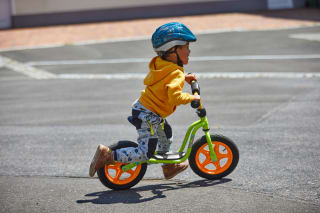
For single-track riding, which a scooter also trains, the balance bike adds sitting like on a bicycle without pedals. The little ones can easily brace themselves with their feet if there is a risk of tipping and practice finding their balance.
Why a balance bike?
Scooters and balance bikes have proven effective for preparing children for cycling. They have replaced the formerly common training wheels on bicycles, which experts criticized as 'falling wheels'. After all, no child learned to keep their balance with them. With both 'vehicles', children also train their spatial orientation, reaction skills and motor skills.
Where to ride?
A large, flat area is suitable for practice. The little ones should ride only in a safe environment and not in road traffic. Experts also advise against using sidewalks next to a road and against riding on downhill paths.
For what age?
At two and a half or three years old, most children are fit enough to sit on the balance bike and control movements and speed.
What to watch for?
Even on the balance bike, the little ones can get used to wearing a helmet. When choosing the ride, a low step-through as well as an adjustable saddle and handlebar are recommended. The child should sit with slightly bent arms and legs to be able to push off powerfully. A brake can be useful not only for little 'speedsters' but also for parents. You should accompany your offspring on foot until they can steer and stop safely. The children can then ride alone in the private yard or other protected areas. Parents should note, however, that braking often still overwhelms very young children coordinatively.
Scooters & kick scooters
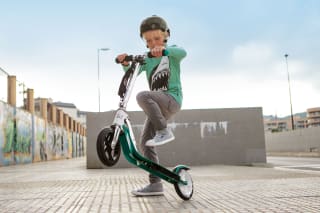
ROLL, ROLL, SCOOTER
The scooter as a classic children's vehicle has, after a small dip in popularity, reclaimed its firm place for many years now. Even the very young learn to gather momentum and start riding in no time and older children still love to zoom around with gusto.
Why a scooter?
Like the balance bike, it prepares well for cycling. Its advantage: when things get tricky, 'dismounting' is easier than on a bike. Children pick it up quickly, but balance, coordination and reaction skills are still required: the kids have to gather momentum, steer, brake, stop and watch where they are going and what is happening around them. Leaning into a curve also needs practice.
Where to ride?
Thanks to the large wheels, the ride is smooth almost everywhere, from paved roads to dirt tracks. Scooters are a bit more sensitive. From a legal perspective, scooter riders must use sidewalks and may ride in pedestrian zones, traffic-calmed areas and residential streets. Bike paths are not allowed for them.
For what age?
Children can handle a classic scooter with one wheel in front and one in back from about 3½ years old. The mini variant with a total of three wheels requires less balance. With this, 2½-year-olds can already get along well without tipping over. Scooters resemble the classic scooter, but have different wheels, are lighter and usually foldable. Their cooler look makes them interesting for older children, who also like to carry them in a backpack.
What to watch for?
They disappear in a flash: because they travel quickly with the scooter, children should wear a helmet. It is advisable to choose the size of the scooter according to the child's size. If the handlebar is roughly at elbow height, the proportions are right.
Bicycle
RIDING LIKE THE BIG KIDS
Trainers from road safety organizations, the police and other organizations who administer cycling tests in fourth grade report that children are getting worse at riding bicycles. Riding with one hand, braking properly, doing a shoulder check while still riding straight—these tasks overwhelm more and more children. Motor skills and coordination leave something to be desired. A common reason: lack of practice.
How to learn?
If children have been very active with a scooter or balance bike, learning to ride a bicycle is usually very easy for them from the start. In the first attempts, parents can help by holding the bike steady while the child mounts. When the child has their feet correctly on the pedals, the adult helpers push the bike slowly. It can be held by the saddle or the luggage rack.
What to watch for?
A well-fitting helmet is essential. At a stop in the playground it should be removed because of the risk of strangulation. Parents' example matters here too. Every second mother and every second father of younger children wears head protection when cycling. They thus belong to the most diligent helmet wearers among adult cyclists. But half of the parents are still missing from the club. Do not buy a bicycle to grow into. The right size is important so the child can control the bike.
When to let them ride alone?
Age alone cannot determine whether parents can send their child into traffic alone on a bicycle. Experts believe children are only fully ready around the end of fourth grade. Because it's not enough to be able to move safely on a bike. Children must also know the traffic rules, keep an eye on traffic, recognize hazardous situations and react prudently. Parents can practice all of this with their offspring by cycling a lot together, gaining experience in traffic and talking about various situations. Every kilometer helps improve motor skills, coordination, strength and confidence in traffic.
Where to ride?
Until their 8th birthday, riding children must use the sidewalk. There they must also show consideration for pedestrians. If there is no sidewalk, the little ones may ride on the road. Eight- to ten-year-olds can choose between the sidewalk and the carriageway when cycling. For older children and adults, riding on the sidewalk is off-limits. The regulations can put parents in a dilemma: the child on the sidewalk, the mother on the road, but still close enough to intervene? Because that is expected of the 'supervisor'.
Inline skates & roller skates
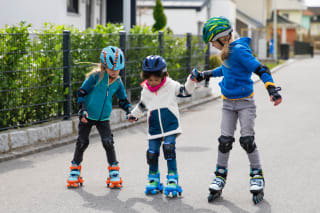
SHOES FOR ZOOMING AROUND
With inline skates you can go somewhat faster than with roller skates. The classics are more maneuverable and give beginners a secure stance. But whatever children strap to their feet, fun tearing around is guaranteed.
For what age?
From about five years old, most children can successfully start skating. Even when they are soon moving at good speed, they must use the sidewalk and not the road.
Where to ride?
Quiet streets without traffic, residential streets or parking lots are suitable, also for the first steps. The surfaces should be level, dry and as clean as possible without stones or other trip hazards.
How to learn?
Parents can initially support their children by standing to the side of the child and holding a hand for safety. Better not to grab under the arms from behind. That way the inline beginner doesn't learn to lean forward and is less likely to fall. Courses for inline skating are also offered by dedicated inline schools, community colleges or clubs. And then it is: practice, practice, practice until the rock n' roll on the road works.
What to watch for?
Inline skates must fit well and no child should be on wheels without a helmet, knee, elbow and wrist protectors. Beginners must not forget to practice braking. At the beginning, using the heel brake is best for this. A step onto grass is also possible, but it brakes very abruptly. Falling can also be practiced on grass: for this, in full protective gear let yourself fall onto the knees, the elbows and the wrists. While gliding, children should always stay slightly leaned forward with bent knees and, if unavoidable, only fall forward. 'Supervisor expected.'