From when can you fly with a baby?
Many parents wonder: "Flying with newborns – is that even allowed?" The majority of airlines allow flying from an age of 7 days, some recommend waiting at least two weeks. Important: your baby should be healthy and stable. Especially with premature infants or babies with health issues, you should consult the pediatrician beforehand.
On a long-haul flight with a baby an age of around 3 to 6 months is often ideal – in this phase babies still sleep a lot and are relatively easy to care for.
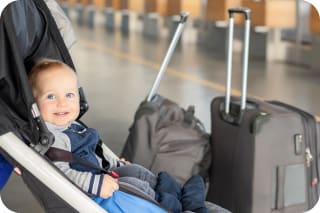
Flying with a baby - what do I need to consider?
A relaxed start to the holiday is important for everyone involved. A few things can help make the flying with newborns or toddlers as relaxed as possible
Check-up: Before the flight you can make an appointment with the pediatrician to check whether your baby may fly. With a cold involving a blocked nose or sinuses, your baby may have trouble equalizing pressure in the cabin. If necessary, mucolytics or nasal sprays can help in the short term; otherwise the trip should be postponed. Depending on the destination, the pediatrician can also tell you whether additional vaccinations are recommended for your child.
Extra seat: Children under two years are not entitled to their own seat. They then travel with an extra belt on the parents' lap. Additional safety during takeoff and landing or on long-haul flights a bassinet, which the airlines provide and which can be attached at certain seats. If you need a separate seat for your baby you usually have to pay for it in full.
Passport: By law every child requires a passport for international air travel, even newborns. Applying for a child's passport can take 1-2 weeks. Therefore plan the visit to the authorities and the photographer (for the passport photo) early.
Pre-boarding: As a rule, families with children are given priority during boarding. This way they do not have to stand in line, avoid the hustle and crowding when boarding the plane, and have time to settle into their reserved seats.
Reserving seats: If you have not already reserved your seats during online booking, an early check-in is recommended to get child-friendly seats. Airlines often take the needs of families with small children into account when assigning seats – for example, the first row usually offers more legroom and space for children to move around a bit.
Packing list for air travel with baby & children
A packing list for flying with a baby and (small) children saves stress. Depending on your child's age you'll need:
Diapers & wet wipes
Baby food & feeding bottle or, for older children, small snacks & a water bottle
Change of clothes
Favorite toy
Blanket & Pacifier
Travel first aid kit (ongoing medications and emergency medications)
Wet wipes & cloths
Travel documents & health records
Tips for relaxed flying with baby and toddler
Don't forget about pressure equalization
During takeoff and especially landing the sudden change in air pressure often affects babies. Since they cannot consciously control pressure equalization yet, this can quickly lead to ear pain or restlessness.
How you can help your baby with pressure equalization:
Breastfeed or give a bottle: Sucking helps with equalization – best right at takeoff and during descent.
Offer a pacifier: Sucking can also help reduce the pressure.
Don't let them sleep during the landing approach: If the baby is asleep, they won't suck – better wake them briefly beforehand.
Keep the nose clear: Before the flight, if necessary, use a saline solution or nasal drops (after consulting a doctor) to reduce swelling.
Not only for babies, but also for toddlers who do not yet manage pressure equalization well, nasal drops can be helpful during takeoff or landing.
Choose clothing for different temperatures
Best in layers. At the airport and at the holiday destination it might be warm, but in the air-conditioned cabin it can quickly get cold. Several layers of thin clothing and a few extra socks are optimal so that your baby or toddler doesn't sweat or get cold during the trip. A change of clothes is also sensible in case of an accident. For older kids, an extra sweater or cardigan is often enough to avoid being cold on board.
Ensure enough drinks
For babies and toddlers, regular drinking on the flight is even more important than for adults, because the air-conditioned air in the aircraft is very dry. Parents with children under three years are allowed to bring large water bottles in carry-on luggage to ensure an adequate supply of fluids.
Remember food: from baby food to snacks for (smaller) children
Breastfed babies always have their food with them anyway. For bottle-fed babies or toddlers who already eat solid food, you can bring bottles or jars on board. The flight crew will help you with preparation or the warming of baby food. Swallowing while feeding also supports pressure equalization, so a small meal at takeoff or landing can be helpful.
"Mom, I'm hungry!": The food on the plane is not exactly renowned for exceptional taste. And children aren't known to respond kindly if it doesn't taste good. So remember not just to have a few gummy bears on hand, but maybe also a tasty filled roll.
By the way: Some airlines offer a special children's menu – it's best to simply ask the airline in advance.
Ask about changing facilities on board
If it becomes urgent, you might not want to disturb other passengers with a diaper change. However, airplane toilets often don't have much space. In this case the flight crew will often allow use of the business class restroom.
Taking the stroller to the plane
If the stroller is checked as baggage it is treated as oversized baggage. Some airlines then offer a loan stroller to take you to the gate. However, your own stroller can often also be taken to the aircraft and handed to the staff. That way you'll have it ready again immediately when disembarking.
Air travel with children: Keeping children occupied at the airport
At the airport there is a lot to discover, especially for toddlers and older kids. Big and small planes, the security checks, baggage drop-off and the lively bustle appeal to young and old. So that your child knows what to expect, you can already explore the airport in picture books beforehand. It is all the more exciting for your child when they rediscover what they saw earlier in reality.
As a rule you have to be at the airport several hours before departure anyway – and this time can be put to good use to go exploring. So plan enough time to inspect everything calmly. That way ideally no stress will arise before departure.
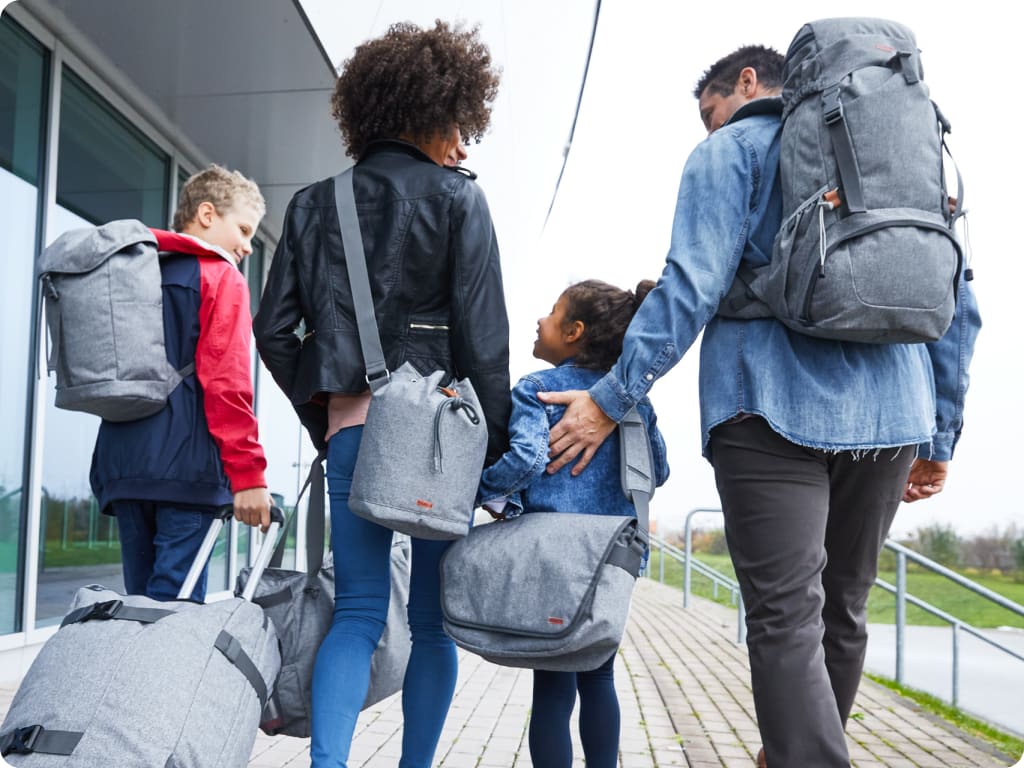
Keeping children occupied on the plane: How do babies, toddlers and older children stay calm while flying?
To keep awake periods stress-free, familiar cuddly toys, snacks and age-appropriate entertainment help. Ideal are compact activities that need little space and do not cause noise. This prevents boredom during the flight with babies, toddlers and older children:
Babies find physical closeness to mom and dad calming during the flight. For distraction and entertainment, grasping toys or soft small cloth toys such as cloth books, soft play cubes & co. are suitable.
Some airlines offer coloring supplies or small toys, and on larger carriers you can also watch movies and TV series on long-haul flights. It's best to check in advance which entertainment program you can expect.
Depending on the length of the flight, you can, with varied travel games prevent boredom from setting in. These can complement the existing entertainment program.
During the flight, a book about the destination is also a great way to keep children calm and in good spirits – and as a bonus it also increases anticipation for the vacation.
If your child is interested in technology, you can certainly spark enthusiasm with specialized information and books about airplanes and flying. Now you can show them the individual parts of the airplane in detail.
More articles about leisure & creativity


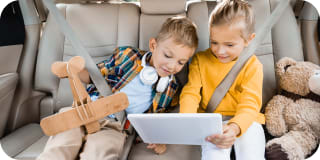

Image credits
Small child, baby boy, playing at the airport while waiting for his plane © Tomsickova - stock.adobe.com
Baby boy sits in the stroller near luggage © Kirill Gorlov - stock.adobe.com