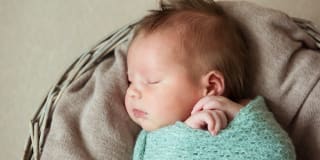
When do babies start to hear?
A baby can already in the mother's womb hear: It perceives her heartbeat and thus already registers a steady rhythm in the earliest stages of its life. It can also hear the whooshing of the blood and the sound of voices even before birth. After birth, the hearing ability is further developed through external stimuli and the baby's brain gradually learns to process different information and to enable the child to have full hearing.
Sounds and voices of familiar people
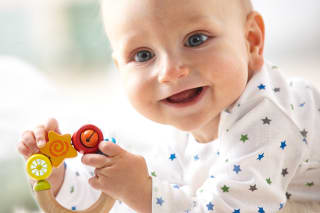
In the first months of life, children especially like the voices of people who are familiar to them. Usually these are the mother and the father, who can soothe their baby with calm words or a song. In this way, parents also promote their child's hearing and speech development. Music is also very calming for babies. In the first months, babies can already distinguish sounds very precisely: thus, for some children the music box has a lulling effect, while others fall asleep to the hum of the vacuum cleaner. From 3 months, babies generally begin to imitate sounds and squeak, hum, or babble.
Babies love rhythm and musical instruments
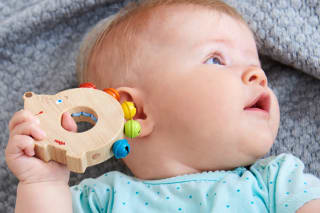
Toddlers enjoy singing and making music and also love moving along to it. They react with curiosity to different sounds and voices and perceive music and rhythm as something very natural. Making music together and experimenting with various objects and instruments strengthens not only their auditory perception but also their emotional and social skills.
Research regularly shows that children who grow up with music can walk earlier and start speaking sooner. First there are sung nursery rhymes and finger plays, then experiments with various musical instruments that affirm and delight children's natural curiosity for tones and sounds. Read more here about how you can bring musical variety into your child's life.
Promote the auditory perception of babies and toddlers
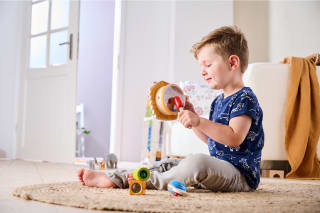
Promote auditory perception with play trainers
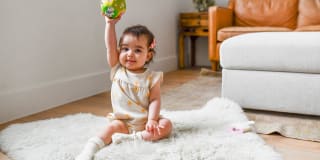
First toys such as Grasping toys or play trainers enable babies to get to know different sounds and to produce them themselves, e.g. a crackle, a rustle or a jingle.
Promote auditory perception with musical toys
Musical instruments for toddlers enable children during and after their second year of life to gain a playful introduction to musical development and a sense of rhythm. When trying them out, children have great fun alone or in a group and bring drums, rattles, sticks and flutes to life.
Promote auditory perception with hand puppets with effects
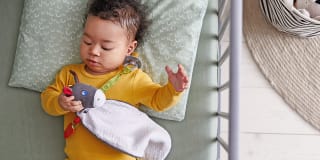
Particularly popular with babies and toddlers are the hand puppets with effects. The little play companions are brought to life by adults and sewn-in rattles or squeakers make the play more lively. Children can also make the sound puppets come alive themselves. This way, all the senses are promoted!