Is my child's separation anxiety really normal?
Fears are as much part of our emotional world as joy, anger, sadness and many other feelings. Therefore, temporary separation anxiety in your child is fundamentally a completely normal developmental phase, which can occur repeatedly and with varying intensity during childhood.
Separation anxiety in infancy: the famous 'stranger anxiety'
Between six and eight months of age most children begin to show stranger anxiety: suddenly they consciously perceive separation from their parents as such and begin to cry when someone other than Mommy or Daddy wants to pick them up. Many remain fixated on their primary caregivers until the second or third year of life and are very wary of strangers.
Temporary separation anxieties in children
Many parents experience that their children develop separation anxieties completely unexpectedly and suddenly cling to Mommy and Daddy around the clock. Maybe it is an attempt to get to know and make sense of their own emotional world, maybe it is other everyday experiences that first have to be processed. What is certain is that such anxieties can recur and usually pass after a few weeks.
Separation anxiety in children as an emotional disorder
In a very small percentage of children, separation problems are not temporary but constitute a disorder to be taken seriously. These children react in panic even to brief separations from their parents, do not go to bed alone in the evening, or suffer from nightmares. If such anxieties persist for a long time, affected parents and children can consult a child psychologist. Individual family therapy can help to get separation anxiety under control.
What to do about my child's separation anxiety? – Tips for parents

As parents we know these days: our child doesn't want to go to kindergarten, experiences separation anxiety when saying goodbye, doesn't want to be alone at their best friend's house and certainly doesn't want to go to bed without Mommy and Daddy.
That children seek the closeness of Mommy and Daddy in uncertain situations is completely normal. If your child's separation anxiety is temporary, these tried-and-true tips can help:
Show understanding: signals to your child that you take them in their situation and understand that they are sad and anxious. To be seen in their own feelings is often already the key to the solution.
Have patience: Perhaps your child needs another 10 minutes of cuddling before they can let you go, maybe they will stay at their friend's if you are initially with them. Be patient and give your child time to gain a sense of security.
Use comfort objects: Whether a cuddly toy that brings the security of home, a comfort cloth or a favorite book: with a familiar object you give your child a bit of security to hold on to, which makes parting easier.
Stick to agreements: Children want to be taken seriously. So be honest, don't just slip away or fib that you'll be back soon. Because unkept agreements weaken trust and only unsettle your child even more.
Practice small steps: It doesn't always have to be an overnight stay at Grandma and Grandpa's. Practice with your child the short separation for a few hours and in ever new situations, so that they themselves experience how they can manage these farewells well – and naturally shed the fear.
Find new solutions together: Often as parents we have fixed ideas about how something should work. "The others manage it too", "I wasn't made to be begged as a child either" are phrases that swirl around in our heads. Free yourselves from comparisons and find with your child the solution that fits best for you. That also shows your child that you take them seriously.
Provide reassurance: If your child has separation anxiety or is unsettled for another reason, they need above all one thing: security. Give your child the trust, that you are there for them and always return at the agreed time. And let your child repeatedly experience how it can also gain security on its own - with every small success.
Image credits
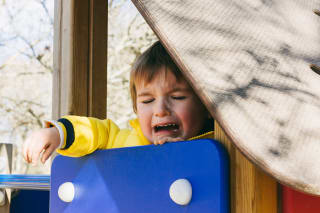
little boy cries while sitting on a slide at the playground © Alexey Bakharev - stock.adobe.com
child lies crying in the mother's arms © Halfpoint - stock.adobe.com