When is the right time for toilet training?
As with many other developmental steps, the rule is: Every child develops at their own pace, that you can only influence to a limited extent. Some children are clean by two years old, others still show hardly any interest in getting rid of their diaper even at four. Some children fundamentally refuse the potty and others are already dry during the day but still need a diaper at night.
Parents quickly become unsettled when it comes to the supposed rules for getting dry. Try to stay relaxed about it. There are quite a few children who are still not reliably dry at five years old. Above all, it is important that you do not put pressure on your child and instead observe when it becomes increasingly interested in the potty.
Only when your child, upon entering primary school age, still does not have full control of their bladder should you seek advice from a pediatrician to rule out any possible medical reasons.
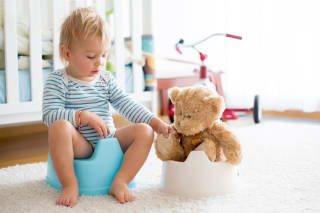
First signs: When does my child want to stop wearing diapers?
There are a few typical signs that your child is ready to get rid of diapers:• When your child notices or lets you know when they need to go.
When your child shows increasing interest in the toilet or, for example, wants to watch you use the toilet.
When they sit on their potty voluntarily and without pressure.
When they no longer want to wear a diaper or find wet diapers very bothersome.
Not all of these points have to apply to your child. Perhaps it only shows one or two of these patterns – but the chances are good that toilet training will work now.
Is potty training useful?
Starting potty training at a fixed time, for example from the second birthday, makes little sense. Only when the neural connections from the bladder to the brain are fully developed can your child recognize the urge to urinate and control bladder function. This development takes different amounts of time in children. On average, little ones are dry during the day at 28 months and at night at 33 months.
Of course, one-year-olds can already be taught to use the potty – but mostly that's more of a 'potty drill' than true toilet training. And not infrequently, too-early potty training is associated for parents and children with great frustration or even with later bedwetting.
It still doesn't work without any training. Although children learn to control their bladder more or less on their own, they still need some practice for using the toilet with everything that goes with it. Over time, children learn how much time they need to allow for peeing and that they can also go to the potty 'preventively'. If your child is physically and mentally developed enough to understand and consciously make the trip to the potty, then a relaxed (!) potty training is absolutely sensible.
Toilet training – more than just using the potty
It's not called 'toilet training' for nothing. Because, besides the actual peeing, children also have to learn everything, what else is part of the trip to the toilet. Take the opportunity and practice a few things right from the start: The more independent your child is when going to the toilet, the harder it will be to remind them to wash their hands and so on.
Opening buttons and zippers: Many children initially have difficulty with pants buttons, especially when things are rushed. Help if necessary, but let your child try on their own for a while.
Wiping: Even children who already go to the toilet independently often still need help wiping their bottom – most of the time their arms simply aren't long enough.
Flushing: Children who are already practicing with the toilet seat should ideally operate the flush themselves and practice this as a regular part of the toilet routine. Some children find the flushing noises scary – it may help at first if you press the flush button together.
Handwashing: Handwashing should be an integral part of potty training from the start. Your child will soon naturally associate handwashing with going to the potty.
The most important rules of toilet training
stay calm!
integrate the potty 'casually' and without much fuss into everyday life
pay attention to bodily signals
regularly offer the chance to use the potty
be prepared for small mishaps (even frequent ones) and don't scold
practice the surrounding aspects (e.g., handwashing) from the start
do not compare your child to others
don't put pressure on anyone – neither your child nor yourselves
if it really doesn't work: just wait a few more months
Discover more articles about babies & toddlers










Image credits
Parents sit on the couch, a yellow potty is in the foreground © danr13 - stock.adobe.com
Toddler playing with his teddy bear and using the potty © Tomsickova - stock.adobe.com