Why do children enjoy playing with weapons so much?
A stick lying around becomes a rifle, stuffed animals suddenly spit fire or shoot bolts of lightning, and in the toy store everything else becomes uninteresting next to the cowboy pistols with blank cartridges: parents find their children's fascination with playing with sabers, knives and guns disconcerting. After all, they have done their best to raise their child without violence.
Role-playing like any other:
For children, playing with weapons is the same as any other game: a role-play in which, detached from reality, they take on other personalities and in this way discover their world. In play they address courage, fear, strength and the handling of power.
Reality and make-believe:
Even when children are completely absorbed in their role, they have the ability to clearly distinguish between play and reality. Just as they know they are not actually a princess or a police officer, they do not fight seriously but as part of their play world. Therefore aggressive behavior in children has a different origin than the use of toy weapons.
Do toy weapons make children violent?
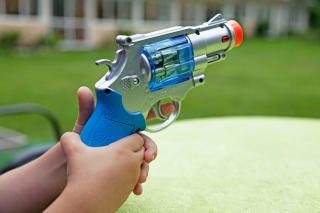
Weapons are ubiquitous in the world of children and are by no means negatively connoted: Robin Hood fights with bow and arrow, to help the oppressed. The brave prince frees the princess by cutting through thorn vines with his sword or by defeating dragons. Almost all fairy-tale and legendary characters carry weapons that help them survive their adventures. For children, weapons primarily symbolize strength rather than harming other people. Especially insecure or fearful children are therefore fascinated by weapons.
Pretend violence does not encourage real violence
According to child psychologists, it is very unlikely that children's fantasies influence their behavior in real life. When children who play fairies or elves try to fly or to enchant things, they do that in their fantasy world, not in the real world. The boundaries between childlike fantasy and reality are often hard for adults to see, yet they exist. It can therefore be assumed that playing with toy weapons has no effect on children's propensity for violence—provided they live in a nonviolent environment. Experts also agree on this point: children are most likely to become violent when they experience real violence in their everyday lives.
Which toy weapons are appropriate for children?
Blank-firing pistols:
Many parents have a strong aversion to rifles and pistols that fire blank cartridges. Not so much because of the noise they make, but above all because of their deceptively realistic appearance. For children who use a stick or a ruler as a rifle, it does not have to be a lifelike copy of a weapon: a simple wooden model or another homemade weapon will do.
Wooden rifles and pistols:
Wooden weapons are usually just a stylized version of the real thing and are therefore clearly recognizable as toys. Children have to use their imagination to fight with these weapons and thereby separate them from reality.
Sword and shield:
Parents can usually come to terms with swords—whether a pirate cutlass from the toy shop or a homemade knight's sword. Those who fear that playful fighting will cause bumps can cut a sword out of sturdy cardboard. Foam variants are also available commercially.
A real bow is a sporting implement that requires some practice to handle. But a children's bow with blunt wooden arrows also trains strength and motor skills. With this toy weapon there is a high probability that children will not fight each other, but rather practice target shooting.
Clear rules - important when handling toy weapons
Regardless of which toy weapons are allowed in your home, clear rules for handling weapons should apply. Aiming at people or animals with a crossbow, pistol or Indian spear should be taboo. Playful fights are only acceptable if no one is afraid or injured. In addition, you should talk to your child about violence and explain that weapons, just like blows or words, can cause serious injuries in real life.
Discover more articles on parenting & psychology



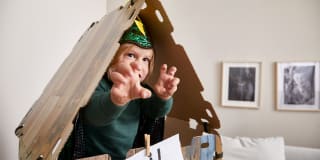

Image credits
Toy colt with index finger on the trigger © Peter - stock.adobe.com