Free play: Benefits for babies and children
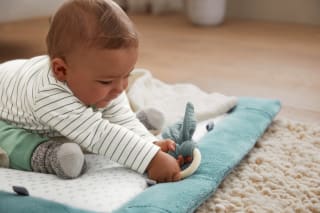
Playing is good for the brain from the first year of life
Every toddler has their own pace when playing. With age-appropriate toys you can help them develop their motor skills. By the way: did you know that, for example, crawling connects the right and left hemispheres of the brain and is therefore important for later learning to write? Watch your baby when they play: completely absorbed, fully focused. Eyes, hands and the whole body are involved. In their first year of life your child is a researcher and explorer. They want to investigate and try things out. They learn by playing: What happens if I put something somewhere? Can I get it out again? If I throw something – can I fetch it back? And if I drop something – will it still be there? In joyful play your child recognizes: What effect does my action have? And once again a valuable life experience is stored in their little head.
Play is not child's play; it has great seriousness and deep meaning

So wrote the educator Friedrich Fröbel at the beginning of the 19th century. But the fact that this is true does not mean that parents should pursue their child's free play with seriousness. Seeing developmental promotion as necessarily behind every playful activity takes away the freedom and uniqueness of play. Be proud of every small step, every joyful smile of your baby. Trust is the most beautiful gift you can give a child at play.
Don't overwhelm your child with too many options
Place only one or two toys on their play mat at a time, with which they can concentrate for a while
After a few days you can swap the toys. Play together, give suggestions, but also let your baby play alone for a while under supervision
Even the very young love, lost in their own world, to try out new things: chewing, squeezing, turning, rolling & pushing - each child has its own pace
Playing means intensive learning and gaining new perspectives. Gentle and sensory
Playing is fun. Playing makes you smart
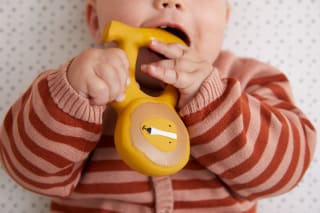
When playing, your child turns all their senses on – and sets off on a big voyage of discovery with eyes, ears, hands and mouth. Every loving stimulus, every new impression individually shapes your child’s personality. Experience together, day by day, the fascination of discovering something new and unique. Playing is a first-class learning program, because there is no 'wrong', only a 'try again'! And when your baby is absorbed in play, give them peace and time for it. Nothing else is then worth a distraction.
In the first months of life, grasping, seeing and hearing — the development of the senses — are high on the agenda. Babies love bright colours, sounds and interesting things to feel — for example toys like grasping rings in different materials, rattles, mobiles and cuddly animals. The younger the children are, the more 'grasping' and 'understanding', 'holding' and 'comprehending' are linked together. In toddlerhood, things that can be moved become exciting: fabric balls, ride-on cars and tricycles. Handy building blocks or crayons that allow little ones to 'create something' themselves are also interesting now.
Good to know!
Children learn through effort. Little ones are proud when they have achieved something by themselves
Did the rattle slip out of your baby's hand and are they now struggling to catch it? Don’t jump in right away; allow them to make a real effort to reach the goal on their own
Parents are best able to judge when the baby really needs help and when they are just being a bit comfortable. Give them the chance to feel strong through experiences of success
How quickly your baby learns
Babies' capacity to learn is fascinating. Never again will a person learn so much in such a short time. Through sensory stimulation, experiences and discoveries the young brain matures. Driven by natural curiosity and the joy of exploration, babies and toddlers not only sharpen their senses but also develop their motor skills, experience basic laws of nature, and practise concentration and attention. To keep the joy of learning alive, it is important that encouragement happens without pressure. Even small babies signal clearly by turning their face away when they have had enough new impressions. Respect such signals, because rest periods are important for processing and consolidating what has been learned.
Your baby needs space to play:
Even if your little one is not yet mobile, give them plenty of freedom to move. They need you to train their muscles and practise movement sequences
Therefore, don’t put your child in a seat or a rocker for longer than necessary
On a soft blanket on the floor with interesting things to look at and grasp, they are better off and can try out to their heart's content what they can do with their arms, legs and whole body
With a box of building blocks or a marble run, little builders show how much imagination, creativity and spatial awareness they have. Those who, for example, enjoy puzzling are already doing highly complex mental work: forming a picture in their head of the missing piece, remembering it, recognizing it — all this promotes logical and mathematical thinking. Over the years the games become more complex and your influence on development as well as on calculation and problem-solving skills increases. As long as children play, they learn.
Playing is all-round training
Just as children develop their brains through play, they also train their bodies. Sometimes they run around wildly, sometimes they examine something carefully with their fingers. But they always strengthen their heart, circulation, muscles and bone structure. Balancing on a line or jumping wildly on a trampoline improves balance and dexterity. Kicking a soccer ball and other ball games train their hand-eye coordination and perception. Because children always play with their whole bodies, they get to know and master them better. Lots of movement also helps prevent overweight. It is best for children to play outside as often as possible, because fresh air also strengthens their immune system.
Playing shapes personality
When playing, children repeatedly experience different emotions: sometimes they are happy and proud when they win, sometimes sad and angry when they lose. They learn to cope with these opposing emotions. With their friends they develop empathy and compassion and learn how to get along with each other. And not least: through play children can try things out and thus gain self-confidence and self-affirmation. It is important that no child plays exactly like another. When the games fit the child and the age, you can best support your child. A tip: join in! Parents are their children’s best and most beloved playmates! Those who share special moments together develop a closer and deeper bond.
Guided play: Are educational games really useful?
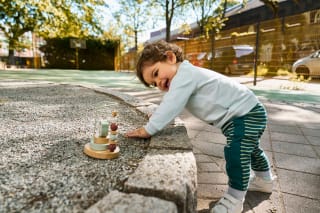
Matching colors and shapes, forming first words or solving memory tasks – when it comes to educational games, parents and children have a rich selection. For every developmental area there are games and exercises available in a variety of media. Many parents gladly use these offerings: after all, they want to promote their children optimally in every respect. This results in the demand to use leisure time as meaningfully as possible and to focus on games with concrete learning effects. What many parents forget: children learn during every game. Whether playing hide-and-seek in the garden, imaginative play with knights and dolls, or splashing around in puddles and the sandbox. We examined educational games more closely and question in the following article how necessary and useful they are for children's development.
What kinds of educational games are there for children?
Classic children's games: Memory, Mikado, Quartett and hundreds of other classics have been played for generations. These time-honored educational games train memory and combinatorial skills, vocabulary, fine motor skills and many other abilities
Educational board games: All well-known game manufacturers offer educational games with different learning focuses for various age groups. For 3- to 5-year-olds everyday knowledge and vocabulary are in the foreground, for example with matching games. For preschool and elementary school children, reading and spelling games or arithmetic games are offered, as well as puzzle games that foster logical thinking. Educational games for children aged 8–12 combine these areas and practice logic, combinatorial skills and strategy
Educational software: Learning games for PC and tablet are available both as free downloads and as paid software. Since children are generally very media-savvy, these games have a particularly strong appeal. However, they are usually played alone, so the communicative aspect of play is lost. Experts also recommend that children, depending on their age, should not spend more than 30–60 minutes per day on the PC
Other learning systems: A major trend is interactive learning books and so-called learning computers, on which children can do various games or tasks. They are an appealing change of pace for children, but the entertainment value is usually greater than the learning effect
Let your children just play!
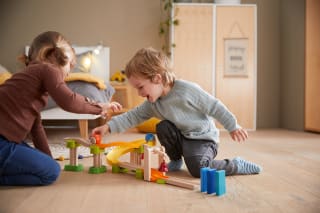
Opportunities for play-based stimulation are almost limitless today, but they are not really necessary for healthy development. Many experts even think that free, undisturbed play is too often missing from children's everyday lives nowadays.
When playing, children not only practice imagination and vocabulary; they also develop problem-solving skills, work out conflicts and strengthen their self-confidence. Those who play tag train gross motor skills, endurance and spatial thinking; those who build a fort must show creativity and 'in the process' practice basic statics.
When absorbed in crafting in the children's room and messing around in the garden, children not only get to know a wide range of materials, shapes and states; they also develop a sense for quantities and intuitively engage with the basics of physics and chemistry.
But the most important thing is and remains:Play makes children happy and gives them the opportunity to discover their world entirely for themselves and at their own pace.
The library: A place to try out educational games
Many libraries offer not only a wide selection of books, music and films for children, but also games
A children's library card is very inexpensive or even free.
This way your child can calmly try out various educational games and explore their interests. Educational computer games or CDs with language games and early musical education are also available for borrowing in many libraries
To-dos for using learning games
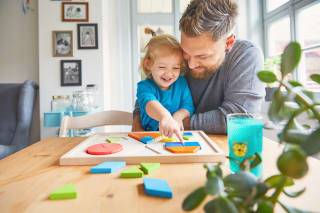
In the right context, learning games can be a benefit for children. It is important that fun comes first and that a child can decide for themselves how they want to learn through play.
<Button All learning and support games>
How to avoid frustration with learning games:
Don't force it: Don't persuade your child to play a learning game they don't feel like playing - playing should not be an obligation.
Let them choose: Consider your child's interests when choosing a game. If your child would rather play a classic board game like "Mensch ärgere dich nicht", that's fine too - these games also have a learning effect.
Let them choose: When you buy a children's learning game, make sure it is aimed at your child's age - games that are too easy or too difficult quickly cause frustration.
Join in: Make playing a family affair - children enjoy the time spent together and learn a lot from their parents.
Provide variety: Offer something new every now and then, but above all make sure that learning games, classic board games and free play alternate so that playing is not perceived as a "chore".