How can I support my child in learning colors?
Parents want to support their children in their development. That's good and completely right. However, be aware that you cannot accelerate your child's development — but you can make it easier for your child. You should take into account your child's individual stage of development: Is your child already far enough along linguistically that they can also name colors can, or does their vocabulary so far rather only include words like "Mama" and "car"? Then stay calm and just wait a few weeks or months.
For the learning colors there is no set age: some children already name their first colors at two years, other children still confuse colors at five. If you feel uneasy and don't know, whether your child can correctly recognize colors, you can always speak to your pediatrician. They can best assess the individual your child's development with regard to learning colors during an examination.
My baby loves red
A preference for certain colors can be observed in many babies: they always prefer to reach for the red building block, the red handbag particularly attracts their interest. But be careful not to provide only toys in the baby's favorite color to get: only in this way can they get to know the variety of colors in their surroundings and eventually distinguish color nuances.
Incorporate colors into everyday life
Colors are encountered continuously in everyday life. Name them again and again – this way they will become more familiar to your child. "Today I'll put the red socks and the blue T-shirt on you," "Your yellow drinking bottle is empty, we need to refill it" – this way colors come up again and again. And your child can remember the color names better.
Games that encourage children to learn colors
Children learn best when they are having fun. It is important that children are allowed to be children – rote learning can wait! With a fun game that is about colors, you can have a lot of fun together with your child – and your child will learn the colors incidentally. Depending on your child's age, the games can vary widely.
Here are some examples with which your child can learn colors through play:
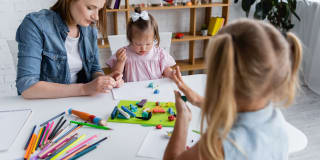
Learning colors with building blocks
For many children, playing with building blocks is one of their favorite activities during a certain developmental stage. By sorting, stacking and arranging the building blocks, they can not only train their motor skills. The colored building blocks are also perfect for teaching children colors. You can, for example, give your children small tasks during playing with building blocks small tasks.
Have them first collect all the building blocks in the same color into small piles. Or they build small structures with two to three different colors that you tell them. When siblings of different ages play together, the older ones can also name the colors for the younger ones and thereby promote playful learning.
I spy with my little eye!
A game that brings great joy to all children and can be played anytime, anywhere without toys is I Spy. You pick an object in the room that everyone can see well and say the sentence "I spy with my little eye and it is yellow." The players look around the colors in the room and then guess which object in the room is meant. If only two of you are playing, you take turns. With multiple players, the next person is the one who has discovered the color and has guessed the correct object.
Get creative with finger paints
With finger paints children can really let loose. In playing with finger paints they let their creativity run free and at the same time they can find out, which colors they are actually playing with. Provide enough space and paper and give your children all the freedom they need when discovering colors. It's especially nice that when experimenting with the colors they quickly notice that mixing produces entirely different shades and they can control whether they want to play with red, green, orange or light blue.
Promote movement and color learning
For older kids, movement games are also great for learning colors. The classic Twister brings good cheer, gets the whole family moving and motivates the little ones to recognize the right colors quickly and accurately. Incidentally, it also trains their sense of balance.