Appointments – What is scheduled in the 1st month?
Apply for birth certificate: The birth certificate should be applied for as soon as possible after the birth, as it is needed for the child benefit and parental allowance applications as well as for the child's health insurance. Usually the registry office reports the birth automatically to the residents' registration office.
U2 (3rd to 10th day of life): The U2 is carried out by the pediatrician or in the maternity clinic if mother and baby are in the hospital at least until the third day of life. If you already have a pediatrician, ask in advance whether a home visit is possible – many offer this for the U2.
Submit applications: The most important applications are those for child benefit, for parental allowance and for the child's health insurance. In addition, there may be applications for childcare allowance or a child passport. You can already submit the application for parental leave to your employer some time before the birth.
Delegate tasks: Almost no mother or father is keen to go to the authorities or the doctor's office with the newborn in the first days or weeks after the birth. Try alternating appointments or delegating them to other trusted people, and prepare applications, required documents and, if necessary, powers of attorney so that important appointments in the first weeks do not cause extra stress.
Important developmental milestones in the 1st month
Almost all children need some time to get used to everything. While some newborns sleep up to 20 hours a day sleep, other babies are very restless at first and cry a lot because they need to process the impressions of the birth or the new environment. Not always does the first month of life unfold as new parents had imagined. There are new developmental milestones almost every day that you can observe.
Recognition: Babies show signs of recognition very early. They react differently to mom and dad than to strangers and, for example, are easier to soothe. Because babies rely especially on their sense of smell in the early period, you should initially avoid strongly perfumed creams and lotions on yourself.
Growing attention: As wakeful periods increase, the baby's attention grows too. Bright colors, familiar voices or movements pique the baby's interest.
Seeing and focusing: Within just a few weeks, your baby can focus on faces at close range and follow things with their eyes.
Grasp reflex: The grasp reflex is still very pronounced. Not only do the baby's hands automatically close around fingers or objects, the little feet also try to 'grasp' when touched.
First sounds: Babies communicate with their parents from the first day of life. Apart from crying, many babies already experiment with their voice and make sounds in the first month of life.
How much should my child weigh in the 1st month?
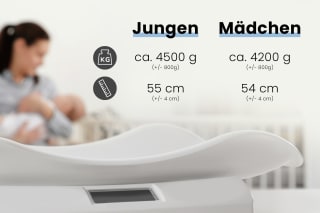
In the days after birth many babies lose weight, but then usually a rapid development begins. Don't let 'good advice' drive you crazy if your baby seemingly gains too little or too much. Your midwife and the pediatrician regularly check your child's length and weight — and they are competent contacts if you are really worried.
As a guideline: In the first month your baby weighs approx. 4,200 to 4,500 grams and is about 54 to 55 centimeters long. Deviations are completely normal.
Discover more articles on parenting & psychology








Image credits
Newborn baby sleeping in a basket Mohawk hairstyle © irena_geo - stock.adobe.com
Modern baby scale on the table and blurred woman with child in a house © New Africa - stock.adobe.com