When is my child ready for kindergarten?
Usually the kindergarten age begins at three years. But that does not mean that every child can start kindergarten immediately after their third birthday. Many kindergartens only admit new children once a year, each time at the start of the new school year after the summer holidays. But it is not enough for a place to be available; your child must also be ready to assert themselves in everyday kindergarten life and in dealing with other children and educators.
Kindergartens promote development: Experts agree that children benefit from kindergarten. This refers not only to professional care and various support opportunities, but above all to interacting with other children, which promotes children's social skills and independence. Many parents who have concerns about starting kindergarten, for example because their child is very shy, are surprised by the developmental progress their child makes in the first year of kindergarten.
Motor and language skills are prerequisites: Children develop differently. Therefore, it is not so much the age but rather the individual development that is decisive for starting kindergarten. Children should be able to communicate sufficiently and follow instructions from the caregivers. Motorically, your child should be able to take part in everyday routines such as washing hands, brushing teeth, tidying up toys, setting the table or joining in crafts. This can already be the case at two and a half years or only at three and a half years.
Better not to start too early: An early start in kindergarten, for example because a place is available at short notice or because the parents have to return to work, can be stressful for a child. The lively kindergarten routine, where there is laughing, romping and shouting, can quickly become constant stress for two-year-olds. When a child is ready for daycare depends on the child's personality and developmental level, but also on the size and orientation of the daycare. Trust your gut feeling, but if necessary you should first keep your child in the nursery/crèche or have them cared for by a childminder.
Do kindergartens only accept children from three years of age?

Legal entitlement: From the age of three, every child in Germany has a legal entitlement to a kindergarten place. Since 2013 this entitlement also applies to crèche places for every child aged 1–3 years. That does not mean, however, that a place in the desired crèche or daycare must be available immediately upon the first or third birthday. The entitlement refers to any care place within the municipality.
Admission at the start of the school year: Many daycares base the admission of new children on the school year: Whenever a cohort starts school, places for new daycare children become available. However, this only applies if a group is fully occupied. If care places are free anyway, they are allocated as needed. It is best to speak to your preferred daycare in good time to arrange a possible start date.
Admission at two years? If a child is suitably developed, most kindergartens already accept children from two and a half years. The prerequisite is that a daycare place is free and that no three-year-old needs that place, because due to the legal entitlement the older child has priority in the allocation of places.
At what age can my child go to the crèche?
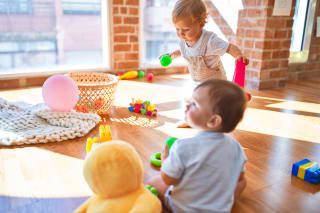
About one third of children under three years are cared for in a crèche. For the majority, the crèche period begins at just under one year. At this point regular parental leave ends and the legal entitlement to a care place becomes effective. But there are also children who go to the crèche much earlier, for example because the parents have to return to work. Most children's crèches accept babies at the earliest from three months, and in principle settling in at this age is generally easier than later at one year. However, babies under half a year essentially need 1:1 care from the crèche staff, which cannot always be guaranteed. Many educators also recommend putting a baby in the crèche at the earliest at six months or alternatively having them cared for by a childminder.
Image credits
Childminder plays with her children © Krakenimages.com - AdobeStock
Child walks hand in hand with her mother © dusanpetkovic1 - AdobeStock
Two toddlers play on the floor © Krakenimages.com - AdobeStock