Your baby's development in the 29th week of pregnancy
Primary sex organs: A few weeks ago you learned whether you're having a girl or a boy. In the 29th week of pregnancy the sex organs are becoming more refined of your baby. Thus the boy's testicles descend through the groin from near the kidneys into the scrotum. The girl's labia still need to grow a little until they fully cover the clitoris.
A fully developed baby: The internal organs have fully developed by week 29. Now they only refine further so that your baby can breathe and digest its food independently after birth.
Fetal position: In the womb the fetus has less and less space, which is why in the coming weeks it will gradually take on the typical fetal position takes up.
Stronger immune system: Through the placenta the fetus receives in the 29th week of pregnancy important antibodies against disease. Your body regularly exchanges antibodies with your baby to significantly strengthen the immune system.
Baby fat: Your child continues to gain weight steadily. In the coming weeks it will on average gain an average of 250 grams per week. As a result it not only increasingly looks like a newborn, it can also regulate its body temperature better and better on its own.
Fluttering its eyelashes: For a few weeks now the fetus's head hair has been growing. In the 29th week the eyelashes and eyebrows of your baby are now also growing more.
The brain becomes more active: The brain and nervous system develop significantly further in the 29th week of pregnancy and function in a more differentiated way. As a result the brain volume also continues to increase and the skull grows with it. At birth your baby already has 100 billion brain cells.
What is visible on the ultrasound image?
In the 29th week of pregnancy your child is now around 39 to 40 cm long. This corresponds roughly to the size of a butternut squash. With a proud your little miracle is rapidly approaching the 2-kilogram mark. Since last week it has gained 100 grams and at this rate it continues. This is becoming increasingly clear on the ultrasound image. Thus your baby looks from week to week more and more like a 'real' newborn. The skin appears noticeably firmer and with its more pronounced movements it draws attention to itself. Depending on the position of your child, you can catch a glimpse of its grimaces and its still wrinkled-looking face.
Physical changes – what happens to the mother in week 29 of pregnancy?

The last trimester is considered by many pregnant women to be the probably most strenuous phase – physically as well as mentally. More and more pregnancy complaints such as inner restlessness and changed sleeping habits as well as the steadily increasing growth of the belly make everyday life more difficult. To leave little room for the symptoms, it is important that you allow yourselves regular rest breaks enabled. With a lot of composure you get through the last months of your pregnancy very well – this also has a positive effect on your baby.
An emotional rollercoaster: Again and again during pregnancy it happens that your hormones cause mixed moods. Especially in the last period before birth many women think about how their life will develop after delivery. It often helps if you talk in such situations with your partner, your mother or experienced friends. They can certainly take away some of your worries and calm you.
Practice contractions: In the 29th week of pregnancy the uterus of the expectant mother contracts from time to time. These are small practice contractions that make your abdominal wall feel hard. This is your body's way of rehearsing birth. As a rule the practice contractions are less painful they occur. However, if you complain of increasing and recurrent pains, it is important that you consult your gynecologist.
Back pain: Due to the steadily increasing weight of the baby and uterus your posture changes and your back is exposed to the increased load. Depending on your child's movements, a few nerves in your back can sometimes be affected, which causes a painful sensation.
Healthy appetite: Your baby is completely set on growth in the last trimester. You notice this not only in your belly. The energy requirement increases again, because your body is already preparing for birth and builds reserves. Your hunger grows ever larger and you might eat an extra slice of bread or an extra apple a day to provide you and your baby with sufficient nutrients.
Fullness: Many expectant mothers may feel hungrier, but at the same time also complain about a feeling of fullness. There is little room in the belly for a full stomach, which is why it is helpful if you have several small portions a day to consume. This approach also helps you get heartburn under control.
Breast milk: a marvel of nature
Already in the 16th week of pregnancy your body began to produce the first colostrum. In the last trimester it is more common that, due to the increased hormone levels, it also leaks from the breasts even before delivery. Nursing pads that you can already wear in your bra help prevent unpleasant wet spots on your T-shirt. But what's actually in breast milk? Here you'll learn more about it.
Colostrum (first milk): In the first days after birth the breast milk is still slightly yellowish and thick. It contains exactly the substances your baby needs in its first days. The contained immune factors strengthen the immune system. It also contains a particularly high amount of protein, trace elements and vitamins. The colostrum has a mild laxative effect and helps kick-start the baby's metabolism.
Transitional milk: Transitional milk is produced in the first week after birth produced. During this time there is the so-called 'milk coming in'. This can mean that your breasts feel tight and very sensitive. In transitional milk the fat and sugar content is significantly higher and it contains less protein and immune factors.
Mature milk: About 2 weeks after birth, the breast milk changes again. It now contains water, sugars, protein, fat, minerals and vitamins – so all that your baby needs for its development. The mature milk even changes its composition during feeding: At the first latch there is still a lot of water. During feeding, however, it becomes increasingly richer and contains more nutrients, which satisfy your child's hunger.
Not just for drinking: Breast milk can do more than just satisfy your little one. The breast milk has anti-inflammatory properties and the included immune factors can also help with infections. A few drops can, for example, soothe sore skin on the baby's bottom and relieve a blocked nose.
29th week of pregnancy: get breastfeeding advice
Even though there's still some time until the birth, it can already be useful if youhave your midwife or a breastfeeding counselor advise you on feeding your child. Many women worry that they won't be able to breastfeed after birth or will have too much pain. In breastfeeding counseling you will already learn different latching techniques and can discuss your questions with a midwife.
More articles about expectant mothers
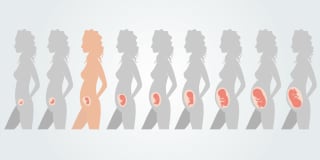
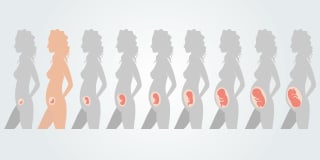
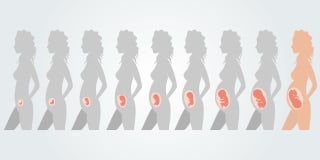
Image credits
Pregnancy silhouette 8 months © designer_things - stock.adobe.com
A pregnant woman holding a bowl of vegetable salad sitting on the carpet, view from above © KseniaJoyg - stock.adobe.com