The baby's development in the 7th week of pregnancy
Facial features develop: In the 7th week of pregnancy the embryo's head develops significantly. This is due to the rapid development of the nervous system. In particular the face begins to take shape:Eye cups and eye vesicles, as well as the nose and ear pits, form.
Muscles form: In week 7 of pregnancy, thefirst muscle strands of your baby. Even now it moves in the womb – still uncontrolled, but the muscle contractions are an important coordination exercise.
Internal organs develop: The primordia for the most important organs such as the liver, lungs, and kidneys as well as the internal sexual organs are already present in week 7. In the coming weeks they will further develop and grow. In particular the Sexual organs progressively differentiate. Until now, both sets of sexual structures were present in the embryo, even though it was already possible to detect biologically whether you are expecting a boy or a girl.
Nervous system and brain develop: The first primordia for the nervous system and the brain arise – already in a few weeks all the baby's nerve cells will be fully present. However, the complex nervous system of a child is only fully developed a few years after birth. The basic 'blueprint' for the brain is also defined. During week 7 of pregnancy the organ develops into forebrain, midbrain, and hindbrain.
Spine stabilizes: From the neural tube, the spine slowly develops in week 7. The spinal cord closes completely. At the same time the rudiments of the arms and legs become more visible – your baby develops more and more human forms.
What can be seen on the ultrasound image?
The baby grows rapidly – by about one millimeter each day. And so the size of the embryo in the 7th week of pregnancy is usually between 5 and 10 millimeters. Basically, the size varies depending on whether you are at the beginning or the end of the pregnancy week. At 5 millimeters the baby is only as big as a blueberry or a peanut. Even though the embryo now has a more human body shape it still isn't possible to see very much on the ultrasound. Besides the first body parts you only see small black dots at the head or face, where the eyes will later be. In addition, the nostrils and the mouth can be made out. Overall, the head still appears large compared to the body. From the 7th week of pregnancy your gynecologist now also measures the crown-rump length (CRL), which is recorded in your maternity record to document growth.
Symptoms in week 7: Physical changes in the mother

In the 7th week of pregnancy the pregnancy symptoms usually do not subside. In many women they even intensify. However, this is a good sign in terms of the embryo's development. Because the strong symptoms show that your body is caring for the protection of your baby more and more. The following Pregnancy complaints may now become noticeable to you:
Nausea: From week 7 many women experience nausea or vomiting. You can hardly avoid the nausea, but it usually subsides after the first trimester. It is important that despite feeling unwell you eat small portions regularly and drink enough. Many pregnant women find that something sweet, such as a cookie, helps against morning sickness.
Loss of appetite: Some women suffer from loss of appetite at the beginning of pregnancy or are very sensitive to certain smells or tastes. As a result, they may lose weight rather than gain it in the first weeks.
Fatigue: The pregnancy hormone progesterone causes tiredness and the body demands rest. Many women nevertheless sleep poorly at night in the first months because of the 'hormone storm' or frequent need to urinate. Remedies, depending on possibility, are several naps or rest breaks to give the body enough space to recharge.
Pulling sensations in the abdomen: With the growing uterus the stabilizers, the so-called round ligaments, stretch. This can lead to harmless but uncomfortable pain in the lower abdomen. To make the pulling more bearable and ideally completely relieve the pain, use a hot water bottle and rest.
Weakened immune system: In early pregnancy the mother's immune system works in a reduced way to protect the embryo. Many women are now particularly susceptible to infections and should therefore allow themselves extra rest. A cold usually runs its course without problems, but gastrointestinal infections can, in the worst case, cause a miscarriage – so caution is advised.
Dizziness and circulatory problems: To ensure the embryo is sufficiently supplied with blood, the mother's blood vessels dilate and relax. The resting pulse therefore rises to about 80 beats per minute – about 10 beats more than normal. Additionally, blood volume increases by 30 percent and the blood becomes thinner to flow better into the baby's small vessels. The heart therefore works harder, which in some women triggers dizziness attacks or circulatory problems. To counteract this, it's helpful to get fresh air and avoid standing for long periods or getting up too quickly. Alternating showers can also be helpful.
High blood pressure: If high blood pressure concerns you, have it professionally checked at the pharmacy or preferably by your doctor. If you already suffered from high blood pressure before pregnancy, a visit to the doctor is even more advisable to rule out possible diseases of the mother and the child.
Frequent urination: Due to the hormone surplus and increased blood circulation, the expectant mother's body produces more fluids. Additionally, the growing uterus presses on the bladder. All of this can lead to increased need to urinate.
Tips: This is important in the 7th week of pregnancy
If you have already had your first prenatal check-up with a doctor, in week 7 the expectant mother can focus entirely on herself and her health and allow herself as much rest as possible.
Balanced diet: In the pregnancy, a balanced, nutrient-rich diet with plenty of fiber is recommended. With the development of your baby's nervous system in week 7, Folic acid and iron are particularly important. Folic acid is, for example, found in green leafy vegetables and nuts. At least during the first trimester you should also take a folic acid supplement or a combined supplement with folic acid and iron from the pharmacy.
Regular exercise: If your condition allows in the early months of pregnancy, it helps to be active regularly in the fresh air. Especially for nausea and fatigue, fresh air is a proven remedy. If you are unsure about your favorite sport, you can ask your doctor whether there are risks for the baby. If you plan to take a special pregnancy exercise class, it's best to check the offerings now and sign up if necessary, as places are often limited and classes fill up quickly.
Take rest breaks: Especially in the first trimester it is important that as expectant mothers you allow rest breaks, avoid stress and give in to tiredness at times to get enough sleep. This gives your body the opportunity to gather energy for the baby's growth.
Find a midwife: A trusted midwife is an important contact person for many parents before, during and after birth. Experienced midwives are in high demand and typically care for only a small number of women at a time. Therefore, seek a midwife near you early and arrange a first meeting.
More articles about expectant mothers
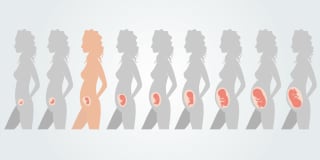
Image credits
Pregnancy silhouette 2 months © designer_things - stock.adobe.com
Woman thinking about her problems while she drinks coffee on the sofa at home © nenetus - stock.adobe.com