The baby's development in week 8 of pregnancy
The heart is developing: The embryo's heart has actually been beating since<LINK> Week 5, but only now do heart valves and walls. The heartbeat is still almost twice as fast as the mother's. However, it cannot yet be heard.
Further development of individual organs: While in previous weeks the rudiments of various organs were already present, they now continue to develop steadily. Thus, the liver as a bulge between the heart and the umbilical cord and the intestine also continues to take shape. However, it is still too large to fit entirely within the baby's abdominal cavity. For this reason it protrudes as a kind of loop into the umbilical cord to transport waste products from the embryo's body – this results in the so-called umbilical hernia. This is completely natural and, in nature's terms, initially harmless. In about four weeks the digestive system will move back into place.
Development of the limbs: From the paddle-shaped beginnings of the arms and legs, gradually elbows and knees emerge, so the embryo develops increasingly human limbs. Also fingers and toes are slowly forming, but are still connected by small membranes, the so-called 'webbing'.
Skeletal formation: In the 8th week of pregnancy, bones slowly form from cartilage in the embryo's body. Also the skull bones form around the brain: however, these remain only loosely connected until after birth so the brain can continue to develop. In addition, your baby will turn its head for the first time in week 8 of pregnancy.
Sensory organs and nerve cells connect: The sensory organs are already well advanced in week 8 of pregnancy and are increasingly connecting to the brain. Thus there are first connections between the eyes and the olfactory cells in the brain. The nervous system, which is progressively maturing, also already communicates with the muscles. The development of the nervous system is a critical developmental step during which the embryo is more susceptible to toxins such as nicotine or alcohol.
Note: If the mother did not know about the pregnancy until week 8 and smoked or drank, there is no reason to panic: the body follows the early pregnancy 'all-or-nothing' principle, so that a pregnancy continues only if the baby has not been harmed.
Development of the eyes: The embryo's eyes have migrated in the head to the position they will keep in week 8 of pregnancy. The optic nerve in the eye is formed and the eyelids develop. The latter will be closed over the eyes by at latest the 12th week of pregnancy be closed over the eyes.
Week 8: The first prenatal check-up
If you have only taken a pregnancy test at home so far, it's now time to go to the doctor: The first prenatal check-up should take place between the 5th and 8th week of pregnancy. At this examination, the gynecologist asks about the mother's general health, issues the maternity record and calculates the due date. In addition to an initial ultrasound examination of the embryo, also potential risk factors such as pre-existing conditions or a family predisposition to certain illnesses are queried. In addition, the doctor determines the blood and urine values, as well as body weight at the beginning of the pregnancy.
After this first appointment, further prenatal check-ups once a month. In the last two months of pregnancy the appointments then take place every two weeks.
By the way: Prenatal check-ups can also be carried out by your midwife. The only exception is the ultrasound, for which generally only doctors have the appropriate equipment.
What can be seen on the ultrasound image?
By the end of the 2nd month of pregnancy, a small clump of cells the size of a pomegranate seed has now become a mini person measuring 9 to 16 centimeters grown. This corresponds to approximately the size of a raspberry. On the ultrasound image you can now see the miniature human form of your baby, on which the tiny hands and feet becoming visible appear. In addition, the jaw with the teeth forming in it usually shows up as a bright spot in the head area.
Week 8: Physical changes in the mother

Externally, in the 8th week of pregnancy there is usually still no belly or only a minimal protrusion to be seen. However, internally there have been numerous changes taken place: For example, the uterus has already doubled in size and also some pregnancy complaints become noticeable again now: From shortness of breath to mood swings as well as slowly growing body parts it's all there.
Shortness of breath: Often a woman already feels out of breath after short exertion. Since part of the oxygen goes to the child, many pregnant women have the sensation of shortness of breath.
Dizziness: During the course of pregnancy, the mother's blood volume increases by 40 - 50 percent to supply the baby – this is hard work for the circulatory system. Many women therefore suffer from dizziness and circulatory problems, especially in early pregnancy.
Mood swings: In the first trimester the complete hormonal change is particularly evident: many women experience an emotional rollercoaster, from insecurity and being overwhelmed to sadness and outbursts of anger. Often a certain sensitivity remains throughout the pregnancy and also in the weeks after birth.
Growing breasts: Although the pregnancy is not yet visible at the belly, many mothers already notice in week 8 that their breasts begin to feel tight and grow. In addition, the nipples can become darker.
Frequent urination: The baby and the uterus grow steadily and are now together about the size of a goose egg. As a result, the uterus can press on the bladder and you may need to go to the toilet more often than usual.
Tips: What is important in the 8th week of pregnancy
Enough rest and eat regularly: Even if nausea and loss of appetite are common in the first weeks of pregnancy, the mother should try to eat small portions regularly. This helps some women against nausea – at least proper nutrition during pregnancy provides sufficient energy, which is important now.
Find a midwife: Although there are still 7 months until birth, it is advisable to look for a midwife in your area early. She can support you until the end of your pregnancy and often proves to be a significant help during your birth preparation.
Inform your employer: If you haven't yet told your employer about your pregnancy, now would be a good time to do so. If you inform your superiors now, they have the chance to include your maternity leave and subsequent parental leave in future planning.
Work bans for hazardous occupations: In professions where there is an increased health risk, that are physically very strenuous or mentally very stressful, the doctor can issue a work ban to protect the unborn child. Typical professions for this are the care and support sectors as well as manual trades. From which week of pregnancy the work ban applies depends on the individual situation and the doctor's assessment. The employer receives the medical certificate and must release the expectant mother from her work.
More articles about expectant mothers
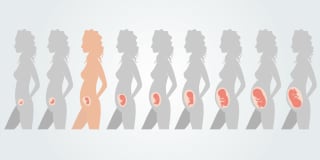
Image credits
Pregnancy silhouette 2 months © designer_things - stock.adobe.com
Prenatal yoga breathing © fizkes - stock.adobe.com