Why should children help with household chores?
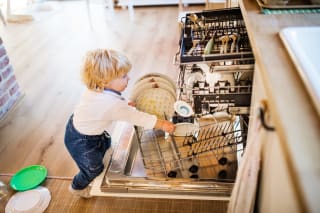
Independence:By the time your child is a teenager, you probably expect them to help out around the house. However, independence needs to be trained earlier and doesn't automatically come with their 14th birthday. In addition, young adults can better organize themselves in their first own apartment or shared flat if they already carried out tasks while living at their parents' home.
Task and time management:Through initial tasks and duties your child gets a sense of how they need to organize themselves to accomplish certain things. Your child gains a sense of time planning and is encouraged to think about when to get something done so that tasks, for example, do not clash with other hobbies or meetings with friends.
Sense of responsibility:Your child develops an awareness of their duties. For example, it can be useful to always assign your child the same fixed areas of responsibility. Such a sense of duty is a good foundation for school, university and work.
Pride and sense of togetherness:Working together for your home strengthens family cohesion. When everyone has to pitch in, appreciation for the respective tasks increases and everyone feels like contributing to family life to contribute. This also increases pride in one's own work.
The best training:Many parents hesitate when it comes to assigning household chores to their children. On the one hand, the little ones should enjoy their childhood, on the other hand many tasks are completed faster and neater when you take them on yourself quickly. However, children train their perception and also their motor skills.
Our household tips
Practical step stool to join in the kitchen
Most of the time it only takes small tricks and many things around the house become easier. Everyday challenges then turn into wonderfully unforgettable moments. To help you master challenges, we'll now regularly provide you with clever and witty ideas, which you can easily put into practice. They make life with kids so much more colorful, easier and nicer. Let this hack inspire you and try it out:

Is your child dashing around the kitchen whining because they have Huuunger? Are they whining because they're bored while you cook or bake? Here is our Eye-level hack: let your child join in! You will see, it works better than you think. Little ones really put in a lot of effort when they're allowed to help.
To bridge the missing centimeters between you, an height-adjustable step stool is the ideal kitchen helper. Your child stands right next to you on it and won't miss anything anymore. Often the little one is already blissful just watching mom and dad. Or the little ones eagerly chop up their own play-dough salad creations with a play-dough knife. Whatever it is: with the same working height everything works much more easily.
Clever vacuum idea to tackle kids' room chaos
Sound familiar? There are a thousand little pieces on the kids' room floor, but a basic clean is still necessary? But how — without vacuuming up toy crumbs or spending ages tidying up beforehand?
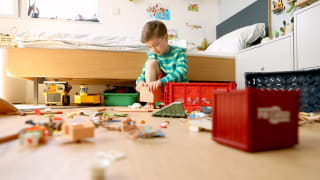
Our hack: a stocking with a mesh pattern. The holes must be big enough for dirt to pass through, but tight enough to stop Lego & Co. Pull the stocking over the vacuum tube and secure it there with an elastic. Then put the vacuum attachment on and you're good to go!
Sucked-up small items will at most reach the attachment thanks to the "stocking membrane". From there you can easily rescue them and return them to the toy cycle. Everything clean, everything there, everyone happy!
Legal regulations on helping with household chores
As parents you surely ask: Are children allowed to help in the household or is that child labour? According to the Civil Code (BGB), children and adolescents are even obliged to help in the household according to their developmental level. In §1619 of the BGB it says:
"The child is, as long as it belongs to the parental household and is raised or maintained by the parents, obliged to perform services for the parents in their household and business in a manner appropriate to its abilities and social position."
Helping in everyday life together is important. However, your child should of course still have enough time and space to just be a child!
From an early age: Which chores are appropriate at which age?
Between 3 and 6 years: Younger children usually want to help around the house because what mom and dad are doing is interesting and they want to explore it. Putting away toys, finding matching socks, handing things over while cooking, or giving the flowers a drink with their own watering can – the little ones usually enjoy that a lot.
Between 6 and 10 years: Now your child can already be fully responsible for their bedroom. In addition to tidying and making the bed, dusting and vacuuming are included. Also your child can now help with the laundry, take out the trash and take responsibility for the pet. You can also safely expect your child to dress themselves, tie their shoes and butter their own bread.
Between 10 and 16 years: Not only can your child already take on setting the table and unloading the dishwasher alone. The first attempts in the kitchen — perhaps still with some support — around simple dishes like pasta, sauces or fried eggs and pancakes will occasionally take cooking off your hands. As your child grows older, smaller repair jobs like hammering or changing a light bulb as well as weeding are already possible without problems. It can also run errands for groceries by itself or look after younger siblings.
From age 16: During puberty defiance about participating in household tasks increases. Of course, your child must still continue to take part and assume responsibility. Those who want to be treated like an adult should also behave accordingly. Performing tasks consistently and steadily also helps personal development. Duties can then become gradually more complex.
How to motivate your child to help with household chores
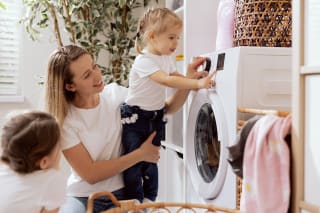
Lead by example: You can only demand from your child what you also model yourself. Therefore you should do household chores with the same energy you expect from your child and also admit when you don't feel like it and still get the tasks done. By the way: If your children see that the housework doesn't always fall on one parent, they are more motivated to help.
Fair distribution: Household work should be divided fairly. Tasks are distributed according to age and time. Don't assign your child only the tasks you don't like yourself. It's best if everyone has done everything once. That way you also increase appreciation for the different tasks.
Make a plan: Create a colorful schedule for the household where the tasks are written down and small name cards that can be moved back and forth: This way everyone can see who has to do what and can remove their name from the task once they have completed it.
Praise instead of pay: Better to praise once too often than too little. Through praise your child feels the value of their work and develops pride and self-confidence. Rewarding household chores with pocket money is not helpful: as an adult you also have to do these tasks without receiving a reward. More on Allowance rules for children you can read in our article.
Not too much or too little: Make sure your child can handle the tasks well. Being underchallenged signals to your little one that you might no longer trust them and don't take them seriously. Tasks that are overwhelming, however, lead to frustration and lower motivation.
Let go of perfection: Remember — your child is still learning. They don't have the same sense of order and cleanliness as you. It can happen that the dust isn't wiped away as you'd like or the dishes aren't loaded into the dishwasher the way you imagine. Talk to your child about expectations, because only then can they learn and improve. If, however, you silently start "improving" the work, you convey to your child the impression that their work wasn't good enough.
Discover more articles about everyday family life








Image credits
Dad vacuums the kitchen with his two children © Halfpoint - stock.adobe.com
Toddler unloads dishes from the dishwasher © Halfpoint - stock.adobe.com
Mother and children do laundry together © ABCreative - stock.adobe.com