The unforgettable treasure hunt for a kids' birthday party
Whether in the woods, in the neighborhood or in the house: with riddles, treasure maps or hidden clues – the design possibilities of a treasure hunt are diverse and give every child the opportunity to to see themselves as treasure hunters.
With a treasure hunt at home or outdoors the little guests are equally challenged and learn to pull together to tackle tricky tasks and overcome obstacles as a team. Besides the cooperation in the group the tasks and puzzles themselves also offer an educational value for children: From number and arithmetic puzzles to word games and quiz questions to research tasks, you have numerous possibilities in a treasure hunt to make these child-friendly. Fun is guaranteed!
Our tip: Choose a nice theme for your kids' birthday party and tailor the treasure hunt accordingly. Ideal are themes that mean excitement and adventure for children, such as pirates, knights and the Middle Ages, ancient Egypt or the jungle. Little adventurers particularly love immersing themselves in fantasy worlds – and as parents, the theme can help you come up with suitable puzzles and tasks!
From what age is a scavenger hunt suitable?
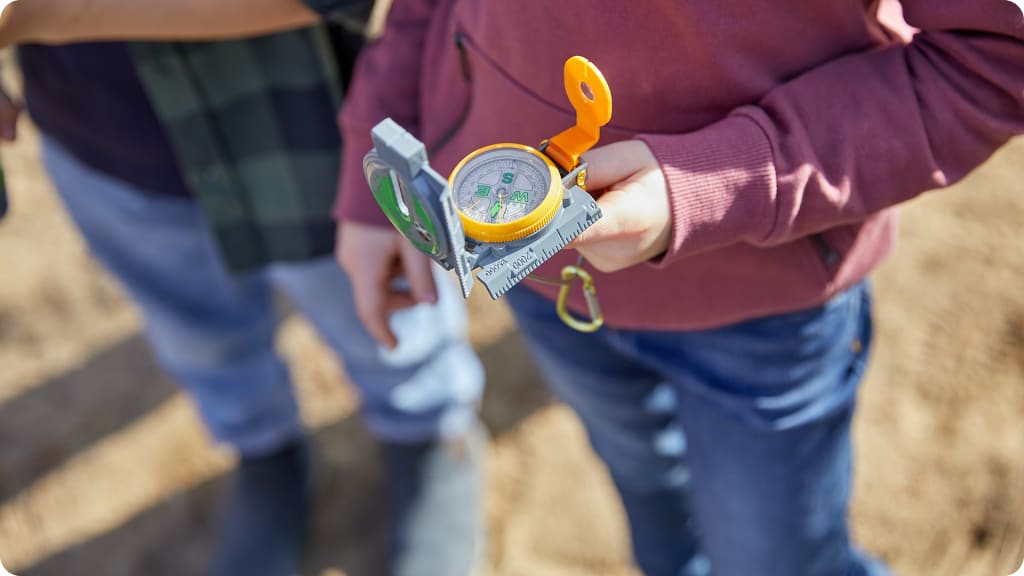
A scavenger hunt is fun at any age and even children from kindergarten age are thrilled when they solve tricky puzzles together with their friends. Adjust the difficulty level of the tasks, the procedures as well as the design of the treasure hunt to the respective age group of your kids:
Scavenger hunt ideas for children up to 4 years old
For younger children, caregivers should be present to accompany them on their adventure through the neighborhood or the woods and help them solve the puzzles. A maximum of 5 stations are sufficient at this age. In terms of content, search games or small tasks like the pot-hitting game (Topfschlagen) or feeling or smelling objects are suitable. Particularly helpful for younger treasure hunters: Sensory picture puzzles or directional arrows.
Scavenger hunt ideas for children aged 5 to 6 years
In a scavenger hunt from age 5, the puzzles and tasks for the scavenger hunt can already be somewhat more challenging. Ideal for a scavenger hunt at a children's birthday from age 5 or 6 are, for example, counting or knowledge puzzles that let your children explore their surroundings playfully: Through questions that focus on identifying garden plants or the animal inhabitants of the flowerbed, children experience nature with all their senses.
Scavenger hunt ideas for children aged 7 to 10 years
At school age, children already have a broader knowledge and are able, in a scavenger hunt at a children's birthday from age 7 or 8, to tackle trickier word, logic and math puzzles or research tasks to solve. Always keep in mind the approximate level of knowledge of your little adventurers and design the scavenger hunt tasks so that every child can participate in solving the puzzles.
What do I need for a scavenger hunt at home?
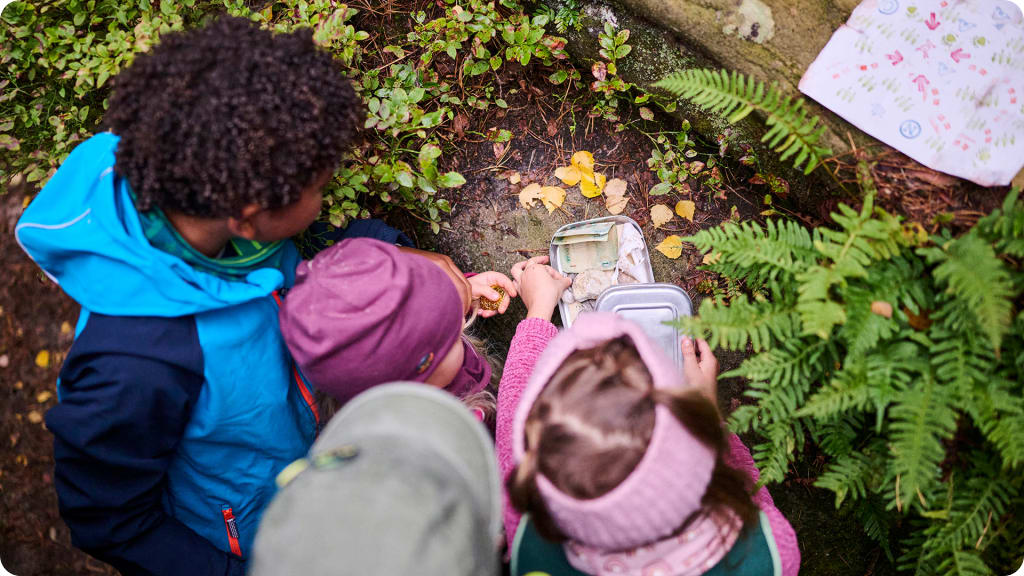
For your scavenger hunt at home or a treasure hunt in the garden you don't need much – with paper, pens, creative puzzles and tasks, and a treasure chest, which is to be searched for, and in no time an exciting adventure for your kids in the comfort of your own home or right outside your door! And with these tips the scavenger hunt in the apartment or out in the garden becomes a unforgettable experience:
Unusual hiding places: In a smaller space, clues are of course easier to find, which is why the hiding spots can certainly be a bit more difficult. It's best if they're so specific that your children can only find them with the help of the puzzles!
Hide solution words:
At home, a version of a scavenger hunt is suitable in which your kids go through various puzzle stations and meanwhile collect solution words. A final solution word, for example consisting of the initial letters of the individual answers, then indicates the place where the treasure is hidden.
Design varied stations:
It's especially stimulating for your children when they have to solve a wide variety of tasks. Whether painting, demonstrating knowledge, or mastering a maze – the possibilities are diverse and a lot of fun!
Organize a scavenger hunt in the forest
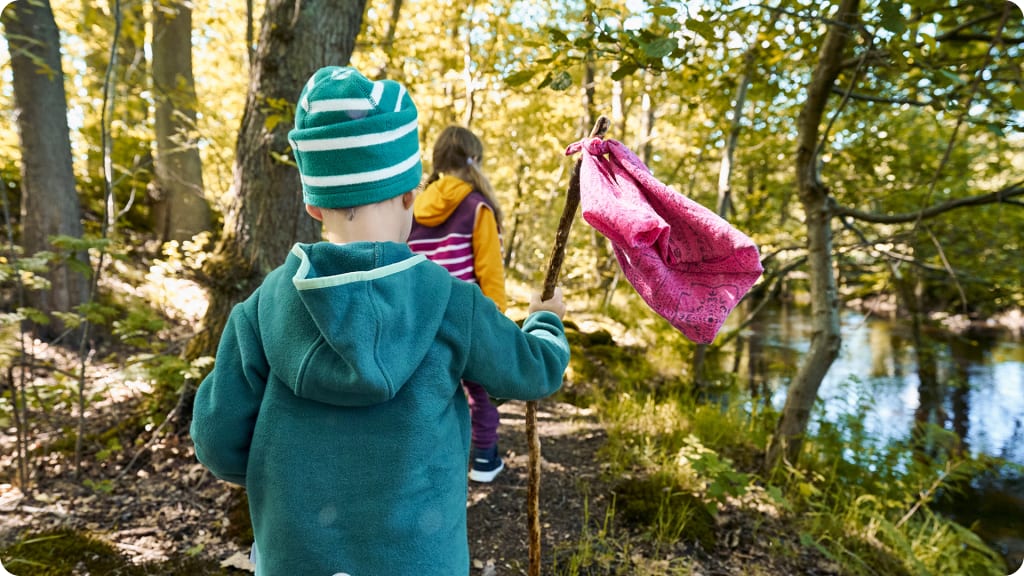
The forest is particularly suitable for a scavenger hunt! A forest rally for a children's birthday with creative tasks will definitely stay in their memories forever. Because in the forest, children not only have plenty of room to romp around in the fresh air, it also offers numerous opportunities to learn about nature and its inhabitants – for example through fun forest games.
Playfully children explore the plant and animal kingdoms on a forest treasure hunt and feel like real nature explorers. Of course, a very special "researcher" equipment shouldn't be missing, such as hand lenses or plant or insect identification cards. The forest also offers an incomparably mysterious, fairytale-like atmosphere with numerous possibilities to hide clues, in the branches, in small niches or tree hollows. That makes the treasure hunt in the forest something very special! Are you looking for concrete tasks for a scavenger hunt in the forest? Then read on:
Ideas for scavenger hunt tasks in the forest
1. Many different trees. Search for three different leaves and find out the names of the trees they belong to. (You can use a plant identification book)
2. "How many legs does an ant actually have?" Examine it using a hand lens, to be sure. Be very careful and then release the ant afterwards."
3. "Look around carefully: Very close by you will find a shrub with edible fruits. The next clue is hidden there. Which fruits are they? Caution! Although they are edible, you should not touch them. Do you know why?"
4. "Which forest animals do you know?" Write down as many as you can! If you find 10, you will receive the next clue."
5. "Do you see the holes in the tree? They were made by a a very special bird that uses its beak to extract insects from the tree trunks. Do you know its name? Note: A supervising adult should make sure that the treasure hunters always stay close to official walking and hiking trails. Also, in the interest of nature and environmental protection, you should work out certain rules of conduct with the children in advance, for example, not leaving any litter and not to disturb plants and animals.
Organize a treasure hunt as a city rally
Not everyone has a forest nearby – but city rallies can be just as exciting and varied, after all there are for city kids here in nature a lot to discover! And a The city also contains an unbelievable amount of history. The traces of history can be wonderfully linked with the puzzles, for example by asking about historical figures, who are immortalized in a monument or give a street its name. For research, information boards (for example in churches, historic buildings, or at monuments) can be used or even passersby can be questioned ("Do you know who the man on the monument is?").
Note: Especially you should assign a chaperone to particularly younger children during the city rally. In the city, children can get lost just as easily as in the forest. Added to this are the dangers of road traffic. At nine or ten years old, children may possibly be able to go on the journey alone, whereby you should restrict the route to the immediate neighborhood or the surrounding blocks.
Ideas for treasure hunt tasks in the city
Even in the city there are all kinds of hiding places for clues and signposts available. As in the forest, you can also here use a treasure map really well and, for example, set the following tasks:
1 "When was the church built? Search in and around the church for the answer." (At historical buildings there are often information boards that provide information about the building and its history.)
2. "You'll find the next clue on the street that is named after a famous composer from Austria . Walk here to number 45–23." (Mozartstraße 22)
3. "In which front garden does a plum tree grow? Here you will find the next clue at the garden fence."
4. "Nearby you'll find a shop that bears the symbol of a species of lizard on it. Which one is it? There the next clue is hidden." (Pharmacy)
5. "Find two children with shoe size 32 chosen and have one child walk 30 steps from the streetlamp and the other from the fountain toward each other, placing one foot in front of the other. At the point where they meet you must look for the next clue."
Organize a treasure hunt in 6 steps
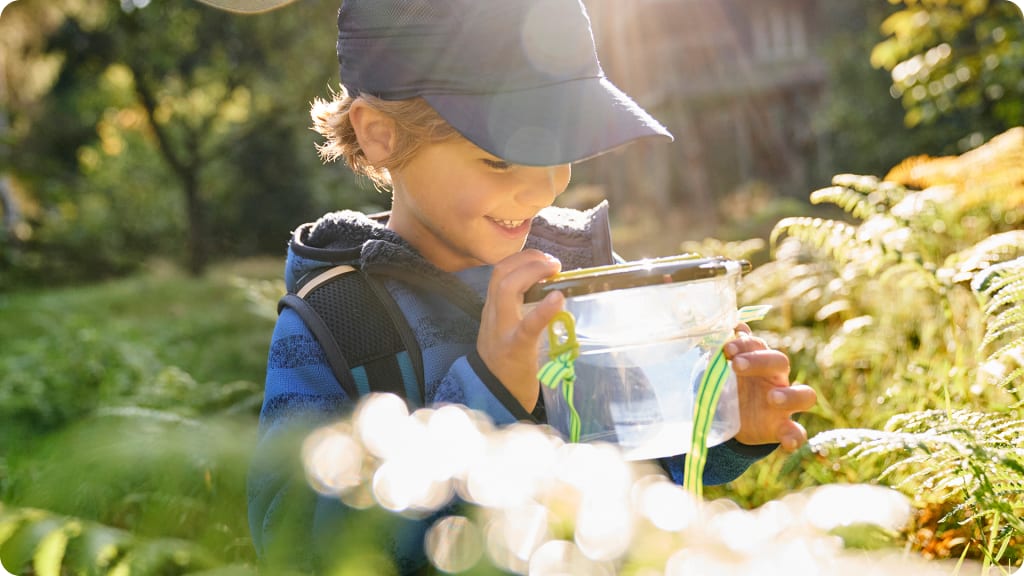
There are countless ways, how you yourselves can design a treasure hunt for your kids. We at HABA support you in organizing with a step-by-step guide:
Step 1: Choose a theme & send out invitations
ThePlanning your treasure hunt for a children's birthday is easier if you have chosen a theme. How about, for example, a pirate or dinosaur theme? Create and distribute the invitations about two to three weeks before the children's birthday. Our tip: Use our free templates for invitation cards with pirate or dino motifs!
Step 2: Determine duration & number of tasks
For children of kindergarten age, five stations are enough for the children's birthday treasure hunt. For school-aged children, there can well be ten stations or more – after all, the treasure hunt should remain a challenge!
Make sure that the route is challenging, but clear and age-appropriate is. A total time requirement of 30 to 60 minutes is usually ideal, including time to solve the puzzles.
Step 3: Plan the route
Then concentrate on the treasure hunt route. Here it's mainly about cleverly placing arrows, symbols or other clues – whether at home or outdoors. If you like, also include street names or other places in the neighborhood in your riddles.
Tip: TheA treasure hunt for children becomes especially exciting, when some tasks and riddles are connected with the immediate surroundings, for example when it's about identifying plants or animals (in the forest) or the construction date of a church (city rally). The discovery of known and unknown places makes your treasure hunt really exciting!
Step 4: Create tasks & define the route
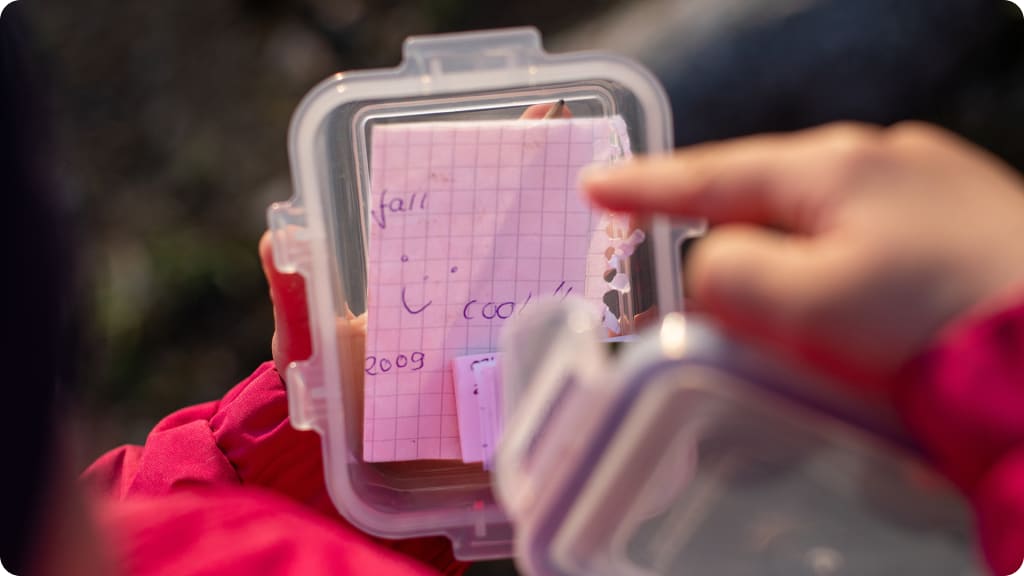
When developing the puzzle tasks there is only one rule: They should be imaginative and exciting. So let your creativity run free! Besides general knowledge questions about the theme you can come up with special touches . With the theme "Pirate" you could, for example, hide a clue in a message in a bottle or in a small model ship.
Often the characteristics of a place can be wonderfully integrated into the tasks, for example in the forest or the zoo. There children can learn playfully about the plants or insects in the forest or the zoo animals through the puzzles.
If you want to focus on an adventurous route , pack the stations and directions of your route into riddles and find good hiding places for clues and signposts. Also secret codes are popular with many children.
Our tip: Place clues also in somewhat harder-to-reach places , such as in a tree or on a wall. To get to the clue, the children must look together for ways, how to overcome the obstacle – that strengthens their social skills.
Step 5: Fill the treasure chest
At the end of a successful scavenger hunt awaits, of course, a treasure for the little explorers! The children can reach the goal in many different ways. Either you guide them from station to station with clues to the treasure or the puzzles form a kind of 'solution word', which points to the place where the treasure is hidden. Working with a work with a treasure map be, which is designed to match the theme is. Here, the children quickly feel like real pirates or jungle explorers. If you make the treasure chest yourself, for a real treasure, for example, cover a shoebox with plenty of gold foil.
And what can you put into the treasure chest as treasure? A tried-and-true option here is of course chocolate gold coins, with which the treasure seekers can treat themselves after the successful tour. If you want to offer the little treasure hunters something extra, you can small gifts hide in the treasure chest. In our Terra Kids range there are, for example, stickers or stamps, with which the children can directly leave their mark on the treasure map can. This way they also hold the perfect equipment for the next treasure hunt for a child's birthday party or another occasion in their hands!
Step 6: Celebrate the scavenger hunt in style
What do you do after your scavenger hunt with the kids? How about a a campfire to round off the special day together? At HABA you'll find great ideas for your campfire with kids – and with our Terra Kids Adventure Fire Steel, grill skewer and kids' pocket knife you are perfectly equipped for it.
Organize a Photo Treasure Hunt with Find the Code
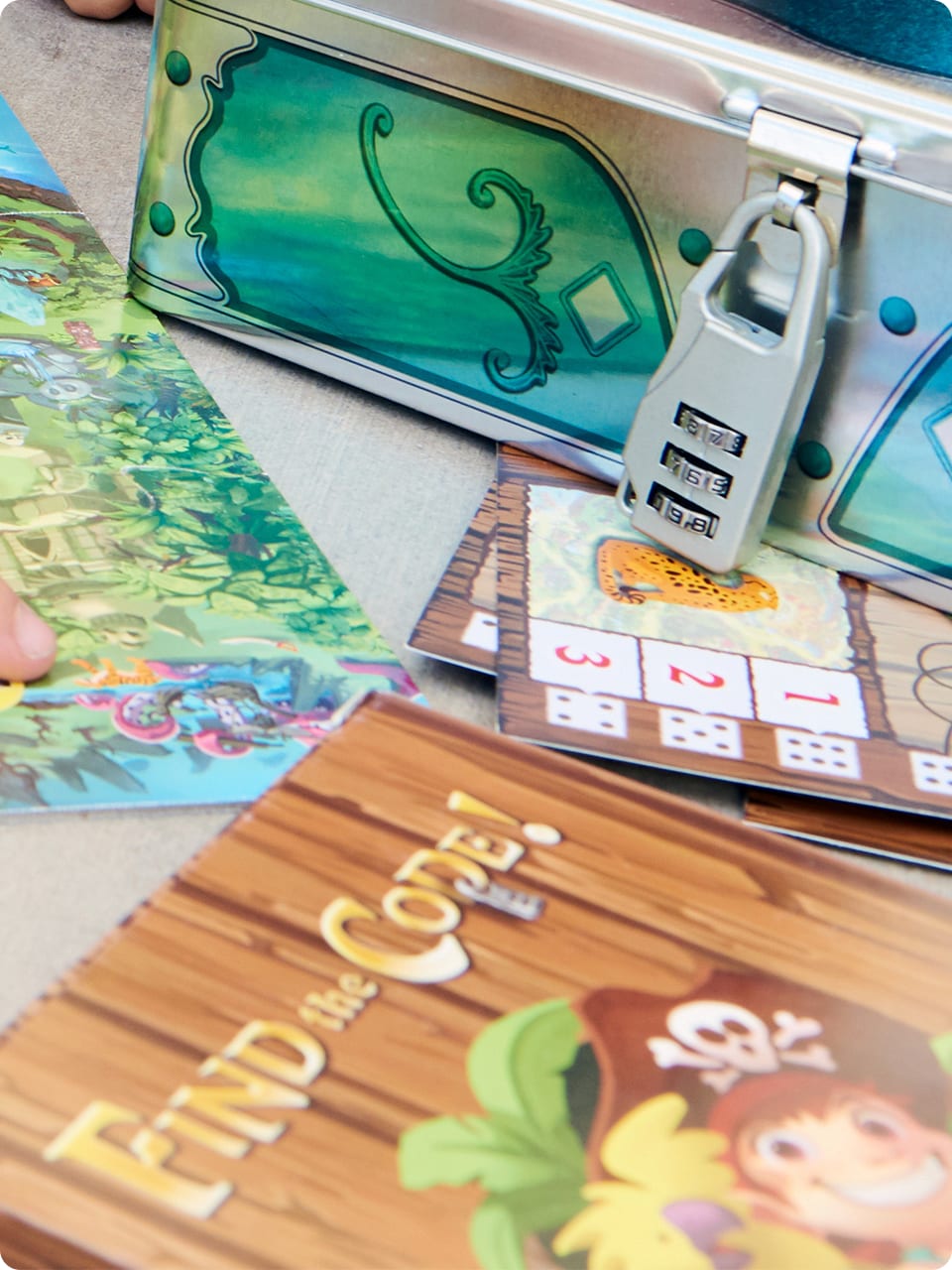
The photo treasure hunt is a popular scavenger hunt variant for children. For this you prepare photos of places that will be found and explored by your adventurers. For the photo treasure hunt you need:
a camera or a phone with a camera,
a printer
as well as as many envelopes or small bags,as you have scavenger hunt stations.
If you have little pirate fans at home, you can combine your photo treasure hunt with our ready-made Find the Code treasure hunt! connect. It contains pre-made puzzles in 3 different difficulty levels and a individually fillable treasure chest for your little explorers.
How to organize a Find the Code! photo treasure hunt in 8 steps:
1. Decide on an area for the treasure hunt – e.g., in the house, in the garden, on the playground.
2. Photograph 9 places or objects in the chosen area and print them out as photos.
3. Think about, in which order the adventurers should find the places.
4. The photo of the first location you place together with the selected puzzle card and the game figure into the puzzle box of 'Find the Code'.
5. Put the remaining photos each together with a puzzle piece into an envelope. Attention: In the ninth envelope there is only one puzzle piece and no photo!
6. At each location you hide the envelope with the photo of the next location. Example: In the puzzle box, next to the puzzle card and the game figure, there is a photo of the doormat. Under the doormat lies an envelope with the first puzzle piece and a photo of the shoe cabinet. In the shoe cabinet there is an envelope with the second puzzle piece and a photo of the bathtub, …
7. Read to the children the exciting story to set the mood from the instructions aloud, or come up with a new story. Then hand the children the closed treasure chest and the puzzle box.
8. Start the photo treasure hunt with these words: “First set out to search for the place that is shown in the photo in the puzzle box. You will find another photo there as well as one of the puzzle pieces. Follow that photo too. This way you will gradually find all 9 puzzle pieces.”