Why is nature so important for child development?
Nature offers children not only almost unlimited play opportunities, but also plenty of challenges. In play, children are repeatedly encouraged to test their own abilities: Can I manage that? How do I solve this problem? Free play in nature therefore stimulates creativity more than any other play and strengthens children's self-confidence. Many parents teach their children that nature is valuable and worth protecting. However, children should perceive nature more as their natural habitat, which offers countless possibilities, some dangers and many secrets.
Experience nature with all the senses – here's how
In everything children do and see in nature, they learn something. But development should never be the main focus when playing in nature: it's about experiencing with all the senses and discovering the world around you. These experiences are most intense when children can play freely and undisturbed. But of course you can also accompany your child into the woods, to the meadow or to the lake. Who knows – if you keep your eyes open, you might discover something new and amazing yourself.
Feel, listen, observe: nature in detail
Children experience their world instinctively with all their senses. Even as babies they thoroughly feel objects and put unknown things into their mouths first. You can explore nature in the same way, e.g. with touch games where your child has to feel certain objects with closed eyes – a piece of bark, a chestnut or a leaf. After a short walk you can simply stop together and listen in silence for a while: what sounds do you hear and where do they come from? Try to describe the smells of the forest or the meadow or to find different colors and shapes in nature. This way your child gets to know nature in detail.
Water and fire: the elements that fascinate all children
When water or fire are involved in play, most children are unstoppable. Streams, lakes or even puddles exert a magical attraction on children, as do candles, torches and campfires. Water games are therefore perfect for luring children outdoors. At the same time they are a great change of pace when things start to get boring in your own garden.
Undisturbed play at the stream
The nicest water play is offered by small streams or watercourses, like those often found in wooded areas or meadows. Here children can float little boats for hours, build bridges and dams and see what the water brings along. You should not let kindergarten-age children play unsupervised at small watercourses either – such waters often have steep, slippery banks that small children can hardly climb.
In summer: outdoor water games
In warm weather a water activity is a welcome cool-down when there's not enough time to go to the lake. A few simple tips:
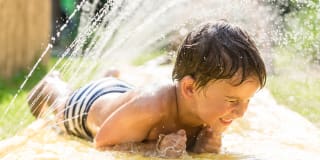
Water slide: Build a water slide from plastic tarpaulins/garbage bags and a garden hose
Sponge fight: Set out a few buckets of water and plenty of bathing sponges in the garden and let the wet-and-wild sponge fight begin
Finding treasures in an ice block: This game works all year round, but it's especially fun in warm weather: empty one of the freezer drawers, put in rubber toys etc., fill with water and freeze. The next day knock the block of ice out of the drawer and place it in the garden – your child now has to use a hammer to find the "treasures" hidden in the ice.
How do I motivate little homebodies to play outside?
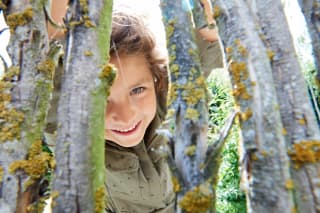
Some children are drawn outdoors in any weather:
They play and romp for hours until it becomes too dark or too cold. Parents are pleased – after all, fresh air is healthy and your child can get rid of all excess energy. But what if a child really needs to be persuaded to play outside? If the toy shelf or the PC in child's bedroom are more attractive than the forest and garden?
Very often little homebodies simply follow their parents' example – which is why the first and best tip to get children into the fresh air is: go outside yourself! Create an incentive that makes the decision easy for your child. Maybe a long walk to the ice cream shop? A bonfire in the garden? A treasure hunt with friends in the nearby woods? If your child has something to do, they will be much more willing to go outside – often one or two friends for playing together are enough.
Experiencing nature in the city – is that possible?
A child's own planter on the balcony and regular trips to the park:
In this way city children can already learn quite a bit about nature. "Wild", unplanned nature is hardly available in urban areas though – a big drawback, as educational scientists say. Because especially uncultivated areas encourage children to play and discover and provide experiences they cannot have on mown lawns and among ornamental shrubs. Some cities have therefore already begun to create so-called "nature-based play spaces" where children can play without pedagogical supervision. So far these nature experience spaces mostly have a model character – but even so there are opportunities in the city to experience nature.
City forests and local recreation areas:
Almost all larger cities have forested areas or local recreation areas where children can play without restrictions. Here there are often also wild-growing sections suitable for hiding and building dens. You should of course accompany younger children, but at primary school age children can already make the trip to the woods on their own.
A day trip into nature:
At the weekend it doesn't always have to be the cinema or the swimming pool. Why not plan a day trip with a picnic to a nature reserve? Many beautiful forest and lake landscapes are also reachable by public transport – and they are appealing not only in summer but also offer many great impressions in spring and autumn. You can find further ideas and suggestions on how to make nature accessible to city children here.
Tips and ideas for nature experiences
Nature in the dark:
Night hikes are the highlight of every school trip – but even the immediate surroundings at home become an exciting adventure after dark. Autumn and winter are best suited, when it gets dark early. Plan the night walk on the weekend and equip your child with a flashlight – off you go: listen to the smells and sounds of the night and experience familiar paths anew in the dark.
Walk in the rain:
Those who occasionally go out in the rain know how different nature smells then and how the appearance and soundscape of the surroundings change. Take your child on a forest walk on the next bad-weather day: with weatherproof clothing it's really fun to experience the impressions that the rain leaves in nature.
Trip to the wildlife enclosure:
Wild animals in the wild are – if at all – only seen fleetingly. In a wildlife enclosure children can see fallow deer, roe deer, wild boar, birds of prey or pheasants in their natural environment and still observe them at their leisure. Depending on the type of enclosure, wildlife feedings are often offered as well.
Birthday party in the forest:
From spring through autumn a children's birthday can be wonderfully celebrated in the forest, including a short forest walk, picnic and various forest and terrain games. The good thing about such a party: the children can romp to their heart's content and be as loud as they like – and the forest offers plenty of inspiration for play and discovery.
Experience nature rather than teaching it:
Go outside together with your child – but avoid trying to teach them everything about nature. Let your child discover the new and the familiar that come together in nature with their own eyes and with all their senses. Only in this way will they experience nature as what it is: a constantly renewing, exciting place to play and live.