Which animal would you like to learn more about?
Little explorers love exploring the environment with all its inhabitants and learning more about the fellow creatures on our planet. Let yourself be carried away by childlike curiosity and explore together with your children the Secrets of Forest Animals. Conscious engagement promotes mindful interaction with nature in all its facets and is also great fun!
And we can learn something too. Let's be honest: do you know what sounds foxes make or which bear is the largest? Later we can continue to rave about the beauty of the animals, for example in a cute pajama with a deer motif or while coloring our adorable forest animal coloring sheet.
Roe deer fact sheet
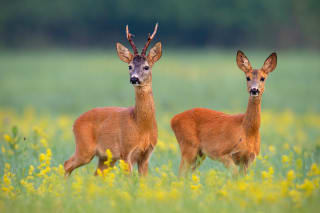
The elegant roe deer is the most widespread and smallest species of deer in Europe. Nowadays it is found not only in forests but also on open farmland.
Habitat: Forests, forest edge zones and fields across much of Europe
Age: up to 12 years
Size: 54 to 84 cm shoulder height
Weight: 15-22 kg
Diet: Grasses, herbs, leaves and buds
How do roe deer live?
The way of life varies across the seasons. In summer, roe deer usually live alone. Especially after the birth of the fawn, female animals, also called does, spend time alone within a small home range. Males show pronounced territorial behavior and occupy their territory usually for several years. At the beginning of autumn the roe deer form into small groups together. The peaceful intraspecific coexistence makes life easier for the animals during the winter months. In late winter the groups begin to dissolve again. By the time the young are born in May, the dissolution phase is completely finished.
When are roe fawns born?
Roe fawns are born in the favorable early summer months May and June into the world. They are usually born singly or as twins, rarely as triplets. About three to four weeks after birth, fawns remain crouched on the ground at a sheltered bed with abundant undergrowth. The mother visits her young only to nurse. This saves energy for the resting fawns and at the same time offers them the best possible cover. Only from an age of about four weeks do the young begin to follow their mother.
What does a roe deer look like?
With its wedge-shaped body and long legs, the roe deer is perfectly adapted to silently moving through dense vegetation. Based on its physical characteristics, the roe deer is assigned to the so-called 'slip-through type' assigned. This means that when threatened it seeks shelter in the thicket with a few quick jumps instead of running away. In summer the animals' coat is brown-red to pale yellow. The winter coat is more light to dark gray and provides better insulation against the cold. Roe fawns carry a white-spotted coat for optimal camouflage on the ground. However, the spots disappear completely with the first change to the winter coat.
Do roe deer have antlers?
Only the male animals, that is the roe bucks, carry an antler. It is primarily used in fights against conspecifics to contest the dominance order. It normally consists of three tips or branches on each antler beam and is about 15 to 20 centimeters high on a fully grown roe buck. In bucks that have completed at least their first year of life, the antler falls off annually between October and November. It grows back under the nourishing velvet regrows. The growth phase lasts about 60 days and ends in January. After the antler formation is complete, the dead velvet is rubbed off on bushes and trees in the second half of March.
Wolf profile
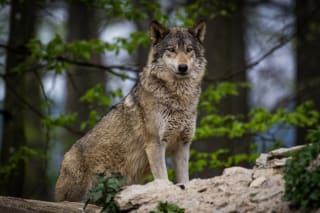
The wolf was considered extinct in Germany for a long time. Today the pack animals can once again be found in certain forest areas.
Habitat: Vor allem Waldgebiete in Osteuropa, Russland sowie Kanada und Alaska
Age: up to 13 years
Size: approx. 60-80 cm shoulder height
Weight: 30-50 kg
Diet: Plant-eating mammals of the respective distribution area
Are wolves extinct in Germany?
Once, wolves were among the most widespread mammals worldwide – they could be found across the entire Northern Hemisphere. In many parts of Europe, however, the wolf was displaced by humans – in Germany it was considered eradicated since the 18th century. In the year 2000, however, a major conservation success could be reported: the first free-living wolf pups in around 150 years were born in Germany. Since then the wolves have slowly reclaimed their old habitat. In the survey period 2017/2018 there were 73 packs, 31 pairs and three territorial solitary animals in six federal states registered.
How fast does a wolf run?
The wolf is an excellent runner. In short sprints it can reach top speeds of up to 50 kilometers per hour. But the wolf is not only a good sprinter but also a true endurance runner. It often moves within its territory up to 20 kilometers, sometimes even 80 kilometers per day. In doing so it trots at an average speed of 10 to 12 kilometers per hour.
What does a wolf pack consist of?
A wolf pack is a kind of family unit. It consists of a breeding pair and their offspring. Wolves are very social animals with strong bonds – a wolf pair usually stays together for life. The young leave the pack on reaching sexual maturity after one to two years to form their own family. Each wolf pack lives in its own territory. The size varies greatly depending on the number of prey and can range between 75 and 2,500 square kilometers.
How much wolf is in the dog?
Our modern domestic dogs are domesticated, i.e. bred, forms of the wolf. They belong to the same species (Canis lupus). Wolves show some characteristic features that distinguish them from dogs. For example, the muzzle and legs are longer, the always erect ears are usually smaller than those of the domestic dog. Wolves also often have a light spot above the eyes; the eyes themselves are yellow to yellow-green and set obliquely. The extent of the differences varies greatly depending on the dog breed. How much wolf is in a dog can only be determined definitively by a DNA analysis.
Squirrel fact sheet
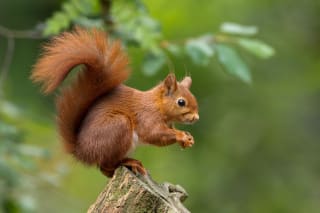
Squirrels have adapted to human environments and now often live in cities, gardens, and parks. They stockpile food for the winter.
Habitat: Forests and parks across large parts of the Americas, Europe and Asia
Age: up to 10 years
Size: approx. 30 cm
Weight: approx. 200-400 g
Diet: Seeds, kernels, nuts, tree fruits, leaves, shoots
Which species are there?
Currently, 29 species of squirrels are distinguished. In Central Europe, the European red squirrel, with the scientific name Sciurus vulgaris. It can be recognized by its reddish fur. It faces competition from the robust and adaptable grey squirrel, which was introduced to Great Britain at the end of the 19th century. In the meantime, the grey squirrel has almost completely displaced the European squirrel on the British Isles. However, the grey squirrel has not yet been able to establish itself in Germany.
Do squirrels hibernate?
Contrary to common belief, squirrels do not enter a true hibernation, but only a winter dormancy. For this they build up food stores in autumn. They bury them in the ground, where they can mainly find them again using their sense of smell. During the winter months, squirrels have a daily activity phase of one to two hours to retrieve food from their cache. Afterwards they return to their sleeping nest and become inactive again.
How far can a squirrel jump?
Squirrels are excellent jumpers. For them, it is no problem to five meters to jump. Their special body structure allows them to develop enormous jumping power. Their large feet can also be turned 180 degrees backward, allowing them to safely climb down trees headfirst. Their long, sharp claws give them a secure grip.
What does a squirrel's nest look like?
Squirrels build spherical nests in branch forks, which are called dreys They build these from twigs and leaves. The drey is lined with soft materials such as grass and moss. A drey has an outer diameter of 30-50 centimeters and an inner diameter of about 15-20 centimeters. It usually has at least two entrance holes for a quick escape and is waterproof on the outside and well insulated. An ideal place to raise the initially naked and blind young animals.
Bear fact sheet
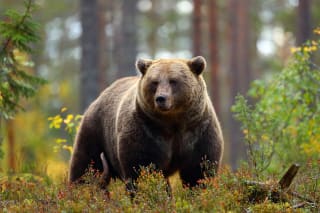
Depending on the species, bears vary in appearance, fur color and range. All bears share a stocky body and short, powerful limbs.
Habitat: Primarily in Eurasia and the Americas
Lifespan: up to 30 years
Size: depending on species up to 1.50 m shoulder height
Weight: depending on species 25-800 kg
Diet: Small animals, fish, fruits, insects – omnivores
What types of bears are there?
The bear family includes eight species: the American black bear, the Asiatic black bear, the brown bear, the polar bear, the sloth bear, the sun bear, the spectacled bear and the giant panda. Some of these species are divided into further subspecies. The brown bear is one of the best-known bears in our regions. When we hear the term 'bear', the first image that comes to mind is probably a large, placid brown bear. The brown bear has a stocky and powerful body and a muscular hump over the shoulders. Although it used to be widespread, there are now only small remnant populations in Western and Central Europe.
Are bears dangerous to humans?
No one needs to fear a bear. While a bear can, because of its enormous strength, seriously injure a person with a bite or a swipe of its paw, bears usually flee when a person approaches. If an attack occurs, it is usually due to provocation or careless behavior on the part of the human. Far more dangerous than the bear to humans is the human to the bear. Bears are still hunted in some regions. In addition, bears are displaced from their natural habitat by humans.
Do bears hibernate?
In fact, many species of bears enter a winter dormancy during the cold season. It is not a true hibernation, as the body temperature drops only slightly and bears can be relatively easily awakened. Respiratory rate and heartbeat are reduced only so far that the bear can still defend its den at any time. Before the winter rest in late summer and autumn, they gorge themselves to build up a substantial layer of fat. During the winter rest they then lose about a third of their body weight. How long the winter rest lasts cannot be generalized across all bears. Bears are highly individualistic.
Which bear is the largest?
The largest bear is the Kodiak bear. It is a subspecies of the brown bear and lives on the Kodiak Islands off the southern coast of Alaska. The Kodiak bear reaches a total length of up to 3 meters and a shoulder height of 1.50 meters. Along with the polar bear and the Kamchatka bear it is considered the largest land-dwelling predator on Earth.
Hedgehog fact sheet
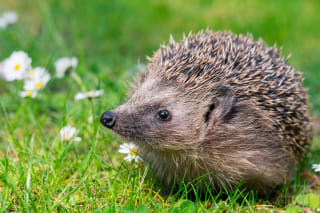
The hedgehog is able to roll itself into a spiky ball when threatened. The spines are already formed at birth, but they are not yet fully hardened.
Habitat: Forests, gardens and green spaces in Eurasia and Africa
Age: up to 7 years
Size: approx. 20 cm
Weight: 350-1.500 g
Diet: Insects, earthworms, spiders, snails
Which hedgehog species is native to our area?
Two species of hedgehogs live in Europe: the brown-breasted hedgehog and the northern white-breasted hedgehog. In Germany and large parts of western and central Europe, the brown-breasted hedgehog is typically encountered. With the loss of its natural habitat, it is increasingly found in human settlements — in hedges, wildlife-friendly gardens and parks.
Do hedgehogs hibernate?
Because the hedgehog finds little food in the cold season, it prefers to sleep. In November it sets out to search for a suitable winter shelter. This must not be too cold or too damp and should, of course, also be safely protected. A large pile of leaves is a popular option, for example. During hibernation, the hedgehog reduces its metabolism to a minimum. Breathing, body temperature and heartbeat are significantly reduced. The animals live off the fat reserves they have built up before winter. In spring, when temperatures rise, the hedgehog awakens from its sleep.
Why does the hedgehog have spines?
The hedgehog defends itself with its spines against predators. When danger threatens, it quickly rolls itself into a ball. This protects its soft belly and makes it almost unattackable. An adult hedgehog has 5.000 to 8.000 spines. These are brown and beige in color, which additionally camouflages the hedgehog in dense leaf litter.
Can you help a hedgehog in winter?
If you see a hedgehog walking around in your garden or the woods in winter, this is not necessarily a cause for alarm. If you don't notice any injuries or signs of illness, it is likely that the hedgehog has interrupted its hibernation for natural reasons. It is quite possible that its original winter quarters were damaged. The animal will then look for a new suitable place. You may be able to create such a place in your garden with a few branches, leaves or logs. If you are unsure whether the hedgehog needs human help, seek advice from the nearest hedgehog rescue centre.
More articles about leisure & creativity











Image credits
Deer in a meadow in the sunshine © stock.adobe.com
Roe buck and doe © WildMedia - stock.adobe.com
Wolf on a rock © Thorsten Spoerlein – stock.adobe.com
Squirrel sitting on a tree trunk © schaeferfotografie – stock.adobe.com
Fox sitting in the foliage © rtaylorimages – stock.adobe.com
Brown bear walking through the forest © Antonioguillem - stock.adobe.com
Hedgehog sitting in a meadow © mirkograul - stock.adobe.com