What does reading aloud promote in children?

Regular reading aloud makes an important contribution to your child's language development. While listening it expands their vocabulary, learns grammatical structures of the language and internalizes how stories are structured.
Reading aloud stimulates the imagination: Reading aloud creates worlds of adventure – while listening, children experience the story vividly and shape their own inner world. This promotes their creativity and trains their abstract thinking.
Reading aloud strengthens empathy: Many children's books and stories address everyday conflicts and fears in an understandable way. While listening, your child engages with these and learns important principles for getting along day-to-day. Stories often convey basic behavioral patterns that children unconsciously adopt and try out.
Reading aloud is "low-stimulation": Unlike TV or computer games, when reading aloud you can respond to the child's needs, take small pauses, repeat a sentence, or answer questions about a picture or a situation. Talking about the story in particular stimulates your children's creativity.
Stories encourage conversation: Pick up interesting points and talk with your little listeners about the characters, how they act, what they think, or about the pictures in the books. How would your children behave in that situation? Have they ever experienced something similar? The list of possible conversation starters is long!
Reading aloud is important for shared time: Cuddling together on the sofa and reading a book is wonderfully cozy – a storytime can provide parents and children a break from everyday life. Make a conscious effort to take this time and, if possible, set aside half an hour regularly for reading aloud.
When is the best time to read aloud?
Basically, the ideal time to read aloud is whenever, you have time and the necessary quiet. You can also deliberately use a reading session to bring some calm into everyday life – for example after lunch or when you have picked up your child from daycare. The classic reading time is, of course, in the evening before bedtime. This ritual is very important to many families – and if you read a longer book that continues evening after evening, the anticipation is even greater.
Which books are suitable for which age?
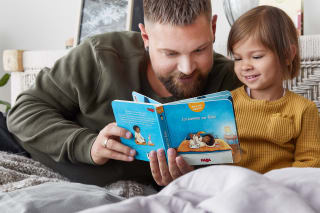
Reading to babies
Since babies pay particular attention to your voice, your speech rhythm and your modulation, you can therefore also read to them from your favorite book or the current crime novel. If your baby sits fairly securely on your lap, suitable are simple picture books with frequent repetitions or rhymes, which your baby will quickly recognize.
Reading to toddlers
From the age of one, children are big enough for their first board books. Well suited are simple rhyming stories, books with simple pictures and first-word books and clearly illustrated picture books.
From 2 years old children enjoy short stories, first simple non-fiction books, preferably about everyday things or things they can observe themselves: vehicles, life on the farm or animals in the forest.
Children up to three years love picture books with short texts. At this age, pictures are important to understand the story. From this age, it is advisable to read in a dialogic way, that means, to break up the text with questions or prompts about the illustrations. This easily creates situations for follow-up questions or short comments on the text just heard. You can draw the children attention to details of the story, which are also shown in the picture. Do not read too quickly; the little ones need enough time to follow the action and to imagine the pictures in their head. If there is too much text and too few pictures in the book, they can quickly lose patience. Most children at this age do not need a large selection of books. They often want to hear the same book every day. Still offer a different book now and then – maybe a new favorite will be among them!
From 4 years old the range of topics broadens. Just try what your children like: classics by well-known children's authors, picture books with longer texts per page or books with several chapters. Fairy-tale or realistic, dragons or superheroes, fairies or princesses … The possibilities are varied. And don't be afraid to read aloud topics that at first glance do not seem to match your children's interests, because that also broadens their horizons!
Reading aloud for kindergarten and primary school children
From around five years old, children are interested in serial stories. They are now able to recall what they heard the day before and link it with the next chapter of a story. When reading aloud there are now fewer pauses, since fewer pictures need to be discussed or explained. Reading tip: Dive with your kids into our Kullerbü- or Little Friends stories in. The story „Witch Holterpolter and the Exploded Cough Syrup“ is perfect for a cozy read-aloud evening and is guaranteed to be a lot of fun for young and old.
How to make reading aloud fun
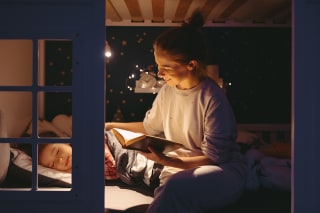
Sit comfortably together – and take plenty of time for a shared book. With these reading tips for parents reading aloud is really fun:
There is no wrong way to read aloud. It always depends on the personality of the reader, the age and the receptiveness of the children. In classic reading-aloud, the selected text is read straight through. Depending on the talent of the person reading aloud, the individual characters get different voices – but that doesn't have to be the case! Especially when you read a story several times, you automatically convey moods, depending on whether the described situation is funny, exciting or serious and how the characters act. With these reading tips for parents you are well prepared:
Focus on the book: Try to read in an engaging and varied way; that makes listening even more enjoyable.
Be a role model: Regularly pick up a book or newspaper yourself – that way reading becomes the norm for your child.
Don't wait for your child to come to you with a book – regularly offer new books or make the shared reading time a fixed ritual.
Read a bedtime story: Ten minutes in the evening is enough to calm down and read a nice story together.
Let your child choose the book: Even if it's the same book for the 50th time, or you would rather read something pedagogically valuable instead of the pink princess story – what's important is that your child enjoys the reading!
More articles about leisure & creativity









Image credits:
Mother reads a story to a child and kisses the child on the head © Elena Kratovich - stock.adobe.com
Mother reads a bedtime story to a girl in bed © JenkoAtaman - stock.adobe.com
Father and daughter lie on the bed and read a book © Juliaap - stock.adobe.com
Mother reads from a book, daughter sleeps © JenkoAtaman - stock.adobe.com