What does creativity mean for children?

With the term 'creativity' we primarily associate artistic abilities. Creative people are musicians, painters, and all those who realize their own ideas in a variety of creative ways.
In childcare, however, creativity is defined much more broadly. It's not so much about teaching artistic techniques; a creatively designed everyday life should introduce children to different ways of expressing their feelings, testing their abilities and limits, and creating something new.
Reading aloud and finger rhymes, singing, dancing, painting and crafting — all of these are small creative exercises for children. Coercion and high expectations have no place here, because however important creativity is for child development, it should above all be fun.
Reading and storytelling – the best way to support language development
Basic need: language:
Even in the womb, babies listen to their mother's voice and recognize familiar voices, such as those of the father or siblings. The human voice is one of the first and most formative sensory impressions and will for the rest of your child's life always be the first way to make contact with others and communicate.
Storytelling promotes creativity:
Reading aloud and telling stories not only stimulates children's imagination, it also makes them more articulate. Without noticing, children absorb new words from bedtime stories or funny poems and over time develop an instinctive sense for the use of language, story structure, and linguistic nuances like puns or irony. Children who are read to frequently usually find it easier to invent their own stories and play with words.
Listening – an underestimated social skill:
It is well known that reading aloud and singing to children supports their language skills even in infancy. What is often forgotten is that storytelling, rhymes and songs train not only speaking but also listening. This seemingly passive ability is as fundamental to social interaction as speaking itself. Stories, finger rhymes and poems teach children to listen attentively to others, to pay attention to details and to recognize linguistic peculiarities.
Storytelling and listening for children – tips for everyday life

Bedtime story:
A bedtime story or lullaby is part of the bedtime ritual in almost every family. If your child is not yet too tired, you can take a few minutes after reading to talk about the story with them. This helps them learn to put things into their own words and to recount impressions or memories. From around age five, you can also read one or two chapters of a continuous story each night. Beforehand, briefly review with your child what happened in the story the night before.
Goofing around:
Children love being silly. The same goes for playful language of all kinds. There are countless simple word games and linguistic playthings you can use in everyday life. Try, for example, finding rhymes for everything on the breakfast table or inventing crazy stories where each person adds one or two sentences. Speaking in different voices, singing or whispering sentences are also creative ways of using language that delight children.
Rhymes and poems:
Reading poetry is not everyone's cup of tea. But there is a wide selection of cheerful and playful poems for children. A good idea for fitting simple rhymes and poems into everyday life is, for example, before meals: each family member may choose a funny table rhyme, as is often done in kindergartens. Or you can choose small poems that suit the season, for example for Easter and Christmas, and recite them together with your child.
Now it gets loud: singing and making music with children
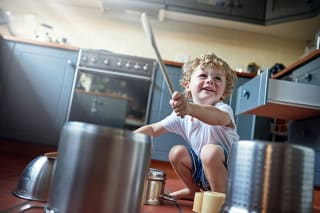
Most parents notice early on that singing and music have a special effect on their children. They calm down more quickly when they hear a familiar lullaby, they 'dance' along to certain songs or experiment with their own voice by singing to themselves absentmindedly. Singing together is one of the most immediate ways to be creative, for example when your child claps to the beat, accompanies a sung song by drumming on the table, or perhaps changes the melody or lyrics. Enjoyment of music cannot be forced, but if singing and music accompany your child naturally from the start, they will find many ways to express themselves through music.
Crafting with children: playfully training creativity and fine motor skills

Painting, crafting and modelling are an integral part of educational work in most day-care centers and schools. So is it still necessary to do crafts at home? Doing crafts with your child is of course not a must. But crafting is not just about finishing a pretty window decoration. Crafting is time spent together. It is an opportunity for your child to implement their own ideas and to show certain skills or techniques in a playful way. And not to forget: cutting, folding and gluing is simply fun — for moms and dads too.
When and where should I craft with my child?
Crafting is not bound to appointments — that's the beauty of it. Craft according to your mood or whenever you get a good idea. It's best to have a basic supply of craft materials at home: simple items like construction paper, paints, safety scissors and craft glue, etc. A special workspace is not necessary. The kitchen table, the living-room table or even the floor are great for most craft projects. It is, however, sensible to have something like a PVC-coated tablecloth at home to put down while crafting.
Templates and craft instructions
Today there are suitable coloring or cut-out templates to download for every craft idea. That's practical, because many motifs can be used not just for one but for many different craft projects. You can use our craft motifs and coloring templates for window pictures and mobiles, as cheerful designs for book covers, greeting cards and much more. For those who want to know every detail, we offer many detailed craft instructions on a wide range of topics, for example felting or making candles yourself.
Crafting with the seasons
Crafting is of course even more fun when it's cold and dark outside and you can make yourself comfortable together at the craft table. But there are also plenty of great ideas for the warm season that let your child be creative. Felting yourself or working with clay is even more fun when you can mess about outdoors. We have put together creative craft tips and instructions for you throughout the year.
More articles about leisure & creativity




Image credits
Child drums on pots with cooking spoons © peopleimages.com - stock.adobe.com
Mother pulls her child in a laundry basket through the apartment © ABCreative - stock.adobe.com
Dad and daughter lie on the sofa with outstretched arms © opolija - stock.adobe.com
Dad and daughter dance in the kitchen © Halfpoint - stock.adobe.com