Why and from what age should your children learn to swim?
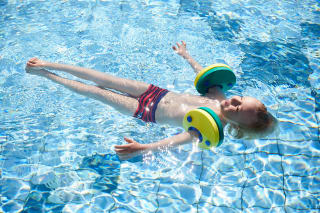
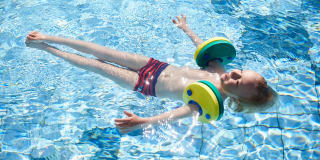
Water attracts many children like a magnet. The gentle feeling of waves on the skin and the splashing arouse the little ones' interest, so they can hardly wait to explore the world of water.
But this also holds sources of danger that curious explorers are only too quick to underestimate. Drowning is one of the most common causes of death among children.
How can you best prevent that? Swimming is the best protection for your little ones. For they acquire a certain 'self-rescue competence' that enables them to escape dangerous situations on their own and to keep themselves afloat independently for some time.
Last but not least, your kids also spare their joints, strengthen their muscles, immune system and endurance. Postural problems and tension are also prevented.
The earlier your children learn to swim, the better. This not only helps to prevent swimming accidents, it also gives them a natural and fearless sense of security, independence and self-reliance.
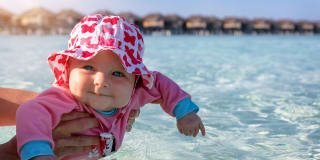
Even babies and toddlers should regularly come into contact with water so that they become familiar with the element.
Proper learning to swim can be started at around four or five years old since only then do your children have sufficient motor skills that enable them to perform more complex swimming movements and to learn basic techniques.
They are also at an age where they are tall enough to stand in the shallow pool and to concentrate on instructions.
The following rule of thumb applies: If your children can ride a bike confidently and without training wheels, they are also able to learn to swim.
In the best case, your children can swim before starting school or are at least fully in the learning process. In primary schools, swimming is often only offered from the third grade.
In addition, teachers cannot cater to every pupil and cannot take care of anxious non-swimmers intensively enough. When your children actually learn to swim, however, also depends on their development, interest, and enthusiasm for the water.
Lead by example for your kids. If you show them that you are not afraid of the water yourselves, the likelihood is high that they will enthusiastically throw themselves into the learning process of various swimming techniques.
Water familiarization: How to reduce your children's fear of water
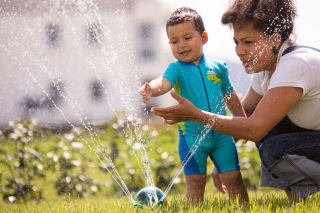
To help your children become enthusiastic swimmers, it's important to introduce them to water at a young age. For that, your little ones do not have to submerge their entire bodies. Especially water-shy children need time to get comfortable with the cool water. Your children's 'swimming career' starts with having fun in the water and splashing around.
Already in the bathtub, the paddling pool and the non-swimmer pool they learn how to interact with water, lose their fear and discover pressure, resistance and buoyancy as properties of this special element. Also through water games and splashy ideas for garden play, children become excited about splashing and, eventually, about swimming.
Through games, non-swimmers gain an easier access to the water. They sooner or later lose the fear of moving in it. If you already start enjoying splash moments with your babies, that is certainly helpful for every further step in the child's development. Your children learn to swim much more willingly and do not perceive it as something unsafe.
However, do not try to persuade your children with pressure and convince them of the fun of water. They have their own pace, which you should only accommodate with a lot of patience and understanding.
If you don't dare to do the water familiarization yourselves, swimming courses that are dedicated exactly to this are an option. Water acclimation courses are often already offered from one to three years of age offered. There your children meet like-minded peers. That often makes it easier to learn and the shyness quietly fades away. We recommend these baby swim trunks for learning to swim for your little ones.
Baby swimming
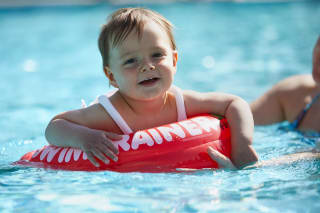
Water familiarization courses for infants and toddlers are known as 'baby swimming'. This is not about learning specific swimming techniques, but rather about the first contact with the water.
Your children thus get to know a certain sense of protection, which makes it possible for them in the future to recognize dangerous situations instinctively and act accordingly.
Before baby swimming can start, you should already prepare your children slowly for the water while bathing.
Get your children used to contact with the wet element during bathing with splash toys, rubber ducks and the like.
Only when your babies and toddlers have become familiar with this feeling on their own skin can baby swimming be considered.
The earliest time to sign up for baby swimming is when your children are four months old. From this age they can regulate their body temperature independently, which is essential for water contact.
To find the right baby swim course for you, you should go to several different trial sessions. A good course is characterized by age-appropriate, pedagogically sound, and child-safe methods.
The child's welfare is the focus and you as parents will clearly feel that. Furthermore, a suitable swimming course is characterized by not having too many people, so that the swim instructor can focus equally on all participants.
You recognize a good swim teacher above all by his abilities and his transparency regarding existing qualifications. He gives the impression of creating safety and taking parents' concerns and fears seriously.
Once you have chosen a baby swim course, you will from now on gather shared experiences that further strengthen your emotional bond.
Playfully, your babies and toddlers expand their range of movement, which at the same time trains their coordination skills. Step by step your water safety improves, which lead you towards a successful 'swimming career'.
Swimming rules for your swim training
Successful swim training is not only evident in your children being able to stay afloat independently. It already shows in the preparatory steps that include an explanation of your swimming rules. Only you yourselves are responsible for your safety while swimming and splashing. Therefore it is helpful if you repeatedly remind yourselves of the dos and don'ts for your swim lessons.
Never enter the swimming pool with a full or completely empty stomach.
Your children only go into the water when they notify you or the swim coach.
Non-swimmers only go into the water up to their stomachs. They should also be able to stand in the non-swimmer pool.
Non-swimmers stay only in the non-swimmer pool until they feel confident in their attempts to swim.
Do not run near the swimming pools!
Keep in mind that (inflatable) swimming and buoyancy aids do not provide reliable safety and should only be used as aids during swim training.
No one dunks another person under or pushes them into the water.
Children are not forced to swim. They go at their own pace.
Always observe the age restrictions and safety instructions posted at the water slides.
Also, slide only one at a time and feet first.
Once you are in the water, leave the slide area immediately.
What your kids learn in swim lessons
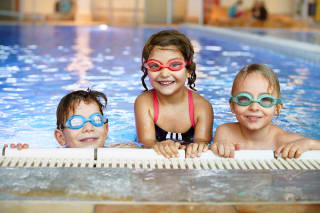
Once your kids have had their first experiences in the water, things really get going. Swim courses can already be taken between the ages of two and five completed. However, note that they can only learn the basic techniques from the age of four or five to learn. Before that, your kids are only to a limited extent able to keep themselves afloat for short periods with light crawl movements (similar to a dog's paddling).
By the age of five, their motor skills have matured enough that more complex movement sequences and basic swimming techniques come easier to them. In principle you can consider the following criteria when choosing a swim course: In a good course there are no more than eight children per supervisor. The swimming instructors do not rely on shock therapy; rather it's about empathy.Because: "Swimming lessons should above all never be associated with pressure or peer pressure." In addition, swimming teachers should convey the swimming movements in a child-appropriate way and in small, thoroughly explained steps.
To find a suitable offering for a children's swim course, it's advisable to ask around among acquaintances about experiences or attend several trial lessons at different swim clubs to attend. Your gut feeling and instincts will guide you. Let your kids have a say, after all, it is primarily about their well-being. Also, parents are allowed to accompany during trial lessons and in many clubs during the lessons and can even support their little water mice during the swimming exercises.
The contents of swim courses differ by age group. While at the beginning arm floaties and other swimming and buoyancy aids are used as support in the water, gradually, various exercises for independent swimming are added in a playful way.basic techniques of front crawl, backstroke and breaststroke to learn as well as later to work towards the "Seepferdchen" swimming badge.
In general, children need about 15 to 20 practice sessions of 30 minutes each. How long your kids actually need to learn to swim, however, varies entirely by child. After all, every little water mouse has their own learning pace to earn their swimming badge.
A rough summary of the most important steps in the course content:
Kicking
Add the arms
Train coordination
Have funi
Teaching children to swim yourself – here's how
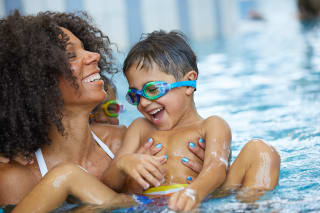
In addition to swim classes, you parents can also teach your children to swim from the age of four – provided you are confident swimmers yourselves. Because only if you feel comfortable in the water and enjoy swimming yourselves can you instill confidence in your little water mice.
Toddlers in particular pay close attention to how you parents feel about being in the water. Your enthusiasm practically rubs off on your kids.
It's also important that you project a certain calm and bring time and patience. Especially at the beginning, your children may still be very hesitant about the swimming exercises. For them to truly master the swimming techniques, it is a lot of practice and repetition are necessary. Your praise and understanding of their learning pace will support them in their development. That increases your children's motivation and leads to small and large successes in the long term.
Don't change your training location too often. That can really throw your children off course. It's best to choose a place where you perform your swimming exercises every time. Whether swimming pools, your own garden pool or outdoor pools – the decision is entirely up to you. Once your children are a bit more confident in the water, you may change locations so that first swimming outings are combined with swimming attempts. However, give your kids some settling-in time. Again: Be very patient.
It's important that you parents have all the knowledge about the right approach. The learning methods should generally be similar to those in a swim club.
Set lesson units
Similar to swim clubs, you should create a kind of timetable. Agree in advance on fixed days and times that you would like to use for your swimming lessons. Fixed and agreed-upon training times allow you to focus your concentration and attention on learning to swim – without distraction from everyday stress.
A practice session should last half an hour and be scheduled at least twice a week – this way great results will appear quickly, encouraging you to keep going.
First do dryland exercises
The swimming movements that need to be learned should always be practiced on dry land first are. Starting with the leg work and then the arm work, these routines become reinforced in your children's minds. In addition, the movements will be noticeably easier for them in the water – they are simply familiar with them.
Leg movements can, for example, be practiced on a chair. The aim is to combine leg and arm work. Once the basic movements are learned, you move on in the water.
Practice kicking – the first leg work
Now the leg work is performed in the water first. Ask your children to kick their legs in the water.
For this, they hold on to the pool edge, the body lies on the water surface and the legs are moved evenly like frog legs toward and away from the body.
Many children tend to let their legs sink down. Support them in trusting the buoyancy and balancing their body.
Practice proper breathing
If the kicking works, show your children how proper breathing works: This keeps them calm even during short underwater moments.
Teach your little water mice how to create bubbles in the water. Hold the breath, then put the mouth and then the nose underwater – that helps build confidence.
Not all children dare to attempt the exercises right away. It's best to demonstrate them at first. That way they see that nothing can happen to them.
Practice paddling (arm work)
You have learned the leg work and breathing, now the arms are added. To be able to move independently, you first practice only the arm work in the water. The sequence of movements is already familiar to you from the dryland exercises. Only after that can you slowly approach the combination of all movements and ease into it.
For toddlers it will probably be easier at first a sort of paddling to tackle before they have enough strength for precise execution. Therefore let them paddle alternately with both legs and at the same time with the arms. Now it's practice, practice, practice until they confident swimming movements perform.
Include fun and games
Boredom should not arise in your swim training at all. Always combine learning with fun water games and little splash breaks. This way your children will perceive the learning process as something positive. Motivation increases and they will want to learn more and more new things on their own.
Water toys or utensils like a hula-hoop turn dry learning units into modern learning methods that your children embrace with great joy. A big dose of fun is also well received not only by the little ones. Surely you parents will also enjoy your swimming sessions.
Swimming aids to support learning to swim
Swimming aids such as arm floaties, pool noodle and kickboard are helpful for learning swimming movements. However, they should not be used for a long time. Keep the following in mind:
Swimming aids serve when learning to swim only as aids for learning the individual movements. They should never be regarded as reliable safety devices because they can even hinder rescue in emergencies or be responsible for swimming accidents.
So consider swimming aids primarily as a kind of 'water toy', which make the first swimming attempts easier but do not replace your helping hands. As a rule, you should also make sure that the buoyancy aids comply with a specific testing standard before using them for learning to swim. The designation EN 13138-1 indicates a 'safe' swimming aid that you can use for your training sessions. Also the GS quality seal should be printed on the packaging or the swimming aid.
If you use arm floaties and the like, they should be made of two or more separate air chambers consist of. It is important that the aids have no Velcro closures or sharp edges have – this only causes discomfort for your children and, furthermore, they can come loose on their own.
Seahorse & Co.: When are children considered safe swimmers?
If your children have mastered the crawl and breaststroke well enough, they are allowed to take the Seahorse badge.
They receive the swimming badge if they manage to to swim a 25-meter lane, jump into water deep enough for swimming, and retrieve an object from the bottom in chest-deep water.
However, this is basically only a motivational badge.
After the Seahorse badge, your children are by no means immediately safe swimmers. It doesn't say much about their actual swimming ability, so children are often overestimated or even overestimate themselves. Dangerous situations can therefore still arise. Above all, because they can become very tired on longer distances after a short time.
To ensure your children are water-safe and can be called safer swimmers, you should keep at it. Continue to practice swimming regularly. Only with the Youth Swimming Badge Bronze are your children considered safe swimmers. The swimming badge indicates that they can also swim several short distances and orient themselves both above and below water.
We wish you and your children lots of fun and success in learning to swim.