When should babies learn to walk? – Useful information on development & tips
Until your little ones to take their first independent steps, a few months usually pass. The timing is very individual and depends on the developmental stage of your babies. While some children reach this milestone as early as eight months, it can take twice as long for others.
Often babies first learn to turn, sit and crawl before they discover their own walking abilities. In general, for learning to walk other physical abilities are the basic prerequisite.
Muscles still need to develop and so every step in your babies' development is something completely natural, which you should not force.
When your children learn to walk, is therefore highly individual./magazine/parenting-psychology/physical-development/developmental-stages-of-a-baby developmental stages in babies
is usually assumed:/magazine/expectant-mothers/pregnancy during your pregnancybabies test the first preparatory steps out. Because in the womb your little wonders row busily with their arms and legs. In the first eight weeks after birth they then also begin to kick
. Especially when you lift them up and their feet come into contact with a firm surface. The supposed attempts at walking are referred to as the stepping reflex
called. The stepping reflex usually disappears by three months. From the third month your babies learn to roll onto their tummy. In addition, they can thus slowly lift their little head
– entirely by their own strength. At the beginning this will only be very brief, but progressively they hold their little head up for longer to take in everything around them./magazine/parenting-psychology/physical-development/developmental-stages-of-a-baby/baby-development-month-5fifth month of life around that your children notice that they can bounce on your lap. They learn to balance on your thighs
, while you hold them upright on your legs – they enjoy it and it incidentally trains their leg muscles./magazine/parenting-psychology/physical-development/developmental-phases-of-a-baby/baby-development-month-6sixth/magazine/parenting-psychology/physical-development/developmental-stages-of-a-baby/baby-development-month-7seventh month they seem to want to accompany you on every step.. To be able to move around, they try out various movements. Thus many children in these months begin to scoot/magazine/leisure-creativity/sports-movement/when-babies-crawlkick
learn to crawl/magazine/leisure-creativity/sport-movement/encourage-baby-to-crawlto encourage crawling/magazine/child-rearing-psychology/physical-development/baby-playgroupbaby playgroups
you can now attend together.Once your children have learned to roll, sit and crawl independently, /magazine/child-rearing-psychology/physical-development/developmental-phases-of-a-baby/baby-development-month-8eight months their walking potential
. Due to their pronounced grasping ability, they can henceforth pull themselves up on furniture and other objects. The first steps then do not take long to follow. /magazine/parenting-psychology/physical-development/developmental-stages-of-a-baby/baby-development-month-10tenth month of life around many children can already cover short distances with small steps
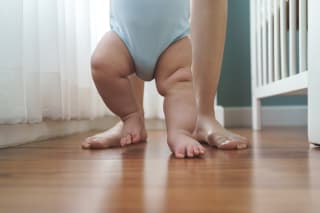
. Whether to the couch or to your outstretched arms – no distance seems too far for them, because walking is fun.
/magazine/parenting-psychology/physical-development/developmental-stages-of-a-baby/baby-development-month-13At 13 months some babies already walk without any help.Thus, in the following months the
is practiced. They also manage to get up from a sitting position to a stand on their own./magazine/child-rearing-psychology/physical-development/development-phases-of-a-baby/baby-development-month-15On average at 15 monthskick
it's then the time and your children are unstoppable. Walking becomes more and more a second natureShifting weight, balancing, gathering momentum and taking a run-up – nothing seems impossible to them anymore. With lots of practice and skill they grow into
walking toddlers . If your babies initially still have bow legs, that is not a reason to worry. The first attempts at walking just look a bit different.Climbing stairs many children only from the 16th month
. At one and a half years old they often already try out the first movement games. Playing soccer, dancing or hopping, now it really gets going. In toddlerhood they perfect their gait so that it is nearly like yours.However note that all of the mentioned developmental phases vary individually from child to child
. All babies have their own learning pace, which you can perceive in a natural way and support accordingly.Never let yourselves be influenced by other families and their milestones and
focus only on yourselves.If your child by 18 to 20 months still hasn't taken any steps, visit a pediatrician for reassurancekick
What skills does my baby need to learn to walk?
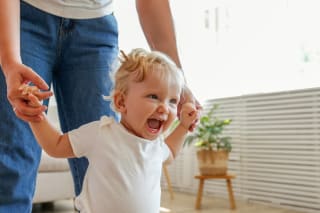
Children require various physical prerequisites and motor skills to learn to walk properly.
Their body is naturally aligned so that they develop all by themselves and thus also at their own pace become little walkers. As parents you can only support them to a limited extent.
For learning to walk, various body parts must work together perfectlykick
tendons, ligaments, bones and muscles as well as senses and nerves can only ensure a successful movement sequence through strong cooperation. Babies learn to walk by training their fingers (fine motor skills) as well as legs and balance (gross motor skills) trainkick
Of course, such a complex learning process also requires sufficient energy, a good body awareness and patience – this also applies to you as parents. The development of the mentioned body parts and abilities already begins during pregnancy. After birth, however, all of your babies' muscles are still very weakly developed. They need to be trained.
Through their curiosity and the stimuli you provide, your little ones strengthen their muscles step by step. Their back and neck muscles already develop in the first months of life so that they can independently lift their head. They learn to roll onto their tummy under their own power and finally also to scoot and to crawl. During these processes the legs become increasingly stronger and sturdier, so that they can now also bend and stand up.
For your children's muscles to grow strong and thrive, a healthy and nutritious children's diet is essential. It gives your babies sufficient energy and strength, which is also reflected in their willingness to learn.
Give your children plenty of opportunities to move actively. Your babies should develop sensory perception, by interacting with their environment. With sufficient exercise you help them to get to know their own body awareness better, so that they can maintain their balance and balance their body weight. You as parents can best assess your babies and how they react in different situations.
Generally: Babies who follow their natural urge to move learn to walk more readily than babies who do not get enough movement.
How to encourage your children's first attempts at walking
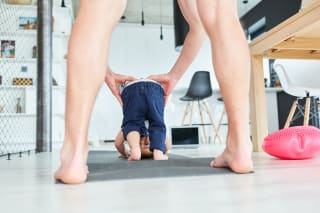
As a rule, parents cannot force learning to walk. However, there are some options and behavioral tips, which make it easier for your children to explore their own abilities.
So this is much more about increasing your babies' motivation than about supporting the learning-to-walk process itself.
Keep in mind: babies learn from successes, but also from failures. Therefore, as in so many areas: 'Practice makes perfect!' .
6 useful tips: This is how your babies learn to walk more easily
1. Give your babies time
It may take some time before your babies dare to take their first steps. Regular practice and your encouragement to move remind them, however, to continue trying things out and to attempt small tentative steps.
In the beginning, it's not about the manner of movement. Your kids should simply feel the urge to moveplayful learningNever be impatient with your children. If you remain calm and relaxed during their development process, your little ones will gladly make progress and be much more relaxed themselves. 2. Set up safe havens when learning to walkIn addition to a safe environment that minimizes the risk of injury, there are also
small homemade and cleverly devised safe haven
s for the learning process are important.The safe havens are to be understood as a small pit stop
to be understood as when your babies take their first steps and cover short distances.They offer seat cushions, stools and the like
. a chance to catch their breath, to straighten up if needed and to gather strength for the next attempt.3. Only be the helping hand when necessaryYour babies don't necessarily need you when learning to walk. At least you don't have to lift or hold them when they make their first attempts at walking.
Only give your little ones a helping hand when they signal that they need your support
. In general, your praise is your children's greatest motivation. Encourage them if it doesn't work right away and give them lots of support.First and foremost, it is important that you do not overwhelm your children and do not demand anything of them that they are not developmentally capable of yet
. For example, help them by sitting on the floor with them or kneeling beside them and encouraging them with outstretched hands to come to you. Once they have managed a few small steps, even under their own power, it will make your kids beam with pride.4. Consider the needs of your little ones Let your children decide when, how and where they want to practice trying to walk
. Your little explorers know best themselves when they need a break and whether certain exercises are simply too tiring for them.
Their attention span
is also not yet fully developed, which is why their interest in certain things wanes after a short time and they want to devote themselves to something new.That you let your babies try things out themselves
and decide for themselves motivates them and at the same time gives them a strong sense of self-worth. So, if they want a toy, you shouldn't just give it to them, but encourage them to reach it themselves.5. Fall down, get up & keep goingThe
safety
of the children always comes first. Since your little ones are still quite wobbly on their legs, you should make sure that there are no trip hazards or objects lying on the floor.In general, the rooms in which your babies practice diligently should be childproof
made. If your kids do fall down, you should motivate them to get up straight away and carry on.6. Use everyday training and walking aidsTo learn to walk, you don't need
any special aids
. Pieces of furniture like tables and sofas are your kids' favorite walking aids.They can pull themselves up on them, straighten up and try small exercises and first steps.Also suitable as training aids are
sturdy boxes, stools or
doll strollers, that can be easily pushed around the room. push walkers are, of course, also fun for the little ones.Learning to walk made easy: Explore the environment safelyOnce your toddlers have worked out how to move independently, they stop at nothing. To ensure they enjoy complete freedom of movement during their exercises and you know your kids are safe, there are
various ways to childproof your rooms.
Put everything within reach of your little ones away – especially valuable and dangerous items. This also includes heavy things that your kids can pull down. To make your rooms safe, there are various
child safety devices that you can attach to sockets, table edges and stairs. push walkersAlso pay attention to tip-resistant furniture
, so that you can allow your children to pull themselves up with peace of mind. If applicable, such items can also serve as good safe havens. You should ideally pad sharp edges and corners with foam or soft cushions. You should also remove trip hazards. Also largely avoid tablecloths so that your little runners don't accidentally pull items off the table.In general, you should always keep an eye on them
. Never let them crawl, creep or walk around unsupervised. To truly eliminate all sources of danger, it's a good idea to do the same as your children and also crawl around on the floor. This way you'll see from a child's perspective whether you need safety gates for stairs, edge protectors for table corners and covers for sockets./magazine/leisure-creativity/playing/playful-learning. So erkennt ihr aus der kindlichen Perspektive, ob ihr für Treppen Schutzgitter, für Tischkanten Eckschutz und für Steckdosen Sicherungen benötigt.
Learning to walk safely for kids – let's go!
Are baby walkers useful?
Baby walkers come in a wide variety of designs and colors. Gängelwagen, Gehfrei or baby walkers all basically follow the same concept and are characterized by a plastic frame on wheels in these, your babies sit or stand and then move themselves along by kicking their little legs.
Yet however helpful the models may seem, Gehfrei and co. are, according to pediatricians, not the optimal choice, to support children learning to walk. Because they delay the natural development of babies. The back and spine are often pushed into an upright position by baby walkers, for which they are actually not yet physically ready, so the musculature is strained incorrectly.
The consequences: Incorrect loading of the spine, foot deformities, muscle shortening and even a delayed development of walking.
In addition, baby walkers a high risk entail. Tipping over, tumbling down stairs or reaching dangerous objects with their help – with these aids your children are moving very quickly. This is often underestimated, so you can't act in time and small accidents happen even more quickly.
Learning to walk – with or without shoes?
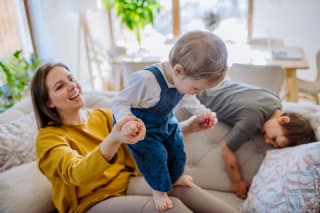
Your children should generally learn to walk barefoot first. It is a very healthy option because walking barefoot trains coordination and balance better than walking in pre-walker shoes.
Therefore let your babies walk barefoot as often as possible. This way
not least of all also the foot muscles strengthened. In addition, your little ones learn through nerve impulses to balance the body from the feet upwards. The natural sense of the body is minimal to non-existent in pre-walker shoes.
Children who learn to walk barefoot on different surfaces can balance out irregularities. The spine and also the foot muscles work together, so that the movements coordinate and eventually work automatically.
Pre-walker shoes are, however, in certain situations a
helpful support, to protect the delicate little feet of your kids. Especially on meadows with bees and thistles, cold surfaces, in public places or with minor injuries, pre-walker shoes can be beneficial for the foot health of the little ones.
Pre-walker shoes or crawling shoes should in general not be worn all day, but only for a few hours at a time be worn. At home, non-slip socks are often sufficient.
Pay attention when buying pre-walker shoes, that they have a flexible, non-slip sole and are soft and pliable. They should not restrict freedom of movement or the natural rolling motion of the feet. Ideal are shoes with a leather sole and non-slip rubber reinforcements at the heel and ball.
The first shoes you should buy when your children
already can take steady steps and now also want to explore the world outside their own doorstep. When buying, pay attention to the correct fit as well as a soft, breathable material. Children's shoes should also have a firm but not too hard sole. Secure support and freedom of movement are the motto here.
Breathable upper materials like leather (especially in winter), cotton or canvas (in summer) are best suited for the first shoes. Instead of laces, you should opt for Velcro fasteners and buckles. The fastenings are easier for your children to open and close.
The following applies to pre-walker shoes as well as children's shoes: They must
fit and allow your children's feet maximum freedom of movement. Correctly measuring children's shoe size is essential. A shoe should at least 12 to a maximum of 17 millimeters longer than your toddler's foot be, so that they can optimally roll their feet.
Frequently asked questions about learning to walk
Is it useful to learn to walk while holding someone's hand?
Why is crawling important for learning to walk?
Is it bad if babies learn to walk without crawling?
More articles about leisure & creativity


Image credits
Baby walking while holding a hand, in the nursery © eggeeggjiew - stock.adobe.com
Baby is held by both hands while walking © Evrymmnt - stock.adobe.com
Baby stands up and is supported © Robert Kneschke - stock.adobe.com
Child stands on the mother's legs © Halfpoint - stock.adobe.com