At what age can children start doing puzzles?
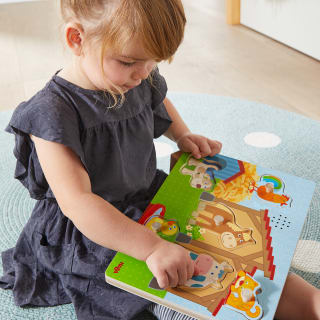
The puzzle adventure can begin for your child between 12 and 18 months – depending on their individual development in the areas of visual perception and fine motor skills. Observe your child and ask yourself the following questions: Can your child deliberately reach for objects? Does your child use the so-called pincer grasp, that is, pick up objects with the thumb and forefinger and turn them back and forth? Can your child recognize and distinguish shapes?
If you can answer all these questions with "yes", your child is at the right age to be introduced to the exciting world of puzzles. However, interest in puzzling cannot be forced. Rather, the motivation should always come from your child.
At what age does puzzling with toddlers make sense?
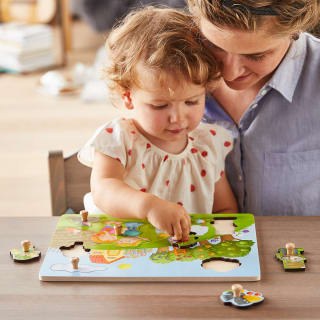
The best introduction to puzzle play for toddlers is provided by the so-called grasping puzzles – wooden puzzles with a knob, in which a picture is completed using only a few, easy-to-grasp puzzle pieces – or the so-called wooden frame puzzles, in which usually colorful motifs or larger wooden puzzle pieces are assembled into a picture. Puzzles train fine motor skills and sharpen the sense of shapes. It is important to note, however, that toddlers can usually concentrate on puzzling only for a short time. It is therefore very helpful if a parent supports the beginning puzzler during the play.
What do children learn from puzzles?
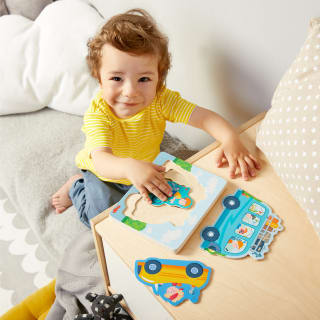
Children train their fine motor skills while puzzling, improve their eye-hand coordination and practise concentration and patience. They learn how to solve problems through strategy and structure – here through the repeated sorting of puzzle pieces. In addition, children better recognise fits and colours through puzzling. Their ability to concentrate and their memory, especially short-term memory, also increase. Perseverance and frustration tolerance are trained as well. Children’s puzzles therefore have countless positive effects on manual skills, cognitive development and visual perception. And not to forget: in the end the diligent puzzlers are rewarded with a beautiful finished picture and are proud of their achievement. Puzzling therefore keeps them mentally fit and makes them happy!
What different types of puzzles are there for children?
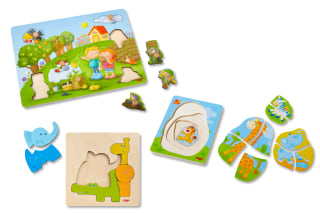
The variety of puzzles is large. Puzzles are distinguished on the one hand by their material and the motifs shown and on the other by their level of difficulty. In general: as the child grows older, the difficulty level of a puzzle also increases. This is made up of several factors: the number and size of the pieces, the level of detail of an image and its colour design, as well as the quality. There are puzzles made of wood or cardboard; the difficulty varies depending on the cut shape, thickness and flexibility of the pieces. A higher number of puzzle pieces, smaller puzzle shapes with more difficult contours and more detailed motifs make assembling the pieces more difficult and make puzzling overall trickier.
Which puzzles are suitable for which age?
Puzzling unfolds its many benefits only if the child engages with a puzzle appropriate to their age and developmental stage. To make sure puzzling is really fun, it is advisable to choose the right difficulty level. In addition, the little ones are happy when you as parents help with the puzzling – especially when it gets more difficult.
1 to 2 years / 12 to 24 months
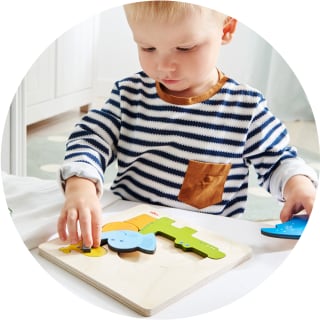
For children from one year or slightly older, grasping puzzles with knobs are ideal, as they are easy to grasp. Wooden puzzles or wooden frame puzzles are also suitable for younger children because they are robust. The difficulty level is easy: only a few shapes need to be assembled into pictures.
To spark the little ones' interest, the motifs are usually designed in cheerful colours. They show popular motifs such as animals and vehicles, specific themes like farm and construction site, or scenes from the children’s everyday life, which in turn stimulates speech development and expands vocabulary. You can also find a wide selection of suitable puzzles for this age at haba-play.com under Wooden Puzzles & Grasping Puzzles.
From 2 years
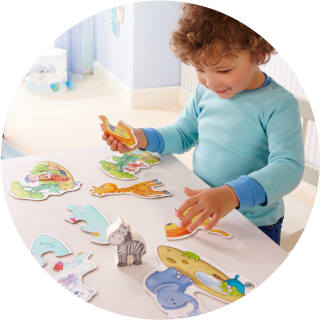
Now wooden puzzles with up to 8 individual pieces become interesting for children from two years. Some puzzles include several designs as a set with an increasing number of pieces and thus offer even more variety: one design consists of two pieces, another of three, the next of four three pieces. Experienced puzzlers in this age group already say goodbye to the wooden puzzle and move on to cardboard puzzles. Sound-grasping puzzles (with noises) are also suitable for children from 2 years. Here, children have the task of fitting the matching pieces into the correct cut-out according to the sound.
From 3 years
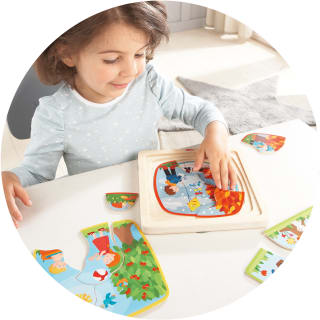
For children from three years, cardboard puzzles with a sturdy frame become increasingly interesting. They begin assembling a larger number of smaller cardboard pieces. At this age, children usually lose interest in exploring their world with their mouths, and they continue to develop their manual and visual skills. Puzzles with up to 24 pieces can be solved. When puzzling, the little ones still often proceed by trial and error.
Ages 4 and up
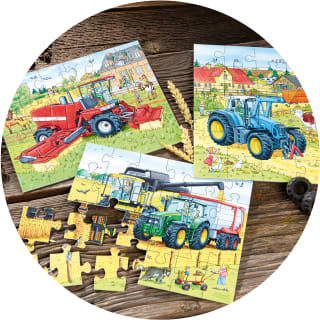
Children aged 4 and up, thanks to their accumulated puzzle experience, cope increasingly well with putting the individual pieces together — usually up to 24 pieces. Some still solve the puzzle by the 'trial and error' method, while others already take a more systematic approach. In terms of content, the puzzles can now feature more complex designs with more details. Many puzzles for children aged 5 contain around 49 pieces, but puzzles with up to 60 pieces are also manageable.
6 to 8 years
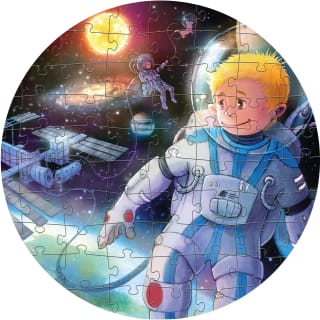
6-year-old children are already able to identify and sort the puzzle pieces according to their intended place. They have their own strategy developed to assemble the overall picture by shape and color as well as by the depicted motif. Puzzles with 100 pieces become increasingly challenging and show richly detailed scenes such as search-and-find pictures, maps, jungle and dinosaur landscapes, fantasy worlds, or outer space.
8-year-old children, depending on their previous puzzle experience, can handle 260- or even 500-piece puzzles. 3D puzzles bring the spatial component into play and train spatial imagination. However, it should always be kept in mind that the number of pieces and the difficulty level of the puzzle should be adapted to the child's individual developmental stage, because puzzling should be fun.
How else can children play with the puzzle materials?
Not all puzzles are the same. There are puzzles with play figures made of wood or plastic for free play. Usually the completed puzzle serves as the play surface. The puzzle and figure stimulate the imagination and invite children to make up stories and act them out. Some puzzles are both a puzzle and a book: children can flip through them, read stories and, as they wish, remove the included puzzle pieces from the book and put them back together. On the internet you can also find printable puzzle templates that can be cut out or cut apart, assembled and colored. Here children simultaneously practice using scissors, pencil and glue.
Where and from what materials are HABA puzzles produced?
HABA puzzles for the very young puzzle fans are made of wood and include large puzzle pieces that are easy for babies' and toddlers' hands to grasp. Wood is one of the most natural and beautiful raw materials there is. Since 2010 our wooden products have also borne the PEFC seal. It shows that we use wood from sustainable forestry.
More information about this can be found on haba-play.com under "If it says HABA on it, it's quality".
When we add color to wooden puzzles, we only use solvent-free paints and water-based stains. So babies and toddlers can safely put all our wooden toys in their mouths at any time. Puzzles for toddlers and older children are made of cardboard, which, due to its compact pressing, is also very robust and particularly stable, so that children can enjoy their puzzles for a long time. And cardboard puzzle pieces can be printed with beautiful illustrations that, in turn, stimulate the imagination.
How safe are HABA puzzles?
As with all HABA products, the quality and safety of the puzzles are very important to us and are controlled by in-house quality assurance as well as external testing procedures. The mechanical safety tests are particularly important: in template tests we ensure that the elements of toddler puzzles are large enough that they cannot be swallowed by children under three years old.
Our wooden puzzles with handles are also subjected to a soak test to ensure that no handle knob comes loose. More detailed information about HABA's quality and safety standards can be found in the section Quality.
What toys promote my child's fine motor skills and cognitive abilities similar to puzzling?
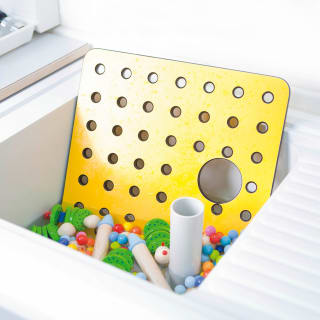
As parents, you can train your child's cognitive skills with other age-appropriate toys such as peg, stacking and sorting toys. You can find suggestions for this from HABA in the section "Cognitive development"."Fine motor skills & motor development".
Discover all HABA puzzles with your children in the product category Children's Puzzles. The youngest, from 12 months, will find a large selection of puzzles for small children's hands in the product category Wooden Puzzles & Grasping Puzzles. HABA wishes all puzzle enthusiasts lots of fun with the HABA children's puzzles!