How HABA pacifier chains are made
The anticipation of a baby is the greatest joy. And it comes with many small and large preparations – among them the question of essential baby supplies. In addition to clothing, a crib and a stroller, pacifiers of course must not be missing. One or more are usually always with you – whether the little ones are at home or on the go. If the favorite pacifier gets lost or falls and becomes dirty, tears are often inevitable. Simple relief is provided by pacifier chains made of wood or textile, which can be attached quickly and securely by clip to the little one's clothing.
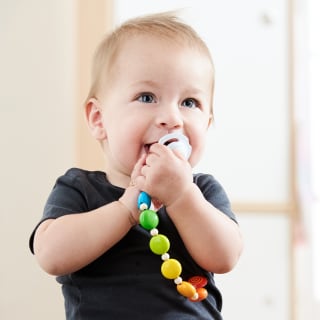
But pacifier chains are not only practical everyday companions and lovely gifts for a birth, they also playfully stimulate the senses of the little ones: the colorful pieces made of wood or textile invite grasping and thus provide first tactile experiences. Especially exciting for babies is discovering the acoustic elements such as bells or clattering plastic rings. In short: pacifier chains are small but versatile all-rounders. Their development and production, however, is much more complicated than it appears at first glance, because many months pass from the designer's first idea to the finished product that arrives at the little customers' homes.
But not only is the development of a pacifier chain a very complex process, the word itself also has a lot to it, as our extensive pacifier-chain ABC shows:
S like safety tests
C like passed chemical testing
H like high-quality wood and Made in Germany manufacturing
N like standards
U like safe
L wie lösemittelfreie Lacke auf Wasserbasis
L like many years of experience
E like baby essentials
R like raw materials from sustainable cultivation
K like child-friendly design
Elike external testing procedures
T like test, test, test
T like textiles
E like easy to attach
Idea generation with the little ones
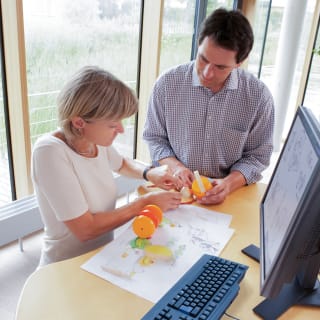
In HABA's design department many creative minds are at work. There is drawing, designing, crafting, testing and constant optimization … until the designers, as well as the product managers, are satisfied with the drafts for the new products. But before that can happen, a spark of an idea is needed – and that is different for every designer. 'I get ideas when I play with children or observe them handling things, building and stacking, knocking over or "repurposing" them. I learn a lot from that – above all, to keep or try out the child's perspective on things. I then incorporate that into my designs,' explains Mirka Schröder, who has worked in HABA's design department since 2013. Among other things, she develops products made of wood and textile for the baby/toddler sector.
Extensive testing
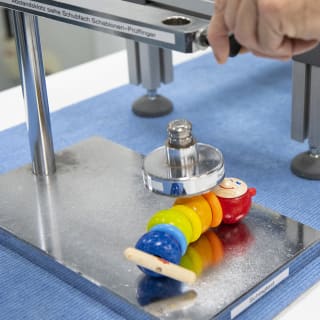
Based on sketches and construction drawings, first self-made prototypes are finally created. And already here it's: test, test, test. 'Pacifier chains, they have it in them,' says Mirka Schröder from years of experience. 'They look so simple: a few little figures and beads strung together, done. Not at all! You wouldn't believe how many different tests a pacifier chain has to pass before it's ready for production.' Even in the design department the prototypes are therefore checked not only for play value but also for safety, e.g. with template and impact tests. Afterwards the prototypes are extensively tested both by the strict in-house quality assurance and by external independent testing institutes. Every HABA product thus goes through several stages of quality assurance and is constantly optimized.
Comprehensive high HABA quality
Wood from sustainable forestry

At HABA we have a principle: toys are only as good as their material and workmanship. Therefore we pay attention to high quality when selecting materials. And we continuously check their processing – both in in-house production and at our suppliers. This also applies, for example, to HABA pacifier chains made of textile, which are developed in-house and produced by external long-standing partner companies that we carefully selected and whose production we regularly visit on site. HABA pacifier chains made of wood are manufactured exclusively at the company site in Bad Rodach.
Wood is for us one of the most beautiful and natural raw materials there is. That is why wooden products have been an indispensable part of the HABA range since the company was founded 80 years ago. The robust beech wood that we use, among other things, for our pacifier chains comes from sustainable forestry in German forests located within a radius of 150 km around our company site.
Solvent-free varnishes and stains
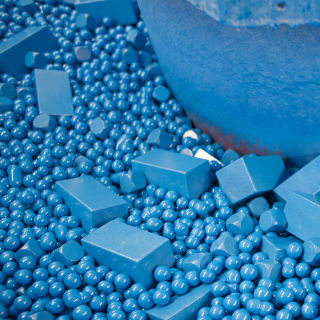
With almost all toddler toys, form and color form an inseparable unit – as with pacifier chains. The high-quality processed wooden elements only get their distinctive appearance through the bright colors and printed, loving motifs. That we use exclusively solvent-free, water-based varnishes and stains here is a matter of course for us. 'Children at toddler age explore many things with their mouths. The toy gets saliva on it and is gnawed. Everything here simply has to be absolutely safe,' explains Matthias Löhnert, responsible for product safety of HABA toys. 'All HABA toddler toys – whether made of wood, plastic, fabric or other materials – go through the strict in-house quality assurance as well as external testing procedures by TÜV Rheinland.'
Safety is a priority
Trust is good, inspection is better, says an adage. We believe: many years of experience are very good, strict controls are indispensable and utmost safety is paramount. This means that HABA products have to endure quite a lot before they reach customers' homes: chemical testing procedures for example, but also template tests and mechanical safety tests.
Template tests
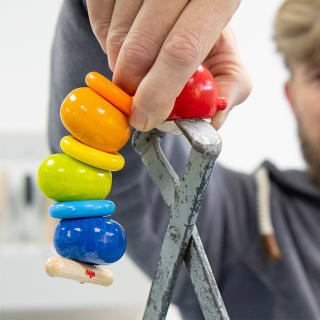
Both the HABA designers and the employees of the in-house quality assurance carry out template tests. With this they ensure two things: firstly, that the elements of a product are large enough that they cannot be put into the mouth by children under three years old and thus possibly swallowed.
Secondly, they check that elements – such as the plastic clip of the pacifier chains – always have a diameter of less than 25 mm, so that even if they get into the mouth there is no risk of suffocation.
In addition, the testers of course pay attention that the overall length of the products is chosen so that there is no risk of strangulation. In the case of pacifier chains this means: they are no longer than 22 cm.
Soak test and pull test
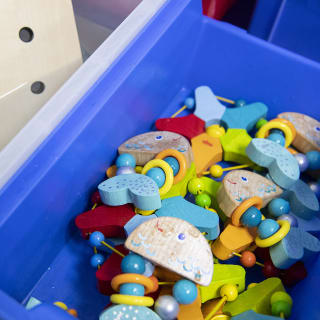
Before all tests the so-called soak test is carried out. The wooden toys or pacifier chains made of wood are immersed completely in water 4 times for 4 minutes each. Between them a 10-minute pause is taken. 'Afterwards every graspable part is pulled with a tool with 10 kg for 10 seconds,' explains Matthias Löhnert. 'The standard actually only requires 9 kg for toddler toys and pacifier chains. For us it's an additional safety aspect to add another kilo. After all the tests no small parts that could be swallowed must come loose.'
Impact and drop tests
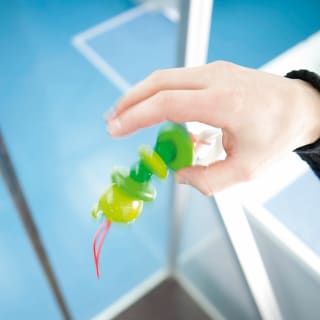
In the so-called impact test a weight of 1 kg is dropped once from a height of 10 cm onto the toy. When pacifier chains are tested, the same weight is dropped from the same height a total of 5 times. In the drop test pacifier chains – and toys in general – are dropped a total of 5 times from a height of 137 cm. With this HABA goes beyond the requirement of the European standard, which only prescribes a drop height of 85 cm, and follows the stricter US requirements. Since both the impact and the drop tests are always performed at HABA, the products have to withstand quite a lot.
Check for saliva and sweat resistance
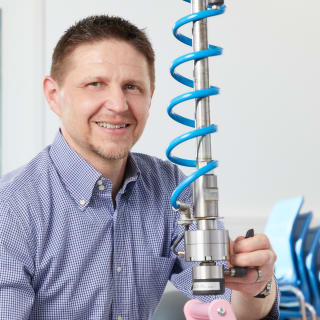
Basically, all rattles, building blocks and pacifier chains are tested for saliva and sweat resistance at TÜV Rheinland LGA Nuremberg according to DIN 53160. 'Internally we monitor the requirements by soaking a cloth with a saliva and sweat simulant and rubbing it several times under pressure over the polished wooden parts,' explains Matthias Löhnert.
Meeting all relevant standards
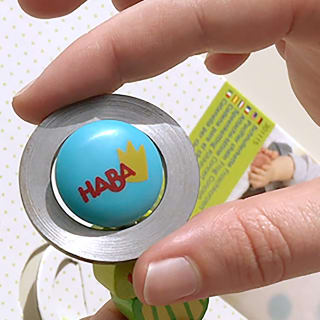
Our products comply in material and workmanship with all European and national regulations for the safety of toys and also meet the US standards, specifically ASTM Standard Consumer Safety Specification on Toy Safety (F 963).
They comply with the European Toy Directive (2009/48/EC) and meet the requirements of the EU General Product Safety Directive (2001/95/EC) and the EU standard for toy safety (EN 71). Another important standard in the production of baby and toddler products is the pacifier-holder standard EN 12586. Every HABA pacifier chain is externally tested by TÜV Rheinland.
HABA pacifier chains feature clips made of high-quality, sturdy plastic that fully comply with the applicable standards. The clips have a diameter of less than 25 mm, which means that no additional ventilation openings are required.
Other accessories for the baby
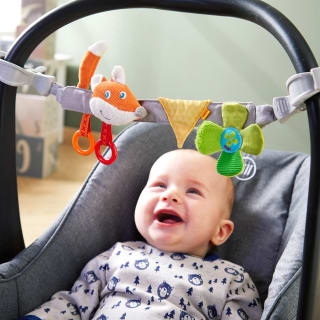
The HABA pacifier-chain ABC has made it clear: the development of a pacifier chain involves much more effort than it appears at first glance. But also stroller chains or grasping toys, play trainers or mobiles go through a lot as part of the elaborate production and testing process. But once they have successfully passed this, they can devote themselves to their real task: accompanying the little ones well through everyday life from the very beginning, entertaining them, putting them in a good mood and bringing a smile to their faces.