In-house quality assurance and external testing procedures
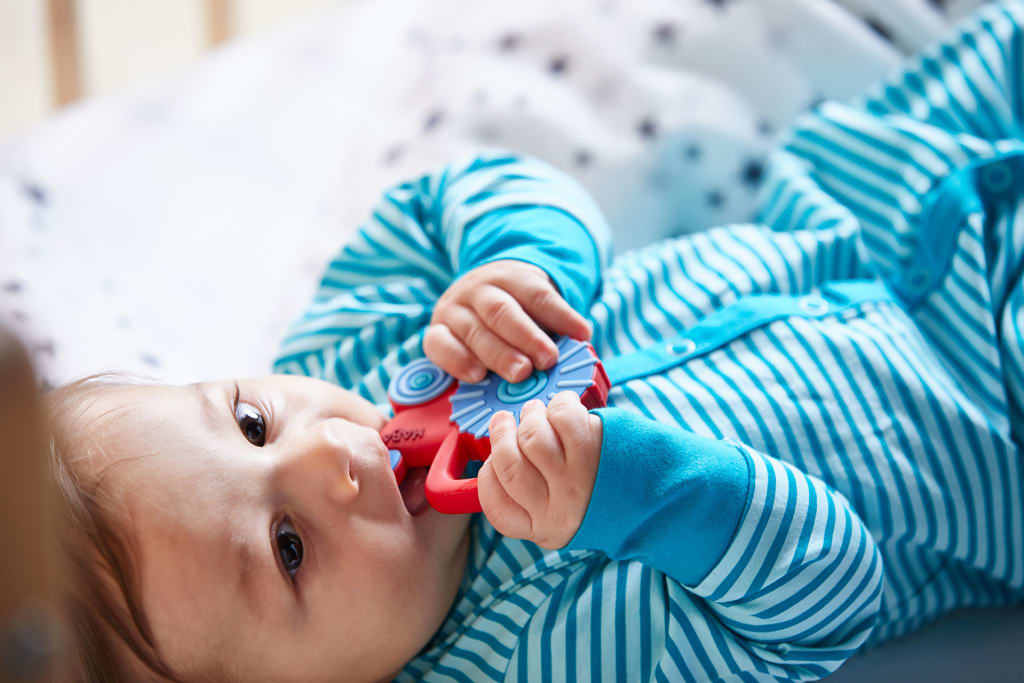
All HABA products comply, in materials and workmanship, with all European and national regulations for toy safety and also meet US standards, specifically the ASTM Standard Consumer Safety Specification on Toy Safety (F 963).
They comply with the European Toy Directive (2009/48/EC) and conform to the requirements of the EU General Product Safety Directive (2001/95/EC) and the EU standard for toy safety (EN 71). Another important standard in the production of baby and toddler products is the pacifier holder standard EN 12586. For example, every HABA pacifier chain is externally tested by TÜV Rheinland.
Testing of wooden toys
HABA wooden toys undergo both our in-house quality assurance and external testing procedures. Mechanical safety tests are particularly important. These include:
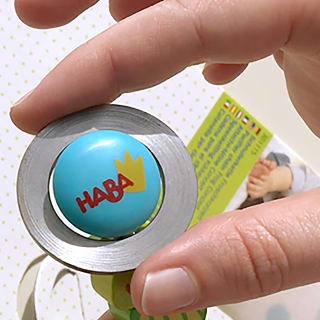
Gauge template tests:
Both HABA designers and the employees of the in-house quality assurance team perform gauge template tests. In doing so, they establish that the components of a product are large enough that they cannot be placed in the mouth by children under three years old and thus possibly swallowed. In addition, the testers of course also ensure that the length of strings or cords is chosen so that there is no risk of strangulation.
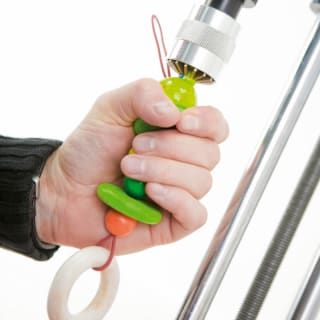
Soaking test and pull test: Before all other tests are carried out, the wooden toys first have to splash around for safety! In the so-called soaking test the toys are fully immersed in water a total of 4 times for 4 minutes each. Between immersions there is a 10-minute break. Once this test is completed, the mechanical safety tests begin, e.g. the pull test. Each graspable part is pulled with a tool weighing 10 kg for 10 seconds. "The standard actually only requires 9 kg here for infant toys and pacifier chains. For us, however, it is an additional safety aspect to add another kilo. After all the tests, no swallowable small parts may come loose," explains Matthias Löhnert, who is responsible for quality assurance at HABA toys.
Bevor alle anderen Prüfungen durchgeführt werden, heißt es für die Holzspielzeuge zunächst: Planschen für die Sicherheit! Denn in der sogenannten Einweichprüfung werden die Spielzeuge insgesamt 4-mal für 4 Minuten vollständig in Wasser eingelegt. Dazwischen gibt es eine 10-minütige Pause. Ist diese Prüfung abgeschlossen, beginnen die mechanischen Sicherheitstests, z.B. die Zugprüfung. Jedes greifbare Teil mit einem Werkzeug mit 10 kg für 10 Sekunden gezogen. „Die Norm fordert hier eigentlich nur 9 kg bei Kleinkindspielzeug und Schnullerketten. Für uns ist es aber ein zusätzlicher Sicherheitsaspekt, noch einmal ein Kilo ‘draufzupacken’. Nach all den Prüfungen dürfen keine verschluckbaren Kleinteile frei werden“, erklärt Matthias Löhnert, der für die Qualitätssicherung der HABA-Spielwaren verantwortlich ist.
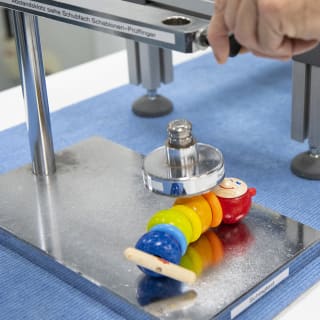
Impact and drop tests:
In everyday life, toys are sometimes flung out of the stroller by their little owners, sometimes thrown onto the floor, or struck against other toys … In short: the toys go through a lot. And the fact that they can withstand all that and much more is checked early on, long before the products reach the little customers' homes. As part of the strict quality tests, in the so-called impact test a weight of 1 kg is dropped once onto the toy from a height of 10 cm. When pacifier chains are tested, the same weight is dropped from the same height a total of 5 times. In the drop test, toys are generally dropped a total of 5 times from a height of 137 cm. In this way HABA goes beyond the requirement of the European standard, which prescribes only a drop height of 85 cm, and follows the stricter US requirements. Since both the impact and the drop tests are in principle always carried out at HABA, the products have to withstand quite a lot.
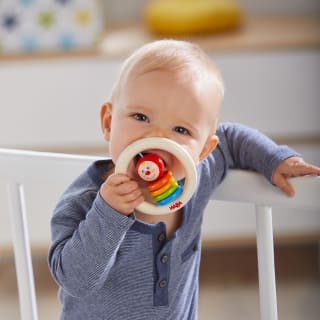
Testing for saliva and sweat resistance:
Children under three years of age explore their environment with all their senses, and of course toys are also thoroughly explored with hands and mouth. Therefore, as a rule, all grasping toys, building blocks and pacifier chains from HABA are tested by TÜV Rheinland LGA Nuremberg for saliva and sweat resistance according to DIN 53160. 'Internally we monitor the requirements by soaking a cloth with a saliva and sweat simulant and rubbing it several times with pressure over the polished wooden parts,' explains Matthias Löhnert.
Testing of toys made of fabric, plastic, cardboard and other materials
Test, test and test again … this also applies to products made from all other materials. Toys made of fabric, for example, are tested for harmful substances by TÜV Rheinland: among other things, they are tested in accordance with Directive 2002/61/EC on azo dyes (synthetic dyes). When plastics are used, the REACH Regulation 1907/2006 must be complied with. HABA's tests go far beyond the legal requirements. Products that contain parts made of cardboard and other materials are, of course, tested in accordance with all applicable regulations.