True or false? – Facts and myths about the pacifier
Pacifiers satisfy babies' natural need to suck That babies are born with a strong need to suck is undisputed. Equally true is that sucking calms them, for example when they are tired or unwell. With regard to the need to suck, the pacifier is therefore not a permanent solution but a targeted, temporary soothing measure — the same function that sucking at the breast also serves.
Babies who use pacifiers feed less well at the breast There is no medical evidence that children who are given a pacifier have difficulty nursing at the mother's breast — but there is evidence that non-breastfed babies are more likely to receive a pacifier than breastfed ones. If you are worried that the pacifier might interfere with your baby's feeding behavior, avoid it for the first period. By one to two months most babies are so practiced at the breast that the pacifier has no influence on their sucking behavior.
Pacifiers promote jaw and palate misalignments There are various studies that confirm an increased risk of jaw, palate, and tooth deformities — if a pacifier is used regularly beyond the second year of life. Whether the pacifiers are symmetrical or anatomically or "jaw-appropriate" shaped makes no difference.
Some children fundamentally reject pacifiers Not all children take to the pacifier – often the size and shape of the pacifier plays a role or it is offered too early. In the first weeks many children still have difficulty "holding" a pacifier in their mouth, so it appears as if they spit it out again.
Children who don't get a pacifier become thumb-suckers Not all children who grow up without a pacifier suck their thumbs, and pacifier babies also sometimes suck or chew on their fingers. In principle, the pacifier is preferable to the thumb because it is easier to wean. Children who suck their thumbs often still do so at four or five years of age. Therefore, when weaning off the pacifier, make sure that your child does not, if possible, switch to thumb-sucking and develop that habit.
When is the right time to wean my child off the pacifier?
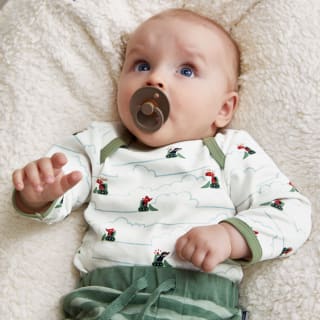
According to the German Association of Paediatricians and Adolescent Physicians (Bundesverband der Kinder- und Jugendärzte e.V.) it is recommended to wean your child off the pacifier around the seventh month to be weaned off. At six months many babies get their first teeth and the sucking reflex recedes while the chewing reflex increasingly develops. That is a good time to begin weaning. By no later than the third year of life you should have your toddler completely weaned off the pacifier.
But note that there is no single right time for weaning. Some babies still have a stronger need to suck even after six months and continue to feel comfortable with the pacifier. Just be attentive to what your child needs and feel your way together to the right time.
Our tips: How to make pacifier weaning work
Finding the right time: The weaning should not fall at a time when major changes are impending, e.g. the Settling into kindergarten or the birth of a sibling — choose a time when there's enough calm
Avoid "radical weaning": For many children the pacifier is an important part of daily life that gives them security and comfort. A radical stop is usually associated with stress — also for parents. Start the weaning as gently as possible by offering the pacifier to your child in fewer situations.
Reduce pacifier times: If you gradually scale back pacifier times, weaning becomes easier. This works from about one year. Many parents also restrict the pacifier to certain places, e.g., to the bed, to the car, or the stroller.
If possible, voluntarily: If your child is not among those who eventually lose interest in the pacifier on their own, you should still try to negotiate a voluntary giving up of the pacifier. From about two years old, children are able to consciously say goodbye to their pacifier, if weaning hasn't already taken place.

Pacifier fairy: The pacifier fairy is widespread: If the child is ready, they leave the pacifier in the evening at an agreed place. At night the pacifier fairy comes, collects the pacifier and leaves a small gift in return. This method has the advantage that your child does not give up their pacifier, but rather exchanges it. Some parents also tell their child that the pacifier fairy brings the pacifier to other 'little babies'.
Giving-away ceremony: Some parents prefer a pacifier ritual to the pacifier fairy tale. In this ritual the child can, for example, hang the pacifier on a tree, dispose of it themselves in the trash, or bury it in the garden. This way they actively contribute to weaning and always know where the pacifier is.
Offer alternatives: When the chewing reflex develops, you can give your child a teething ring as an alternative to the pacifier. This makes weaning easier and helps strengthen the muscles of the mouth.
Summary: Dos and don'ts for using pacifiers
Offer a pacifier only after breastfeeding or bottle feeding is going smoothly.
Make sure the pacifier is the correct (age-appropriate) size.
Use pacifiers only occasionally, e.g., when your child cries or as a sleep aid.
Wean off the pacifier by the child's third birthday at the latest to avoid dental misalignment.
Avoid starting weaning during periods of major change.
Make the weaning process as stress-free as possible.
Don't worry unnecessarily: children can grow up perfectly well without a pacifier and won't necessarily become long-term thumb-suckers.