How are the weeks of pregnancy calculated?
Doctors calculate the course of a pregnancy from the first day of a full cycle, that is on the first day after the woman's period. From this point, the pregnancy about 40 weeks. This method of counting makes sense mathematically, but it also means that you are de facto not yet pregnant in the first two weeks of pregnancy are. Ovulation usually occurs only at the end of the second week of a cycle. Only then can the egg be fertilized and implant in the uterus. With the absence of the first period, the woman is therefore already in the 4th week of pregnancy.

Pregnancy weeks 1-5 at a glance
Week 1 – the period
Although there is still a fertilized egg in the 1st week of pregnancy, the woman's body nevertheless prepares for a possible pregnancy. For a fertilized egg to implant in the uterus at all, the uterine lining thick and well enough supplied with blood is. In week 1 the uterus prepares through the period by shedding the old lining and building a new one.
Week 2 – the fertile phase
Even in the 2nd week of pregnancy you are not yet pregnant in purely mathematical terms. However, the woman's body approaches the middle of the menstrual cycle – this is when the fertile phase begins.
Week 3 – finally pregnant
The actual pregnancy begins at the end of the – purely mathematically considered – 2nd week of pregnancy and the beginning of week 3, when the egg is fertilized on its way from the fallopian tube into the uterus is. Less than two days after fertilization the cells in the egg begin to divide: the embryo grows. Even now it is determined whether the baby is female or male.
Note: It is difficult to say exactly when ovulation occurred. It can happen that the calculated due date may later be adjusted by the doctor if the baby appears more mature or less mature based on its size and development than it should according to the calculated current week of pregnancy.
Week 4 – the decisive phase
At the beginning of the 4th week of pregnancy the fertilized egg implants itself in the uterus. Only if this succeeds does the pregnancy continue. In many cases the egg is expelled, so the woman gets her period without noticing the aborted pregnancy. If the egg succeeds in implanting itself, a gestational sac, yolk sac and placenta form around the embryo for the nourishment of the baby in the first weeks.
Week 5 – pregnancy tests turn positive
In the 5th week of pregnancy the chance increases that already pregnancy tests from the pharmacy or drugstore detect that you are expecting a baby. This is due to the pregnancy hormone hCG, which the mother's body will now produce. The embryo has now settled comfortably in the uterine lining and is busy growing. The organ development begins and thus the heart, blood vessels, connective tissue, lungs and intestines slowly form as well as the nervous system and the sex organs from the neural groove (the midline of the germ disc) and the germ layers. The umbilical cord between mother and child is now also present. This serves to supply the baby. In addition, the expectant mother's body increasingly produces progesterone. The hormone slows the metabolism, allowing the embryo to be optimally supplied with nutrients. From now on, more physical changes generally occur.
The size of the embryo in week 5
The embryo is hard at work trying to reach the one-millimetre mark already in the 4th week of pregnancy. However, at the beginning of week 5 it is usually about 0.5 mm in size. still quite difficult to detect.What becomes increasingly clear on the ultrasound, however, is the gestational sac. It appears as a dark shadow on the image and only hints at where your little miracle is safely hidden. Within week 5 the embryo, however, grows usually up to 2 mm
in size. That corresponds to an orange seed and usually appears in an elongated shape similar to a tadpole.
Physical changes – signs of pregnancy in the motherFirst physical symptoms:
Many women already feel weak and tired at this early stage of pregnancy; some also suffer from constipation and typical nausea even now. Not infrequently, the hormonal change causes strong mood swings that are typical for the first trimester of pregnancy. Period cramps or pregnant?
Before the end of the 4th week of pregnancy you normally notice nothing of the existing pregnancy. The first physical sign is the absence of menstruation, but many women also feel a pulling in the uterus at the same time or experience breast pain or tense breasts. Seven to twelve days after fertilization, that is still in the 3rd or 4th week after the last period, there may be the so-called implantation bleeding. This occurs when the fertilized egg implants in the uterine lining and injures blood vessels in the process. The bleeding can be mistaken for menstrual bleeding, but it is usually only a few drops and lasts only one to two days. A slight pulling in the lower abdomen is completely normal.
The first month of pregnancy: This is important now Maternity record:
As soon as the doctor confirms your pregnancy, he or she will issue your maternity record. It will collect all data and information about the pregnancy up to the birth. Subsequent pregnancies are also usually documented in this maternity record. Appointment for the first ultrasound examination:
Nutrition during pregnancy: Pay special attention not to eat raw (animal) foods. These often contain toxoplasma and listeria, i.e. infectious agents. Therefore heat your food to at least 70 degrees. Wash fruit, vegetables and leafy salads even more thoroughly than you did before and avoid raw milk (products) as well as smoked foods.
Supplements: Most women take iron and folic acid supplements during pregnancy. These nutrients are essential for the health of mother and baby. It is best to have a preparation prescribed by your doctor, as over-the-counter supplements from the drugstore are often insufficiently dosed or not suitably combined. Approximately 0.4 milligrams per day are usually sufficient to support the growth process.
Hygiene: If you are cat owners, it is advisable for the expectant dad to take care of cleaning the litter box. Infectious agents that could harm the baby may also be present there.
More articles about expectant mothers
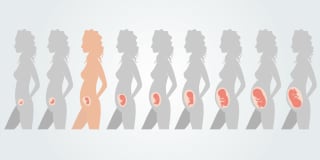
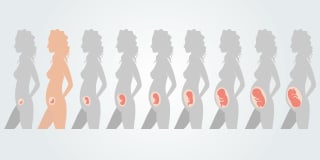
Image credits
Illustration of expectant mothers © designer_things - stock.adobe.com
Woman holding a pregnancy test © pressmaster - stock.adobe.com