Your baby's development in the 21st week of pregnancy
The concretization phase begins: Die grundsätzliche Entwicklung eures Babys ist abgeschlossen – ab jetzt muss es vor allem grow and build up fat reserves. In addition, further organs begin to take on their functions. Thus, the fetus's liver and spleen begin producing in the 21st week of pregnancy white blood cells (leukocytes), which are important for later immune defense. Your baby's kidneys now produce the amniotic fluid on their own and thus relieve the placenta of this task.
Regular sleep and wake rhythm: In the 21st week of pregnancy your baby already has a fairly regular sleep-wake cycle developed. Depending on how strongly you feel the fetus in your belly, you will quickly notice when it is taking a little nap or actively wriggling around in mom's belly.
The brain continues to develop: The development of the brain began already in the first trimester. In week 21, the first grooves, which later make up the typical structure. With the development of the brain, the your child's sensory perceptions further: It listens to sounds and voices, perceives changes in light and feels its own body.
Refined sense of taste: The theory that the mother's eating habits during pregnancy shape the child's later taste preferences is not without reason: already in the 21st week of pregnancy the fetus perceives different tastes by inhaling and swallowing amniotic fluid. Since amniotic fluid is partly formed from the mother's blood, it can take on the taste of the food eaten – so your baby already learns different tastes in the womb.
Fast heartbeat: Your baby's heart and circulatory system are fully developed and very active in the 21st week of pregnancy. You surely listened to the rapid, forceful beating at your last medical check-up? The fetus's heart about twice as fast as yours and is partly somewhat irregular – all perfectly normal for the 6th month of pregnancy.
What is visible on the ultrasound image?
The fetus is growing and thriving, which is becoming increasingly evident on the ultrasound. Your baby is now between 25 and 27 cm (crown-to-heel length) long. That corresponds approximately to the size of a banana. In addition, it has a proud weight of 280 bis 350 Gramm on the scale. Due to your child's enormous growth spurt, it no longer fits entirely on ein the ultrasound image. Therefore your gynecologist determines several reference measurements such as the length of the femur, the abdominal circumference, or the head diameter. From this, your doctor determines the fetus's weight and size. In addition, the fetus's heartbeat can be clearly heard with a fetal Doppler. This moment is always something very special for you as parents.
Physical changes – what happens to the mother in week 21 of pregnancy?
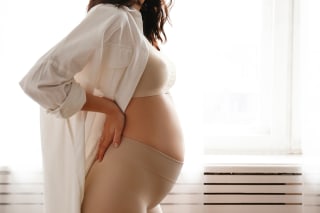
In the 21st week of pregnancy the pregnancy complaints remain manageable – compared with the first phase of your early pregnancy. Find out here what is changing in your body:
Weight gain: In week 21 the expectant mother has usually gained about 4,5 to 7 kilograms since the start of pregnancy. If your scales show a bit more, that's absolutely no reason for concern. Currently your body requires up to 500 extra calories per day, to provide your little miracle with sufficient energy and nutrients.
Colostrum forms: In addition to the belly, your breasts are also growing. In the 21st week of pregnancy they begin to produce colostrum (first milk), which can already spurt or drip from the milk ducts. The colostrum supplies your child for the first three to five days until the actual breast milk comes in.
The baby's head can be felt: In recent weeks your baby's head has steadily grown and the soft skull bones have hardened. The midwife may already feel the small head through the abdominal wall in week 21. Most of the time it is still positioned high at this point, that is, not in the birth position.
Balancing becomes more difficult: Many women in week 21 of pregnancy increasingly have difficulty standing on one leg or performing complex movements, because the growing belly shifts the center of gravity forward. Often women now have an arched lower back and walk a bit more stiffly than usual.
Stretching pains in the lower abdomen: With the growing uterus, a short, increasing pulling pain in the lower abdomen may occur. This happens when the ligaments that hold the uterus on the left and right in the abdominal cavity are stretched. However, the stretching pains should not be confused with contractions – normally the abdomen remains soft.
Back pain: The uterus and your child are steadily growing, which shifts your center of gravity further forward. Because of the weight shift many women back pain or even lower abdominal pain. To prevent these, you should increasingly wear comfortable shoes . Also heavy loads that weigh more than 5 kg are best avoided.
Sciatic nerve: Some expectant mothers complain of a stabbing pain in the buttock and thigh that spreads to the toes. The cause is the sciatic nerve. Your baby can put pressure on it. To counteract the pain, the so-called step position is recommended. To do this, lie on your back and place your lower legs at a right angle to your thighs on a chair. Heat from a hot water bottle also helps against the pain.
Does stress during pregnancy harm my baby?
In the 6th month of pregnancy most women still go to work daily or take care of household and family at home. Even without pregnancy, everyday life can be quite stressful – but can psychological stress, conflicts or sadness harm the baby? It is proven that the unborn child receives a lot of its mother's emotional life via her hormones and picks up much of her emotional life. However, during pregnancy the body develops remarkable protective mechanisms that keep psychological stress away from the baby. In addition, the fetus does not have memory in the way we know it: mood lows, outbursts of anger or bad moods therefore most likely do not have a lasting impact on your baby.
21st week of pregnancy: This is important
An occasional 'baby talk': Already in week 21 your baby can recognize familiar voices, melodies and sounds. Even after birth these sounds will give it a sense of security and help it to calm down. Therefore, in the second half of pregnancy you can more often consciously talk to your child or now and Page 5 of 5then turn up its favorite music. Your baby will soon store the sounds as familiar.
Put your feet up and listen: Taking a break more often and putting your feet up does every pregnant woman good. But from the second half of pregnancy many women look forward even more to the little rest breaks. The reason: the baby aligns its activity more and more with the mother's activity. If she is in motion, the child can be rocked to sleep and becomes noticeably calmer. If the mother lies down, on the other hand, the fetus becomes active: now you clearly feel the twitching and small kicks in the belly.
More articles about expectant mothers
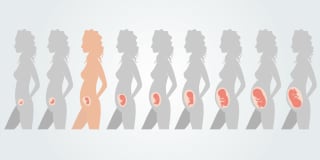
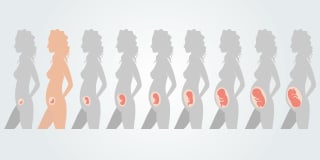
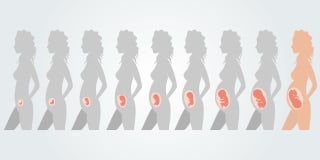
Image credits
Illustration of pregnant women © designer_things - stocks.adobe.com
Pregnant woman in front of the window © Evrymnt - stock.adobe.com