Your baby's development in the 35th week of pregnancy
Own immune system:For several weeks now your baby has been increasingly supplied with antibodies from the mother's blood. In the 35th week of pregnancy its immune system now functions independently.However, the immune defense is still relatively vulnerable, and even after birth you provide your child with antibodies through breast milk.
Meconium:Your baby practices its swallowing reflex with the amniotic fluid. Although the fluid is completely renewed every two hours, skin and hair cells as well as vernix float in the liquid and are swallowed by the fetus. They collect in your child's intestines as meconium or mekonium This sticky, almost black mass builds up and is gradually passed by your baby shortly after birth.
The pupils are trained: Only during the first year of life does your baby's full vision develop.However, in week 35 of pregnancy the pupils already respond better to light. They constrict or dilate depending on lighting conditions. In week 35 your child learns to focus on objects and bring them into sharp focus.
Energy for the first days: Your baby has gained a lot of weight in recent weeks. In the 35th week of pregnancy it weighs approximately 2.5 kg.This is mainly because the fat pads under the skin have been filled to regulate body temperature. In addition, the fetus needs the fat stores as an energy source for the first days.Breast milk will provide enough, but the portions in the first days are still relatively small – matching the size of your baby's stomach.
What can be seen on the ultrasound image?
Compared to the 34th week of pregnancy your child now has a full 300 grams more in weight. So it has now broken the 2.5 kilogram mark and gained a good amount of fat reserves. Currently your baby is about 46 cm long. This corresponds approximately to the size of a honeydew melon.A few weeks ago you could still clearly perceive your child's movements on the ultrasound, but the movements are now noticeably weaker. Space in your belly is becoming increasingly limited, so you now feel your baby's reduced exercises more through the abdominal wall.
Physical changes – what happens to the mother in week 35 of pregnancy?

Pregnancy complaints do not cease in week 35 of pregnancy either. Besides the usual symptoms such as shortness of breath and heartburn the tugging in the lower abdomen increases noticeably in most women. Pre-labor contractions are among the usual complaints in the current week. The following gives you an overview of the different physical changes in week 35 of pregnancy as well as the types of contractions and how you can distinguish between them.
Bladder weakness:Bladder weakness is caused by the increasing pressure of the uterus on the bladder. With the occurrence of lightening contractions, the uterus and thus your child are pushed further into the pelvis. The pressure on the bladder increases and its capacity decreases. You now have to go to the toilet more often because your bladder fills.
Circulatory problems: The pressure of the uterus on the large vena cava, which supplies the heart, can limit its work. The consequence: temporarily less oxygen and blood are pumped through the body and your circulation becomes unstable.
The different types of contractions
Braxton Hicks contractions:You already know these practice contractions. They usually occur from the second trimester and are noticeable by a hardened abdomen. The slight tugging in the lower abdomen is comparable for many women to menstrual cramps. If the pains are more severe, it's best to discuss them with your gynecologist.
Lightening contractions:Lightening contractions bring your baby into the correct position for birth. They usually occur at irregular intervals – often even unnoticed.
Preterm contractions: This type of contractions sometimes occur even before week 35 of pregnancy and are a sign of preterm birth. Many women find it difficult to distinguish these from pre-labor contractions. If you experience pain at regular intervals or have frequent bloody or watery discharge, contact your midwife or your doctor to get to the bottom of the cause and initiate appropriate measures.
Opening contractions: As the name suggests, opening contractions initiate labor. You can recognize them by their occurrence at regular intervals. At first about every 10 minutes, later about every one and a half minutes. In the end they are also significantly more intense than the previously known pre-labor contractions.
Pushing contractions:Pushing contractions generally follow the opening contractions. With the help of pushing contractions, the mother manages to push the little miracle out of the birth canal.
Afterpains:Afterpains are caused by the expulsion of the placenta and only occur after your baby has already come into the world. They usually last around 10 to 15 minutes. The pains feel considerably weaker.
More articles about expectant mothers
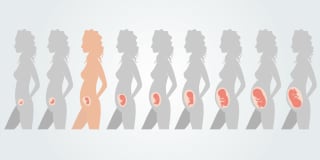
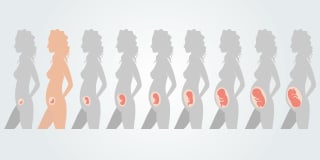
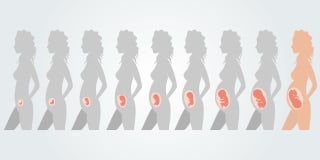
Image credit
Illustration of pregnant women © designer_things - stock.adobe.com
Man taps the pregnant woman's belly at sunset © kariochi - stock.adobe.com