More fun in personal care with child-friendly 'helpers'
A well-thought-out organization in the bathroom saves unnecessary searching. A fixed place for toothbrushing items, for washcloths, soap, shower gel, towels and also for dirty laundry helps keep things tidy. Sounds boring? It's not!
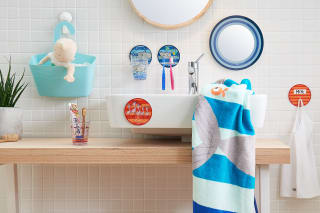
Child-friendly, pretty, own bathroom helpers encourage children to personal care. With colorful toothbrush cups, towels with funny designs, and little tidy-up helpers for small items from hair ties to nail scissors, the bathroom achieves the balancing act between comfort and function.
Not boring at all: Set routines ease the load
Rituals, habits and rules in the bathroom make everyday life simpler and free your mind. A painted plan, a picture collage or simply a list with symbols helps children get familiar with the routines and keep things tidy:
Don't leave dirty laundry lying around; put it straight into the laundry basket,
Rinse the toothbrush after use and place it back with the head up,
Screw the toothpaste tube closed and put it back in its place,
Put the hairbrush away after use,
Towel hang up after drying,
Close the toilet lid.
Worth a try: Let them do it themselves
Children are all the more engaged the more they are allowed to do themselves. That's why things work best in the bathroom when they find the 'ingredients' for getting clean within reach. Depending on the age of their little ones, parents will have to check and scrub afterwards. But eventually it works independently, relieving moms and dads.
O•O Hack: To-do help for independent kids
We also have an O•O hack ready for your routine: the DIY Velcro strip cantransform morning routines! Each child gets their own and may decide what it looks like and which order the to-dos like getting dressed, washing, breakfast, toothbrushing, etc. are on it. Well, putting on shoes and jacket should perhaps always be at the end of the strip …
We have a downloadable document with lots of pictures for important to-dos for the whole day that you can print out and use to craft the strip(s). Of course each child can also draw their own pictures. The important thing is to involve the little ones in designing their strips, because only then does implementation work. From then on the kids are responsible themselves: If a to-do is completed, they flip over the corresponding picture on the strip — until only checkmarks are visible. Ready for takeoff!
Since the Velcro-strip era, our kids are in the mornings ready in no time.Independence and a blessing for the family peace.
You'll need:
one sheet each of red and green construction paper
Scissors and glue
small self-adhesive Velcro dots
Symbol pictures for your personal to-dos – from our download or drawn by yourselves
Markers or crayons for coloring the symbols
Of course other paper colors and coloring materials can be used. Be creative and feel free to show us how you designed your 'check-it-off strip'.
Here's how:
Print out the to-do pictures and the checkmarks.
Think about how your day/morning/afternoon/evening goes and decide the order of the to-dos.
Cut out the to-do pictures that apply to you and the same number of check-boxes. If your construction paper isn't enough for all your to-dos, simply make a second 'check-it-off'.
Fold the green paper in half and glue the red on the back. Tip: So that the finished 'check-it-off' can be folded over easily, you can cut the red paper in the middle, shorten both parts by about 1 mm, and glue them separately to the inside of the folded green paper.
Now glue the to-do boxes as straight as possible onto the red inner part (bottom). Warning: Leave a little space between the boxes so you don't cut anything off when you make the cuts later.
Once everything is glued on, carefully cut from the edge to the fold line with scissors.
Since you have now divided your individual to-do snippets, it's easier to place the checkmarks on the (green) outer side. Important: So that when folded later the checkmarks appear the right way round, they must be glued upside down when attaching them.
Almost done! Now just stick on the Velcro dots. Tip: Stick one side of the Velcro dot on first, place the counterpart on it, and then simply fold the card over. That way you're sure that both sides of the Velcro dots line up.
Extra tips:
Laminate the strip if possible. That way it survives chocolatey fingers and toothpaste splashes.
Instead of Velcro dots, you can attach colorful snap buttons with a snap press.
Do the children prefer to keep the strips with them instead of hanging them up? That works too and saves trips. However, this also increases the risk of occasionally having to search for the strips.
When the sense of time is missing
'Hurry up, we have to leave soon!' – Children only gradually understand how long five minutes are or what 'soon' and 'in a moment' mean. And the fact that mom and dad need to be at work at 8 doesn't interest them at all when they're trying out how high they can build a tower.
A consistent morning routine can help with a stress-free start to the day. Parents can also discuss with small children how the time between getting up and leaving should be spent.
Who needs how much time in the bathroom and when?
A little planning is necessary. Then everyone gets their turn. Some moms or dads like to get up before the rest of the family so they can have the bathroom to themselves in peace.
If things always grind at the same time in the morning, family members should think about other arrangements: Teenagers can get ready in their rooms, two people can brush their teeth at one sink, hair can be combed in the hallway. And kids who are slow to get going in the morning need more time, which parents should factor in.
When to brush teeth in the morning?
By the way, good to know: Those who like to start the day with something sweet should brush their teeth after breakfast. Those who prefer fruit or orange juice, that is something acidic, should reach for the toothbrush before the first meal of the day. Otherwise you would gradually wear away your tooth enamel over time.