How do you design the nursery to be practical and child-friendly?
Expectant parents eagerly await this day: your baby is born and moves into the lovingly prepared nursery. Don't stress about the furnishings of the nursery, because at the beginning your sensitive babies don't need much except mom and dad. Especially in the first months you don't have to set up a separate room for your baby yet.
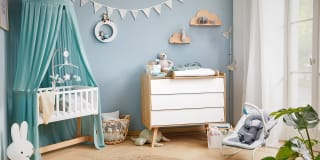
If you still wish to set up a cozy room for your little one even before birth, you'll find here the basic equipment for the nursery:
Crib
Changing dresser or changing table
Closed diaper bin
Warming lamp
Wardrobe
Play mat
Baby monitor
Especially in the first weeks of life your newborn doesn't need much more. Elaborate decorations aren't noticed by the baby anyway. But over the first months many parents find that additional furniture and fittings not only make life easier, but also make the nursery more child-friendly.
Thus, a cozy armchair the ideal seat for a cozy corner: Here you have a quiet spot for nighttime breastfeeding or feeding and also for reading aloud. A nice wall color or wall stickers add playful eye-catchers, while storage boxes and a shelf help keep things tidy and offer extra storage. Also the lighting and the flooring play an important role when it comes to designing the nursery to be practical and child-friendly.
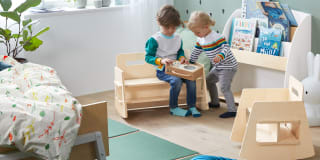
If your baby is one to three years old, you can slowly but surely convert the nursery into your toddler's own realm . Because now your little rascal wants to play, craft or paint alone. They often like to retreat to their own room to immerse themselves in an activity. Now it's also a good idea to integrate some age-appropriate toys into the children's room. That way your little one can grab something whenever they feel like it and play.
Furniture that grows with your child – furnishings for every age
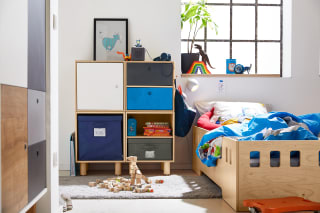
Beds, rugs, furniture – all of this usually costs quite a lot when setting up children's rooms. Our tip: Opt for grow-with-the-child furniture, because your children grow quickly and without adaptable furniture it can take a toll on your wallet. From beds, which can be converted from a baby crib to a toddler bed and later to a child's bed, to height-adjustable chairs and tables up to expandable wardrobes with lots of storage – this way you not only save costs, but also adapt the furniture flexibly to your kids.
Just as quickly as your children grow, their tastes often change too.If green was still the favorite color yesterday and a visit to the farm the biggest adventure, tomorrow the circus or the color red may already exert an irresistible fascination on your child. That should of course be reflected in the children's room. Therefore consider whether it should really be blue furniture or red shelves in the children's room or whether it might be more sensible to opt for neutral furniture instead. You can complement these with a few accessories in the current favorite color
or a large poster.Another furnishing idea for an adventurous playroom are climbing frames and play towers. This lets the little climbers move inside the room and promotes their motor skills. And the best part: these can also be easily adapted to your kids' needs. For more relaxing days you can also hang a hammock or a hanging chair
from the ceiling. Secure them well so that your little ones don't get hurt. Even older kids will still enjoy relaxing here.
Designing the children's room: colors, walls, storage & decorWhen designing the children's room, a theme when furnishing it. Does your child like to play outside in the forest? Do they prefer to imitate a dangerous dinosaur or dive into the magical world of mythical creatures? All of these are good clues for designing the children's room. Here you will find great .
tips and ideas for designing the children's room together and individually
How can children help design the children's room themselves?Depending on your child's age, the requirements for the children's room. While newborns don't need elaborate decor and a changing dresser and a baby bed are completely sufficient, older children demand older children more and more a sayOur tip: in. That's a good thing too, after all your child should feel comfortable and be able to express themselves in their own four walls. Include hobbies, favorite animals or heroes into the design of the children's room. Then the kids will feel acknowledged and understood by you. Take your child along on the adventure "new children's room" from the very beginning: browse catalogs together, stroll through furniture stores and get inspired. If your child is allowed to choose the bed, toys or the photo wallpaper themselves
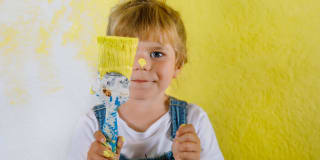
, they will certainly be pleased.A little bit of crafting for the wall decoration should not be missed either: With a bit of creativity, great pictures and deco ideas emerge that your child can paint or craft themselves. A nice idea for older children and teenagers is, for example, an own painting on the wall
. And here's how it works:
You need:
Projector
Template to trace, e.g., with an animal motif or idol, preferably as an outline
Pencil
Wall paints, in various colors according to taste
Here's how:
Red, yellow, green – what color should we paint the children's room?
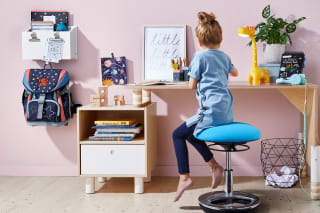
Baby blue for boys, pink for girls? When it comes to wall color in the children's room many people initially think of these "typical" colors. However, as parents you have the entire color palette at your disposal – depending on your child's taste.
Color choice: Gender-neutral colors like yellow or green are becoming increasingly popular. With your color choice you achieve different effects: While red tends to be stimulating, yellow or orange charm with friendliness. Green and blue give the room a calming effect. Although pastel colors are very popular with parents, your kids prefer bright colors, which you should respect. Our tip: Feel free to orient your color choice on the theme of the children's room – for example green for a jungle and blue for the underwater world.
Repainting: When repainting the walls, keep in mind that you will have a hard time painting over very strong wall colors you can. If your child no longer likes the color at a later time or you have to repaint the wall white because of a move, this can entail costs and effort for you.
Low-emission: Almost all wall paints contain solvents or plasticizers that release pollutants into the environment. Especially when decorating the children's room, opt for a low-emission wall paint . These are marked by the Blue Angel ecolabel labelled.
Right to have a say: Sure, in the nursery the little ones can't have a say yet. But the older your child is, the more it should be allowed to be involved in the furnishing of the children's room have a say can. So include your child also in the choice of wall color . After all, it's their own space and they should feel comfortable with the wall design.
Change of mind: Remember also that children's tastes change quickly, and that applies to favorite colors too. Our tip: Paint the room in a neutral color and accentuate with the furnishings and accessories such as cushions and curtains to add color accents. These can be easily replaced, you're more flexible in design and have less effort when painting the walls.
Wall design in the children's room: How to get the most out of the room
When it comes to decorating the walls of the children's room, it also depends on the size of the room . Because colors influence how big or small a room appears. If your child has a rather small room, we recommend using a lighter wall color . This makes the room appear much larger and calmer. In larger children's rooms help bold colors ensure that your kids' domain feels cozier. Here it's advisable to create a cozy corner and integrate it into the color concept — that makes the snug room perfect. Make sure the colors match each other and create an inviting atmosphere.
Not only the color is decisive for a harmonious overall look in the children's room — there are also other furnishing ideas with which you can decorate the walls. Try wall decals or photo murals as an alternative to paint. That way you bring a special and individual touch to the room. Also with posters or pictures you can easily personalize the walls: How about a poster of your child's favorite animal? Or a lovely family photo? Anything your child likes can be hung up.
Our tip:Set up a gallery of self-painted pictures of your little artists. That stimulates imagination and new ideas and also makes them very proud. In addition, chalkboard paint is well suited for spontaneous doodles and artworks. Here your loved ones can let their creativity run wild to their heart's content.
What children's room decor can I make myself?

If cuddly toys and toys on the shelf are already great eye-catchers, you don't need any decoration in the children's room at first. But with as they get older, all children want a bit of decor.So why not combine practical with beautiful? Whether it's a height chart or a coat rack, many furnishings you can craft together with your child yourself
.
You need:
cardboard storage boxes
coloring templates of a favorite motif, e.g. knights, horses, animals
colored pencils or felt-tip pens
scissors
craft glue or decoupage glue
sponge
How to:Depending on the child's age it can color the templates on its own
Our tip: – or needs a little support. Then cut out the motifs and attach them to the box with craft glue. Let dry thoroughly. If you want to work with the napkin technique, prime the box preferably in a light color. When the paint is dry, carefully remove the first layer of the napkin. Spread a thin layer of decoupage glue on the box and let it dry slightly. Now place the napkin on the box and press it down firmly with a sponge.
Work from the inside out to avoid tearing. Finally, coat well with glue once more, as this seals the motif and makes it last especially well.
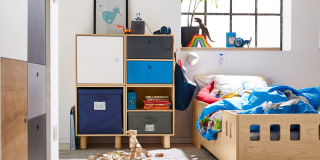
Space-saving ideas for small children's roomsThere's often chaos in the children's room, all parents know that: piles of clothes mix with building blocks and children's books, the school notebooks are hard to find under the drawing supplies on the desk. With the help of boxes, drawers and bins you simply create storage space and use the space in the children's room effectively. At HABA you will find a variety of storage options for more order in the realm of your little adventurers. And the best: your kids can tidy up their toys independently
, because sorting with boxes is easy. For particularly small children's rooms, it's advisable to make use of the room's height. With a loft bed you even create more storage for your kids: under the bed there's space for a desk, toys, clothes or a small cozy corner. Additionally, there are also beds with additional compartments, with which you can get chaos under control with ease.
Cozy atmosphere in the children's room: So that your little ones feel comfortable
The most important thing about the children's room is that the little inhabitants have their own space, can design it as they please and feel comfortable in it. As parents, you can easily ensure this by bringing coziness into the room.
With these furnishings you can create a cozy atmosphere in no time:
teepee, hideout
bunting
Plants (non-toxic plants like spider plants)
How long can siblings share a children's room?
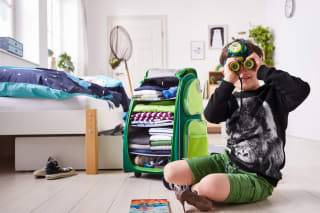
If siblings share a room, as parents you can do a lot to make the time together in the children's room harmonious. Pay special attention to the age and age difference of your children so that everyone feels comfortable:
0-6 years: At this age children learn to get along well and, through being close, learn to be considerate of each other and also to argue. The variety of play options provides lots of fun.
7-10 years: Playing together, doing homework together: at this age a shared room helps to master the new challenges of school. At the same time, children also need the opportunity to withdraw and recuperate.
11-14 years: After primary school, many new impressions flood in with secondary school. A sibling room offers security here. However, the onset of puberty can lead to serious conflicts that make separating the rooms necessary.
After the age of 14: The self-discovery phase of puberty makes having one's own room indispensable for teenagers. The ability to close the door behind them is enormously important for development.
Children's room for two: tips for design
With two children in one room, it's important to think about the room layout. For more space in the room, a bunk bed is recommended. It also offers a variety of play possibilities. So that everyone has their own corner and retreat has, you can work with room dividers . Suitable for this are, for example, open shelves that also serve as storage. This gives each child their own area in the room and helps them learn to respect the space needs of the other child.
From the children's room to the teen room
As soon as children become teenagers, the era of cheerfully colorful children's rooms is over. A cool teen room is needed! Here are our Tips on how the 'transition' can be achieved simply and easily:
Right to have a say
Just don't make decisions behind the teenager's back! Usually the tastes of parents and children differ particularly in decoration and design matters. And after all, kids aged 12 and up spend most of their time in their room – not you as parents. So choose new furniture together, Accessories and wall colors together and leave the decision, as far as possible, to the young female or male occupant of the room.
Versatile furniture
When furnishing the children's room, it's sensible to choose some furniture so that it will also appeal to a teenager. With simple curtains, white dressers and shelves and plain lamps you can't go wrong and can also use them later outside the children's room.
Fresh paint
Fresh paint on the wall goes a long way when it comes to the transformation from the children's room to the teen room. Also here applies: the youngster has Right to have a say and may choose the wall color themselves.
Different individual areas
What already makes sense in the children's room should also be implemented in the teen room. No matter how small the room is – a division into separate areas such as sleeping area, seating corner and workspace brings order and clarity to the teen room.
Allow individuality
During their teenage years, adolescents are fully occupied with finding themselves and their individuality to develop. Therefore children also want to express themselves in their room, which you should enable them to do. Leave decorations and accessories entirely to your child. After all, posters, vacation souvenirs, comics and other decorative motifs can be quickly and easily swapped again when tastes and hobbies change.