
Sun protection for babies and children
How to reliably protect your little ones' sensitive skin
Children love being outside in summer and enjoying the warm weather while playing, romping and swimming together in the sun. This creates memories that last a lifetime – unfortunately sometimes for the sensitive skin of your babies and children as well. Every sunburn causes lasting damage. We've put together how you can best protect your children from the sun and heat.
Children's skin is very sensitive
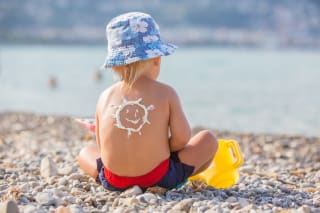
The skin of children and babies is many times thinner than adult skin. In addition, it does not yet produce enough melanin, which is responsible for the skin's natural protection. Therefore, good sun protection for babies and children is a must, especially in summer!
Checklists with effective sun protection tips for babies and children
Basically: the younger children are, the more cautious you should be when dealing with the sun. Shade is the most natural sun protection for your child: especially at the beach or in the garden a spot in the shade is important.
The most important sun protection rules for babies
In the first year of life, babies should not be exposed to direct sunlight under any circumstances! Avoid bright direct sun even when using sun protection such as an umbrella or a sunshade.
Otherwise there is a risk that the child will overheat.
Sunscreens should be avoided for babies under one year, as it has not been sufficiently studied how chemical UV filters affect sensitive skin.
Keep your baby fully clothed even in the shade and choose sun-protective clothing.
The most important sun protection rules for children
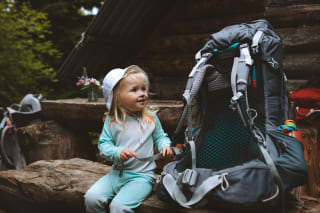
Baby and children's skin needs time to get used to the sun. Start in the warm season with short periods of sun exposure and also pay attention to UV protection in spring.
Avoid direct sunlight and stay indoors or at least in the shade between 11 a.m. and 3 p.m. During this time UV radiation is three times as intense as during the rest of the day.
Make sure your children's clothing lets as little UV radiation reach the skin as possible. For this, use preferably UV-protective clothing with as high a sun protection factor as possible (at least 40). If you don't have UV-protective clothing, dress your child in dark rather than light clothing, cotton rather than synthetic fibers, and dry rather than wet clothing. No more than arms and legs should be exposed to the sun.
Carefully apply sunscreen to your children's uncovered skin areas – even in the shade – and use a child-appropriate sunscreen with a high sun protection factor (SPF). Also apply the rest of the skinevenly and regularly (especially after every bath).
Protect children's eyes with sunglasses. Look for certification marks such as the CE mark and UV 400.
Watch for medications that your child is taking, for side effects in the sun.
Only from the age of 15 does the skin develop the necessary natural protection. However, UV protection should always be a high priority for both children and adults.
Apply sunscreen correctly for the best sun protection
If your child plays in the blazing sun, proper sun protection is essential to protect their sensitive skin. With sunscreen you protect all areas of skin not covered by clothing, for example the face and ears, neck, hands and feet. If your little one is only wearing swimwear, then of course also the torso, arms and legs.
Which sunscreen is right?
Choose sunscreen carefully and check whether your child tolerates it. In general, especially suitable for sensitive children's skin are sensitive creams and lotions, because they provide the skin with more moisture than, for example, gels. Thinner sunscreen sprays are practical, but after a single application they do not provide the same protection as a cream – here you have to spray two to three times and spread the cream well.
Make sure to use sun protection with a high or very high sun protection factor (SPF) of 30, 50 or even 50+. The SPF describes how many times longer your child can stay in the sun without reapplying sunscreen. With an SPF of 30 your child can, for example, stay in the sun 30 times longer. The sun protection factor is multiplied by the natural protection time, which depends on skin type.Still, it is recommended to apply a new layer of sunscreen at least every two hours – that way you're on the safe side.
In addition, the sunscreen should protect against both UVB and UVA rays and ideally water-resistant so you don't have to reapply sunscreen to your child immediately after they jump into the water.
Important: Avoid applying sunscreen to babies if possible and preferably keep them out of the sun. Baby skin is particularly sensitive and may therefore not yet fully tolerate sunscreens. If necessary, together with your pediatrician, you can carefully try options after your baby's first year and see which sunscreen is suitable.
Sun protection clothing for children
Why is sun-protective clothing a good idea?
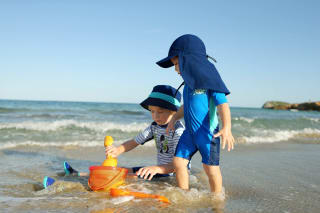
Sunscreen offers good protection against UV radiation. However: sand and clothing can rub the cream off and sweat and water can partially wash it away. In addition, reflection of the rays on water and light-colored sand increases the UV exposure. To guarantee reliable protection with sunscreen, it must be checked constantly and reapplied. And some areas, such as the scalp and eyes, cannot be protected with cream. Therefore, the most effective protection — besides seeking shade — is functional sun-protective clothing 'from head to toe'.
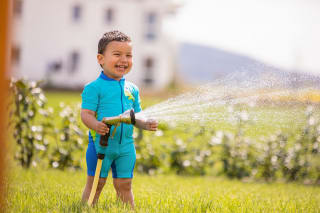
Sometimes your children simply want to be outside without special clothing or the hassle of applying lotion. Also, when you're out and about you don't always find a shady spot to escape the sun. But conveniently there are some effective sun-protection solutions, with which you can provide pleasant shade both at home and on the go.
Shade sails are, for example, recommended for your garden or terrace and create large, shaded areas where the air can still circulate wonderfully, preventing heat buildup. Different shapes and sizes ensure there's a suitable solution for every home. Shade sails can be attached between trees or house walls using carabiners. Sun tents are the perfect solution for a trip to the beach, but they also bring that holiday feeling to your garden. For walks with a stroller, small sun covers are suitable; they keep drafts and sunlight away so your baby doesn't start to sweat. On summer car journeys, a simple car sunshade on the window helps to reliably keep harmful UV rays out.
What are the different skin types?
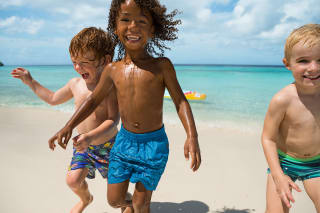
Our skin type overview shows which different skin types there are and what the corresponding natural protection time of the skinis. Please also note: Since in children up to 15 years of age the light callus, i.e. the skin's natural protection, is not yet fully developed, the result of the following skin type determination in children is very, very limited and only provides a rough orientation.
Please consult a dermatologist to reliably determine your child's skin type!!!
Skin type I

| Description | Sunburn | Tanning degree | Natural protection of the skin |
|---|---|---|---|
| Skin: very fair, extremely sensitive skin Freckles: very common Hair: reddish Eyes: green, blue, rarely brown | always severe, painful | no tanning, skin peels | 5 - 10 minutes |
Skin type II

| Description | Sunburn | Tanning level | Natural skin protection |
|---|---|---|---|
| Skin: light, sensitive skin Freckles: frequent Hair: blond to brown Eyes: blue, green, gray | mostly severe, painful | little tanning, skin peels | 10 - 20 minutes |
Skin type III

| Description | Sunburn | Tanning degree | Natural skin protection |
|---|---|---|---|
| Skin: light brown Freckles: none Hair: dark blond, brown Eyes: gray, brown | rarely, moderate | good tanning | 20 - 30 minutes |
Skin type IV

| Description | Sunburn | Tanning degree | Natural skin protection |
|---|---|---|---|
| Skin: brown Freckles: none Hair: dark brown, black Eyes: blue, brown to dark brown | hardly | rapid and strong tanning | approx. 45 minutes |
Skin type V

| Description | Sunburn | Tanning degree | Natural skin protection |
|---|---|---|---|
| Skin: dark brown Freckles: none Hair: dark brown to black Eyes: dark brown | rare; slightly sensitive skin | none | none |
Skin type VI
| Description | Sunburn | Tanning level | Natural skin protection |
|---|---|---|---|
| Skin: dark brown Freckles: none Hair: black Eyes: dark brown | very rare; not very sensitive skin | none | approx. 60 - 80 minutes |
Discover more articles about everyday family life






Image credits
Baby wearing swimwear in the water © moofushi - stock.adobe.com
Child with sunscreen on their back © Tomsickova - stock.adobe.com
Child next to a hiking backpack © EVERST - stock.adobe.com