Choosing the right hiking trail for children
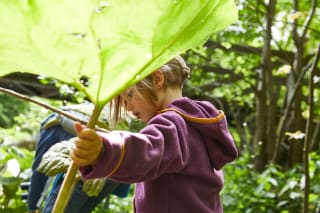
A hike with children succeeds or fails with the choice of the appropriate route. The trail must not be too challenging for the kids, but at the same time it should not bore them. Ideally there is a lot to see and discover along the way. Themed and adventure trails that pass by exciting stations are particularly suitable. Discovery tours through nature and the forest are also fun. Here, local Wild animals can be observed or various plant species identified.
Check with local contacts about excursion destinations in your region. Tourist offices or hiking guides, for example, can be helpful. But numerous hiking trails are also listed on the internet that you will enjoy.
Sure, when hiking we first think of mountain meadows, high forests and well-deserved breaks at the hut. But who says you have to go to the mountains to hike? Throughout Germany there are beautiful hiking routes that are very suitable for hiking with children, especially tours along rivers and streams. At first it's best not to choose a difficult mountain tour with lots of elevation gain, but rather a light hike with small changes in elevation.
How much of a hiking route can I expect my child to handle?
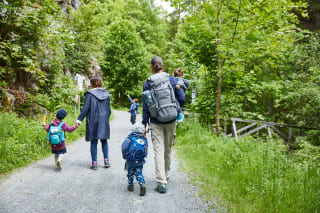
Day hikes are already a real challenge for kindergarten and primary school children. And if your child complains of sore feet or simply doesn't feel like going on, the route won't be much fun for you parents either. But how many kilometers can you reasonably expect your child to manage? A few hours are okay: The hiking time is more important than the kilometers walked – after all, depending on the type of terrain you need varying amounts of time for a route. About three hours is the maximum for kindergarten children. And even with this walking time you should plan sufficient breaks. Primary school children manage four to five hours, depending on fitness and route – and on how motivated they are to continue. Of course, endurance also varies by child. If you go on hikes together with the family more often, endurance will increase over time. It's best to start with a short route that you won't be on for too long. As a rough guideline, the German Hiking Association gives another rule of thumb: age x 1.5. Accordingly, you can reasonably expect a five-year-old child to manage a maximum of 7.5 kilometers. In this calculation, 100 meters of elevation gain corresponds to one kilometer. Hiking holiday with a child? For schoolchildren, a hiking holiday is a good idea – as long as it doesn't mean going from hut to hut and having to complete a specific distance every day. If you can be flexible between different short tours and occasionally take a day off from hiking, children will also enjoy a family hiking holiday.
Basic tips for hiking with children
Adapt to the children's pace: On a hike the slowest participant always sets the pace. On a family hike these are usually the smallest. Always adjust the pace of your tour to your children so you don't overwhelm them. Create an incentive: The 'great view' is not a very appealing goal for children. Maybe you'd rather promise a delicious ice cream at the end of the hike, a barbecue together, or a playground. Games along the way or adventurous experience trails also motivate your kids. Plan plenty of time: With a child you will probably need about 50 percent more walking time for a hiking route than you would alone. Factor this extra time in and possibly schedule one more break – of course with enough time for playing and exploring the surroundings. Bring along children of the same age: If your child only hikes with adults, it can get boring. Children of the same age are great motivation while walking and great playmates during breaks. No performance pressure: If your child is tired or no longer feels like it, you should not react with disappointment – this will probably make them lose interest in hiking even more. Rather try to motivate them by pointing out the goal or the next rest stop, so that hiking gets a positive meaning.
The appropriate equipment for hiking with children
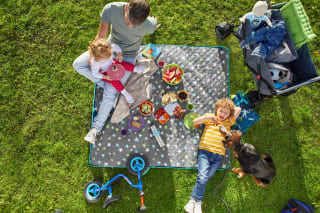
To make the family hike a great experience, the right equipment is essential. Maybe you too face a huge pile of clothes before every trip and don't know what to wear or pack. The rule here is: pack a little less, but the right things. Keep in mind that you have to carry everything you pack on your hike. However, a high-quality basic kit should not be missing for an outdoor adventure. Here are some 'must-haves' you should not do without on your hike with the children. Good footwear Nothing is worse than having to keep walking with sore or sweaty feet. Make sure your child wears lightweight and breathable hiking boots – in the long run it's worth investing a bit more here. Good hiking boots fit the foot perfectly and provide secure support. They also have a grippy outsole so your little one won't slip even in difficult terrain. To keep feet dry on every tour, even in wet weather, waterproof shoes with a breathable membrane are recommended.
Appropriate outdoor clothing As a well-known saying goes: there is no bad weather, only bad clothing. With sturdy outdoor clothing you can be out in any weather. It keeps your kids warm and dry while also being breathable. This allows the youngest to run around outdoors carefree, without you having to worry about mud, puddles or grass stains. For a hike, the 'layered look' is generally recommended, where individual layers of clothing can be taken off as needed if your children get too warm from the activity.
Backpacks for little adventurers What would a real adventurer be without their backpack? A backpack simply belongs on a hike. For the little ones there are special children's backpacks that are usually gladly worn. Just like the grown-ups. Children's backpacks also impress with great colors and cute motifs. You can easily store spare clothing, rain protection or a water bottle in them. Just make sure you don't pack the backpack too heavy for the hike, otherwise it can quickly become a burden for your children.
Hiking with a stroller: what should you consider?
Choose a route that is suitable for hiking with a stroller. Many meters of elevation and especially steep inclines should be avoided. The condition of the path is also important so that you don't get stuck along the way or have to struggle for long stretches over impassable rocky tracks with a buggy or stroller. Ideal are well-developed paths. Often long paved paths run along rivers. But how do you find such routes? Many regions are now expanding their trail networks and creating barrier-free routes or routes specifically for families. These are usually advertised on the internet. In addition, there are even specialized stroller hiking guides. For your first hike with a stroller, choose a not-too-long route. Pushing a stroller can quickly become tiring. A stroller hike is particularly fun in a group with other parents and children. An 'off-road capable' stroller is a prerequisite. Not all family hiking trails are continuously paved or even just stabilized – in sections you must expect gravel tracks or soft forest soil. Therefore you should definitely take a suitable stroller for hiking. Optimal is a light, manoeuvrable buggy with large rubber tires and good suspension. If your baby is still too small for the buggy, the classic stroller also works – but it should also be stable, well suspended and have rubber tires.
Hiking with a baby – out and about with the youngest
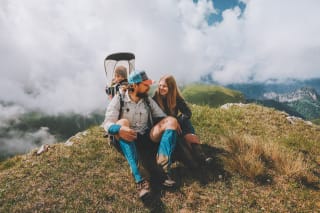
Hiking with children | Even with the youngest you can take trips into nature. A hike is possible when you already do longer walks with your baby. At what age exactly this is possible is hard to answer in general. Since many parents carry their baby on their body, it is usually not the baby itself that is the decisive factor.
It's more about how fit you are for the tour. Don't attempt extreme tours with very small children that go through very difficult terrain and to great heights. Also avoid overly long distances. You can find out how physically fit you are by trying a city stroll with your baby in a carrier first. You also test how your child behaves. Does it sleep blissfully the whole time or does it feel uncomfortable?
Essential for a hike with a baby, however, is a comfortable and well-fitting baby carrier or framed child carrier. It distributes the weight evenly over the carrier's body and offers your child a comfortable sitting position.
More articles about leisure & creativity







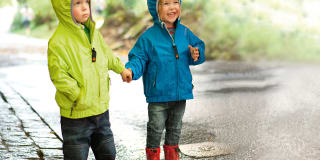

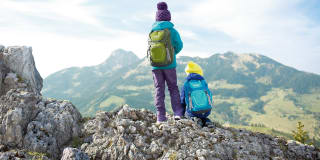
Image credits
Family has fun in the mountains © EVERST - stock.adobe.com