"Play is not mere play; it has great seriousness and deep significance"
So wrote the educator Friedrich Fröbel in the early 19th century. That's true, but it does not mean that parents should follow their child's free play with solemnity. Insisting on seeing developmental promotion behind every playful action takes away the freedom and uniqueness of play. Be proud of every small step, every joyful smile of your baby. Trust is the most beautiful gift you can give a child at play.
Good to know!
Don't 'overfeed' your child with too many offers.Place only one or two toys at a time on its play mat, with which it can concentrate for a while. After a few days you can swap the toys. Play together, offer suggestions, but also let your baby play alone for a while under supervision. Even the very young love to sink into their own world and try out new things: nibbling, squeezing, turning, rolling & pushing – each child has its own pace. Playing means intensive learning and gaining new perspectives. Gently and sensorially.
Playing is fun. Playing makes you smart.
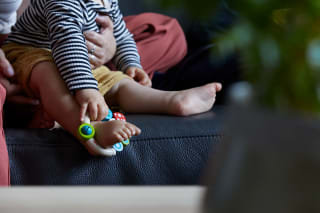
When playing, your child switches all senses on — and sets off on a big journey of discovery with eyes, ears, hands and mouth. Every loving stimulus, every new impression shapes your child's personality in an individual way. Experience together day by day the fascination of discovering something new and unique. Playing is a first-class learning program, because there is no 'wrong', only a 'try again'! And when your baby is absorbed in play, give them peace and time for it. Nothing else is then worth a distraction.
In the first months of life, grasping, seeing, hearing — the development of the senses — are high on the agenda. Babies love bright colours, sounds and interesting textures to touch — in toys, for example grasping toys in various materials, rattles, mobiles, soft toys. The smaller the children are, the more 'grasping' and 'comprehending', 'holding' and 'perceiving' are linked together. In toddlerhood, things that can be moved become exciting: soft balls, ride-on cars, tricycles. Handy building blocks or crayons that let the little ones 'create something' themselves are also interesting now.
Good to know!
Children learn through effort. The little ones are proud when they have achieved something themselves. Has the rattle slipped out of your baby's hand and now it's struggling to catch it? Don't jump in right away; allow it to make a proper effort to reach the goal on its own. Parents can best judge when the baby really needs help and when it is just a bit too comfortable. Give it the chance to feel strong through successful experiences.
How quickly your baby learns
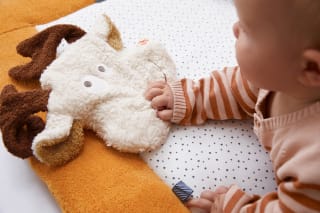
The learning ability of babies is fascinating. Never again does a person learn so much in such a short time. Through sensory stimulation, through experiences and discoveries, the young brain matures. Driven by natural curiosity and the joy of the activity, babies and toddlers not only sharpen their senses but also develop their motor skills, experience elementary laws of nature, and practice concentration and attention. To keep the joy of learning, it is important that encouragement takes place without pressure. Even small babies signal clearly by turning away their face when they have had enough new impressions. Respect such signals, because rest periods are important to process and consolidate what has been learned.
Good to know!
Space to play. Even if your little one is not mobile yet, give them plenty of freedom to move. They need it to train their muscles and practice movement sequences. Therefore do not place them in a seat or rocker longer than necessary. On a soft blanket on the floor with interesting things to look at and grasp they are better off and can explore to their heart's content what they can do with their arms, legs and whole body.
More articles about leisure & creativity

Image credits
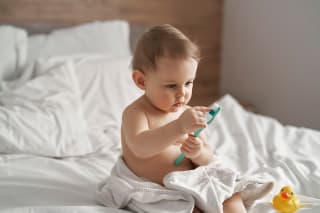
Baby sitting in bed holding a toothbrush © gpointstudio – stock.adobe.com