The 5 Best Relaxation Techniques for Children
1. Breathe and relax – with children's yoga
Over 400 years ago, the ancient Indians already knew that Breathing and body exercises (Asanas) in combination with Meditation lead to a better body awareness. In yoga, the body is relaxed through stretching and stress is breathed away through deep breaths. This allows energies to flow more freely.
Yoga with children in a class or at home
Find out, whether yoga classes for children are offered in your area. But even at home, in a familiar and quiet environment, you can find relaxation together with small, flowing exercises.
Yoga in kindergarten
Yoga also providesrelaxation in kindergarten. Educators who have experience with yoga can try simple yoga exercises with the children and integrate them playfully into the daycare routine.
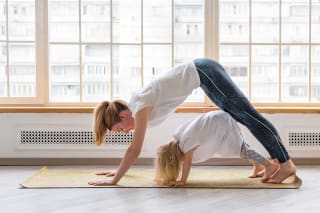
Yoga exercise 'Little Dog'
The first position is the tabletop: Press the palms firmly onto the floor. Now pull the navel inward toward the spine.
The buttocks lift up towards the sky with legs straightened. Breathe, hold for a few seconds, and relax.
Tip: Do the exercises together with your child and repeat them a few times. It's fun, your child can more easily copy and the parent-child bond is naturally strengthened.
2. Loosen up with progressive muscle relaxation
Restlessness, stress and anxiety can cause muscles to tense up – not only in adults but also in children. To counteract this, Edmund Jacobsen 1920 Relaxation exercises for children developed.
The exercises are an alternation between tension and relaxation of different muscles – this lowers heart rate and blood pressure. Thoughts and feelings calm down. Additionally, through sensing and noticing afterwards the body awareness is increased.
Children can practice progressive muscle relaxation from the age of 5 playfully under the guidance of adults.
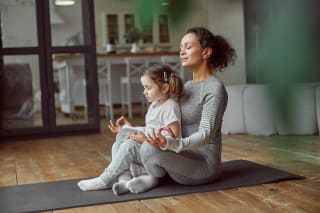
Relaxation exercise for children:
Your child sits relaxed on a chair or cross-legged on the floor.
The hands rest loosely on the thighs.
Now first clench the left hand into a fist – hold the tension for 10 seconds.
Then open the hand and let it lie still for 30 seconds.
Repeat the exercise with the right hand.
Encourage your child to consciously perceive the feeling of relaxation and to feel the difference from before.
3. Deep relaxation through autogenic training for children
Autogenic training and relaxing guided imagery are a nice way to create relaxation at home or in daycare. Children love to immerse themselves in stories and imaginations. Get creative and find tried-and-tested tips specifically for children.
Warmth exercise (10 to 15 minutes):
Create a relaxed atmosphere – either sitting or lying down – maybe even with soft relaxation music. To begin, take one deep breath in and out. Let your child travel mentally to a warm place through your words: “You feel calm and relaxed. You are on a warm, white beach. The sun is shining on your body. Your skin becomes pleasantly warm, you feel the rays first on your arms, then on your legs ... You feel calm and relaxed.”
Tip: On the internet or in bookstores there is already a large selection of specialist books on autogenic training for children. Guided courses in your area help internalize the exercises even more.
4. Relax playfully with coloring books
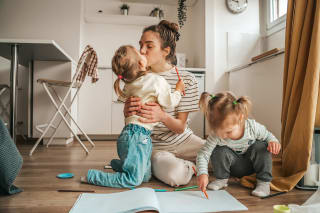
Does your child love to draw, craft, and be creative? Then coloring books are just the thing! It's so much fun, to fill pictures and shapes with favorite colors. You can wonderfully immerse yourself in the colorful world dive in and relax.
Our tip: Is plain coloring too boring for you? Then grab a coloring and sticker book. In it you can embellish your colored pictures with colorful stickers.
5. Relaxation in everyday life through nice rituals
A shared rhythm and personal rituals provide relaxation for both little and big people. These rituals can be very simple; the main thing is that mom and dad are right there and fully involved.
Cuddling in your arms
Evening reading in bed
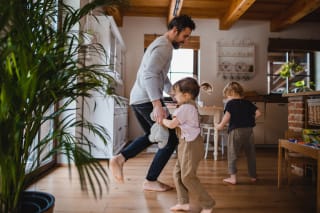
Listening to music and meditative dancing around the room
Wellness day with lots of cuddles and a funny face mask
a leisurely breakfast together on the weekend
Verkrümel tip: The HABA Relaxation den. A cave for retreating, recharging, and daydreaming.
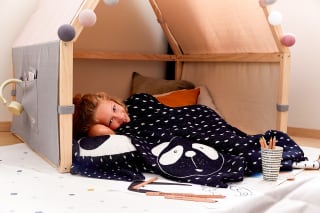
perfect for relaxing and having some alone time
deliberately gentle natural tone to counter sensory overload
loops for a string of lights
foldable dome with zipper
incl. storage bag
5 tips for relaxation in everyday life with children
Protect your children from excessive stress. It doesn't have to be music school, sports club, and arts program all at once.
Ensure free play time. Give your child time to express themselves freely and to simply be creative at home or outdoors.
Create a retreat space for your child: A cozy play tent, a small hideaway or a simple curtain creates a quiet place where your child can retreat and relax.
Avoid too much screen time: Even if children appear calm as soon as they sit in front of the TV or tablet: Digital media can quickly lead to overstimulation in children. Therefore limit media time to the recommended amounts for your child's age.
Talk with other parents and get proven relaxation tips that also work wonders in other families.
More articles about leisure & creativity




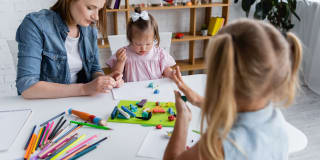


Image credits
little girl sits in lotus position © Надин Стокер - stock.adobe
Young mother does yoga with a 3-year-old girl in front of a window © Dmitry Zimin - stock.adobe
Woman sits with little girl in lotus position and meditates at home © Yaroslav Astakhov - stock.adobe
Mother spending time with her children © zinkevych - stock.adobe
Father dancing at home with two small children © Halfpoint - stock.adobe