When and how do children learn to speak?
Children usually learn to articulate words clearly and form their first sentences within the first two years of life. When a child begins to speak varies greatly. Some say their first words at ten months, others not until 18 months. But already within a few months, babies develop a sense of how language is used and begin to learn the rules of their native language – quite intuitive and natural. Experts call this unguided language acquisition.
Strictly speaking, learning to speak actually begins much earlier: with the ability to hear and thus from about the 24th week of pregnancy. Here the baby already listens to mom's heartbeat and hears how she speaks. It also perceives other familiar voices and internalizes the sound of its native language. And with its first cry the baby begins to 'practice' speaking, because this is how it initially makes itself understood.
The developmental steps in learning to speak
The most important thing first: The following age ranges and abilities in learning to speak are only a guideline, not a 'curriculum' that your baby must meet. Give your child the time it needs. Language development is an individual process.
Moreover, the pediatrician determines during the U6 and U7 check-ups at the ages of 1 and 2 years whether a child's language development is within the normal range. Here parents have the opportunity to clarify their own observations.
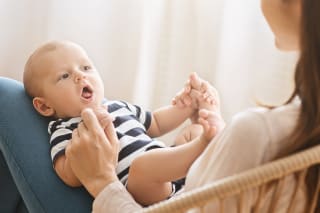
0 to 3 months
The baby cries, coos and gurgles in a variety of pitches.
Also with its facial expressions it already communicates.
This is how you can support your child's language development now:
Talk a lot with your baby and maintain eye contact.
Repeat its sounds, respond to its vocalizations and signals. The more, the better. This builds trust and attachment and thus the desire to communicate, to understand, to express itself.
3 to 6 months
The baby makes initial smacking and hissing sounds.
It produces vowels and first syllables, which often sounds like babbling.
This is how you can support your child's language development now:
Translate and respond to your baby's sounds.
Comment on what is happening, and include toys or everyday items: 'There goes your ball.', 'Now you're getting a fresh diaper.' etc.
6 to 8 months
The baby babbles more and more.
It babbles sequences of syllables like 'Bababa' and makes various gestures.
It can already understand individual words, such as its name..
This is how you can support your child's language development now:
Children's songs, finger plays and lap games fascinate babies. The interplay of language, music and movement has a particularly positive effect on their development – not only for learning to speak.
Use your baby's name as often as possible.
12 to 18 months
The child says its first understandable words (Mama, Papa, doggy, car ...).
At one and a half years it knows about 50 words.
It can say its name , but refers to itself in the third person.
This is how you can support your child's language development now:
Continue to comment a lot on what you do. Involve your child by letting it choose between two options ('Do you want the car or the doll?').
Look together at picture books and let it name familiar things in them.
18 to 24 months
Your child can now approx. 200 words "produce" and increasingly speaks sentences of two to four words.
It combines nouns, verbs, adjectives and places verbs in the base form at the end of the sentence.
This is how you can now support your child's language development:
Best time for matching games, search-and-find and puzzle books!
If your child says something wrong, simply repeat it correctly in the next sentence correctly ("Daddy come." - "Yes, Daddy has come.").
Games, puzzles and search-and-find books that support learning to speak
24 to 36 months
Your child has mastered first complex sound combinations like "ch" or "gl".
It speaks short sentences, asks why-questions, uses pronouns ("I", "my"), can name colors and recognize actions in pictures.
It also talks to itself and imitates adults in everything it sees.
This is how you can now support your child's language development:
Read aloud to your child and let them retell it.
Paint, knead modelling clay, and play role-playing games together.
Talk a lot with your child while doing all this. Name feelings.
This is how speech learning continues
Up to 4 years
Your child also learns difficult consonants such as "r".
Up to 5 years
Your child produces all sounds correctly (except possibly "s", "sch").
Your child already knows over 2.000 words.
Your child applies simple grammatical rules correctly, e.g. plural, simple past tense …
Up to 6 years
The sound production in the child's speech development is completed.
Grammatical rules such as sentence structure, tenses and articles are used correctly by your child.
What should parents pay attention to when their child is learning to speak?
Parents cannot speed up the process of learning to speak, yet they have a major influence on their children's language development. If we keep a few things in mind in everyday life, this awakens the joy in speaking almost incidentally – and, as is well known, everything is learned more easily with joy.
5 Dos and Don'ts for learning to speak:
Be a role model: Talk a lot with your child, even about trivial things, and maintain eye contact. This way your child senses your attention and can see and imitate the movement of your lips.
Read aloud often: This promotes language comprehension and vocabulary.
Don't correct: The what is more important than the how when learning to speak. Constant correction takes away the desire to speak. It's more effective to unobtrusively repeat mispronounced words correctly.
Don't use baby talk: Take your child seriously as a conversation partner, ask them questions, and listen attentively.
Don't compare: Be patient. Every child learns to speak at their own pace.
5 games & exercises that support learning to speak:
Rhythm games: Children with a good sense of rhythm often also develop a good feel for language. Whether children's songs , rhymes or lap games: All of this is great fun for little ones and supports your child in their language development.
Finger plays : They train language comprehension and fine motor skills at the same time, as both areas are closely linked in the brain. In any case, it's worth practicing fine motor skills playfully – whether with finger puppets, building blocks, finger painting, or so on…
Blowing soap bubbles: This strengthens mouth muscles and breathing technique. Difficult sounds are also easier to pronounce this way. For bubble-blowing fun!
Memory games: They are great as language games, because children learn and reinforce new words. The individual cards can also be used perfectly to tell little stories.
Language support games : They don't have to be dry at all, but cleverly combine all aspects of learning to speak with lots of fun and often interesting facts.
More tips on how you can support your child in learning to speak through play, you can find in our article on language support.
Learning to speak and multilingualism
Raising children bilingually or multilingually offers great opportunities, but also entails some challenges. Here we reveal the advantages and risks of bilingual upbringing.
Mistakes are part of learning to speak
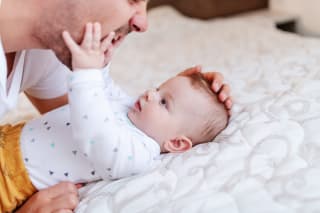
Getting started is hard:
Some children speak very slowly at first, others are extremely unclear. Many lisp a bit or have difficulty forming hard consonants or guttural sounds like the "ch". All of that is normal when learning to speak. Most it only leads to frustration anyway when parents try to correct the supposed speech errors at this age.
Stuttering:
Many children stumble over words when they can't find them quickly enough, or need several attempts to finish a sentence. This can sometimes sound like stuttering, but unlike true stuttering the syllables or words come freely and without tension. As a rule, the so-called "Developmental stuttering" usually goes away on its own by the age of 5. Here you can learn more about stuttering
Speaking requires hearing:
If learning to speak doesn't work, a hearing problem may be the cause. In general, hearing is checked during early detection examinations by the pediatrician. Parents who are unsure can have a separate hearing test with the pediatrician have it done.
Read more useful information on Speech disorders in children and what parents can do in such cases for their child's speech development.
Discover more articles on parenting & psychology








Image credits:
Close-up of a smiling newborn baby on the mother's lap © Prostock-studio - stock.adobe.com
Dad talks to his son and cuddles with him © dusanpetkovic1 - stock.adobe.com
Baby lying on mom's thigh © Prostock-studio - stock.adobe.com