Why does a child hit their parents?
The reasons for aggressive behavior are complex, and parents often lack the necessary distance to explain their children's behavior. Children who are hit often hit others. But an aggressive relationship between the parents, insults, indifference or a lack of attention can also be causes of children's aggressive behavior. Other reasons why a child might hit their parents can include:
Helplessness:
Hitting and kicking are often signs of helplessness. The child sees no way out of a situation or has not learned to seek support.
Frustration:
Children who fail to achieve what they set out to do, or who are less capable than their schoolmates or kindergarten friends, can become angry and aggressive.
Behavioral disorder:
Disordered social behavior can take many forms—for example, when a child has not learned to communicate their needs and reacts with violence because they feel cornered. It can also be impaired impulse control or a lack of empathy, so that a child does not even realize that they are hurting others.
Desire for contact:
In younger children, physical aggression can also be a way to seek attention. Children who have not learned how to approach other children tend to bite or hit their playmates to draw attention to themselves. Scolding is doubly confusing in such cases, because the child actually had good intentions.
Do you want to understand your child's emotional world even better? We have put together everything on the topic Child psychology compiled.
What should I do if my child hits me?
It's not easy not to take insults or hits from a child personally. Usually aggressive behavior is driven not by a willingness to be violent but by frustration, fear, or insecurity. Therefore you should first of all remain calm. The most important thing is to respond thoughtfully and deliberately. If you react as emotionally as your child because they hit you, the situation will only escalate.
Often your child just wants to provoke or test you because they are curious about your reaction. In this case you may show yourself unimpressed by your child's hitting and calmly make it clear that hitting is absolutely taboo.
Here's how you can proceed if your child hits you:
Stay calm and briefly collect your emotions
Hold the child's hitting arm firmly but carefully
Establish eye contact
Say 'No' calmly but firmly and make it clear that hitting is taboo
Once the child has calmed down, address their emotions: 'You are really angry, aren't you?'
If possible, offer an alternative way to release frustration (e.g., hitting a pillow)
Talk about it: Seeking help when my child hits me
If your child hits you in a tantrum, it doesn't mean you've failed as a parent — not at all! Your child still has to learn how to express their anger and channel it properly. They need your help for that.
Also calmly talk to other parents about the situation. They can surely give you a tip or two and support you with advice and practical help. You may feel ashamed that your child hits you and prefer not to bring the behavior up with outsiders. But always remember: nobody is perfect and other mothers and fathers experience exactly the same things as you. Don't hesitate to get professional help if it seems useful. Parenting counselors or child psychologists can help you explore the causes of your child's aggressive behavior and work with you and your family to develop solutions.
Your child hits: When does it become serious?
Little hotheads:A carefully built tower of blocks collapses, and in anger your child throws the blocks across the room. The siblings argue over a book and the fight escalates from shouting to wrestling and kicking until the parents separate them. Mom wants to go home, the four-year-old desperately wants to keep swinging and, in anger, hits the mother when she simply takes him away.
Impulsive behavior in younger children is completely normal:
Many parents know these situations. They occur in most families in this or a similar form and are not in themselves a reason to worry. Children are impulsive and express their frustration physically when they lack the words. But when do aggressions become a problem?
When should parents act?Some children, at certain developmental stages, periodically become little "hotheads" — the best-known example is the defiant phase between the ages of two and three. Tantrums and aggression only become problematic when a child:
regularly loses control or has outbursts over trivial reasons
does not respond to parental intervention during tantrums
does not hit out helplessly but deliberately injures others
is noticed for aggression in kindergarten or school
consequences or discussions have no effect
In this situation, parents should look for the causes of the aggressive behavior together with their child — and, if necessary, seek help from outside.
How can children be taught not to hit?
It's not a pleasant experience when your child becomes so enraged that they hit you in a tantrum. In the worst case, it doesn't stop at the one incident but repeats. But how can you make your child understand that it's not acceptable to hit?
The most important thing in any case: lead by example. Because especially young children are guided less by what parents say than by what they do. So if parents themselves quickly become angry or raise their voices, a child copies that. But what can you do if the child still hits? We've put together a few tips on how to discourage your child from hitting:
Build self-confidence:
Praise, affection, and time together bolster your child's confidence so they can respond more calmly in conflict situations and assert themselves with other children.
Be consistent:
Aggressive behavior must have consequences. If your child hits you, you can send them to their room or take a short time-out yourself. It's important that you react immediately and with the necessary calm, but never with violence.
Foster empathy:
Many children have real blackout moments during tantrums. Make it clear to your child that the hits, kicks, or insults hurt you and make you sad. Maybe next time they'll react with a bit more awareness.
Don't isolate:
If your child is aggressive not only toward you but also toward other children, problems can quickly arise in kindergarten or school. To prevent your child from becoming an outsider, you can try to build contact with one or two "trusted" children — these relationships provide your child with security and self-confidence.
Practice letting off steam:
Children first have to learn how to deal with negative feelings. Parents can give them ideas for letting off steam: on a punching bag, with a pillow thrown into a corner, or by letting off steam outside.
Tip: One reason a child may hit parents or others in their environment can be a lack of social skills. How and when a child develops social skills, we have summarized on a separate page.
Discover more articles on parenting & psychology
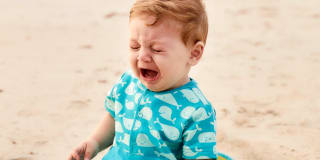










Image credits:
Screaming boy covers his ears © nadezhda1906 - stock.adobe.com