When does each of my child's senses develop?
Your child's senses do not all develop at the same time or at the same rate. Even at birth, the individual abilities for sensory perception are developed to varying degrees.
Vision:
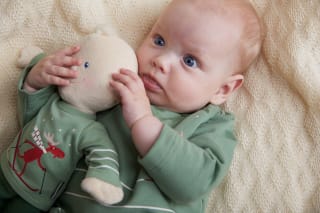
A child's sense of vision is still weakly developed at birth. A newborn can only distinguish light-dark contrasts. In the first year of life, little ones do not yet see as sharply as adults, and it takes a few more years for the development of vision in children to be completely finished. A well-developed sense of vision is important for orientation, assessing dangers, and perceiving the environment.
Touch:
All touches that we perceive with our skin belong to the sense of touch — and this is already developed in the womb. Through experience, children learn to differentiate and evaluate different kinds of touch, such as strong pressure or gentle stroking. Differentiated touches with the hands and feet are important for the development of fine and gross motor skills. In addition, loving touches play a decisive role in the development of the sense of touch — cuddling and hugging are good for you and your child!
Hearing:
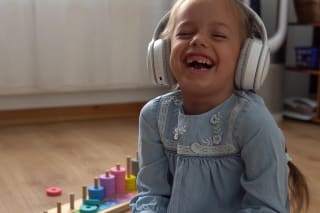
Unlike vision, newborns can already hear well. However, the sense of hearing continues to develop over time as the toddler becomes familiar with new sounds and auditory impressions. For example, children must learn to locate the sources of sounds — and that is not so easy! Children who do not hear well often have problems with speech development. If you notice anything unusual, have your child's hearing checked by a specialist.
Sense of smell:
The ability to smell is already formed in early pregnancy. Newborns can smell very well and are primarily interested in the body scent of their parents, which gives them a feeling of security, as well as the smell of breast milk, which ensures their survival. The sense of smell is closely linked to memory — odors are associated with experiences and are therefore evaluated positively or negatively.
Taste:

The development of the sense of taste depends on a child's sense of smell. Everyone has experienced that if you cannot smell, you do not taste much either. Taste buds on the tongue already form in early pregnancy. Newborns can already taste sour, bitter, and sweet; at about four months of age, babies can also perceive salty tastes. By age three the development of the sense of taste is complete. However, taste preferences will continue to change significantly over the years.
Sense of balance:
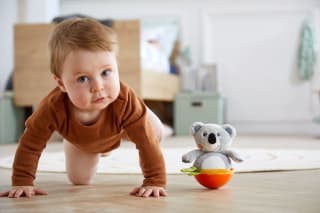
The development of the sense of balance begins already in the womb. Movements of the baby's head stimulate the balance organ, which is located in the inner ear. A well-developed sense of balance is important for many different movements and for the child's overall development.
When sensory perception is impaired - what parents can do
Don't despair: It is completely understandable that you are worried about your child if you notice that they are falling behind in their development. Try to stay calm. First of all: every child develops at a different pace, and sensory perception in children is no exception. In addition, perceptual disorders are relatively common in children. Often these 'initial difficulties' resolve on their own or can be remedied through targeted support.
Sensory games for children: Sensory games are a great way to focus perception on a particular sense — and they are fun for more than just children. In a playful way, children can train their sensory perception and thus learn to perceive their environment more consciously.
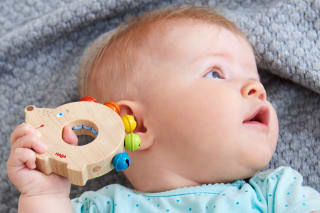
See a doctor: If you are unsure whether your child is developing appropriately for their age, you should definitely see a pediatrician. They can tell you whether a support measure is appropriate and what it might look like.
If necessary, undergo therapy: Many perceptual disorders can be remedied or at least improved with the right methods. Occupational therapy or physical therapy, for example, can help to train specific muscle groups or improve fine motor skills.
Checklist for parents:
You can support your child's sensory perception, but you cannot speed up development.
With play and fun, your child's senses develop almost by themselves. Involve your child in everyday life and let them help around the house: this trains perception, motor skills, and much more.
Children's sensory perception is a process that unfolds over several years. The senses do not develop at the same speed but each follow their own pace and course.
Children get to know their senses over time and learn to use them deliberately.
Many children are affected by perceptual disorders. But don't worry — most problems can be brought under control with targeted support.
Discover more articles on parenting & psychology









Image credits
Baby makes a face while eating puree © Impact Photography - stock.adobe.com
Asian girl smells a raspberry in her hand © yoshiji - stock.adobe.com
Girl with a gap between her teeth, laughing while listening on headphones © mytrykau - stock.adobe.com