Where it says HABA, there's quality inside
Our commitment to the quality of materials and their workmanship
At HABA, we have a principle: toys are only as good as their materials and their workmanship. That is why we pay attention to high quality when selecting materials. And we continuously check their workmanship – both in in-house production and at our suppliers. Since we began producing board games, sturdy cardboard for game boards, cards and tiles has also been among the materials used. Over the past decades, HABA's product range has also been consistently expanded – and so, gradually, for example, various polyester fabrics and high-quality plastics were added. All materials used are carefully inspected before production begins.
Wood … naturally good for our toys

Wood is one of the most natural and beautiful raw materials there is. That's why wooden toys remain an indispensable part of the HABA range. Since 2010 our wooden products have also borne the PEFC seal. It proves that we use wood from sustainable forestry in German forests. Our beech wood comes from forests located within 150 km of our site in Bad Rodach in Franconia. The plywood we import from Finland is also sourced from controlled forestry. In this way we support the preservation of the forests' ecological balance and make a significant contribution to sustainably improving global forest use and forest management. When we add color to wooden toys, we only use solvent-free lacquers and water-based stains. So babies and toddlers can, for example, teethers or pacifier chains put them in their mouths at any time without concern.

Fabric … the material for many cuddly toys
Our designers create a variety of fabric products and use a wide range of different materials for them: smooth, easy-care polyester fabrics, as well as soft velour, corduroy, felt and mesh fabrics. It is precisely the different appearance and tactile quality of the fabrics that makes a baby and toddler toys really interesting. Our fabric toys are manufactured worldwide by various suppliers whom we carefully select and whose production we regularly visit on site. In doing so, we gain an overview of the manufacturing situation and social standards such as working hours, working conditions, etc.
High-quality plastic … versatile in use
Quality management We primarily use plastics for our sand toys in use. The HABA sand-play range contains all the basics for digging and playing in the sand for children from 1 ½ years, but also many sand-play moulds that allow children to engage in creative and imaginative role-play in the sand. Our customers receive a five-year warranty on the polypropylene and ABS plastics used in HABA sand toys.
Furthermore, we manufacture some baby grasping toys as well as various individual components for marble runs made of plastic … whenever our designers can use the advantages of plastic for their designs. This also results in great combinations of wood and plastic, for example in the Kullerbü-play system.
Sturdy cardboard … for plenty of playtime fun
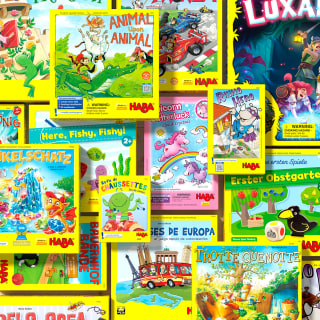
Cardboard may be the most inconspicuous material we use, but it plays a very important role. Because in the area of games we use it for game boards, tiles or cards. And thus the cardboard pieces, alongside the wooden figures, take on a central role, because the atmosphere comes into the game through the illustrations printed there. Also most of our books are made of cardboard. This enables us to incorporate many features popular with children such as flaps, peek-holes and turning discs. Also the beautifully illustrated HABA puzzles are made of cardboard, with the puzzles for toddlers being particularly sturdy.
Excellent quality management
Our quality management is certified according to the nationally and internationally recognized quality standard DIN EN ISO 9001:2015. For example, the standard requires that existing processes and procedures are repeatedly reviewed and, if necessary, adjusted to improve quality. This enables us to continuously improve the quality of our products and services in the interests of our customers. ISO 9001 defines the minimum requirements for a quality management system. With the introduction of the process-oriented approach, processes are reviewed and target specifications are compared with actual values. If deviations are identified, this leads to the definition and planning of measures with the aim of continuous improvement and change. There is also a written quality policy that is regularly reviewed and adjusted if necessary.