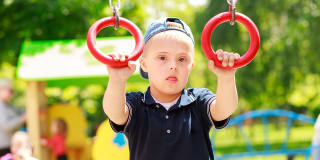
Children who play with puzzles, build with blocks or let a toy train race around, not only have a lot of fun. They also develop important spatial reasoning and thus happily learn math. This also includes that children learn terms like 'in front of', 'behind', 'next to' or 'under' for spatial relations to know. Otherwise they have trouble orienting themselves in the 'number space'.
When the little ones start school, most of them can already count to 20. Counting can already be practiced playfully before school while climbing stairs or setting the table. It helps with the first arithmetic operations, which only later in a child's development are carried out abstractly and automatically in the head.
Long before actual calculation is done in first grade, children develop a basic sense of the world of numbers through play: For example, when they move forward four spaces and two spaces when rolling dice and the next player ties by rolling a 'six'. All this encourages thinking about numbers and helps build a basic understanding of this mathematical world.
Ideas for learning math in everyday life learn
Math is everywhere: in the prices in the mail-order catalog, in house numbers, in the time of day and in the pattern that little ones create when stringing a necklace or with creating patterns with wooden tiles.
It's always worthwhile to talk about it.For solid math skills, students later can't avoid practice - depending on ability more or less. 'Decomposing numbers, mental arithmetic, these are central skills that children need for all arithmetic operations,' says Andrea Peter-Koop
. And the times tables need to be mastered so that students can focus on the further calculation steps. 'A few minutes of practice every day, perhaps unannounced in the car or before dinner, are usually enough,' says the professor. 'We still have to learn math' comes across as rather discouraging to children. And math doesn't have to be that!
Learn math playfully with our games
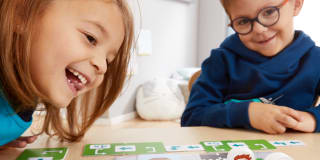
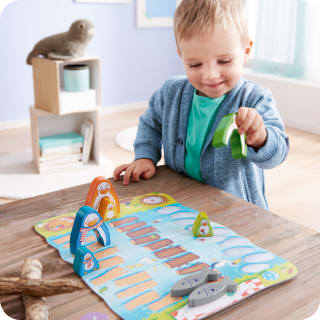
1. Counting is the beginningWith counting rhymes, clapping and counting games like HABA Counting Fun the little ones learn the first numbers and their order. In family games with a numbered die, players need to interpret the dice face and translate it into steps on the game board or other actions. It's exciting for children to discover that they can count or hop not only forwards but also backwards or in small jumps.
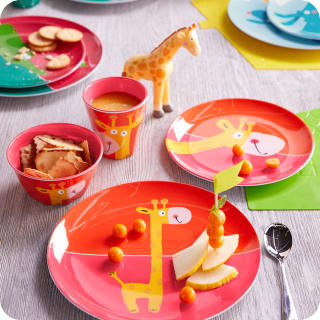
2. Setting the table – How many plates do we need?
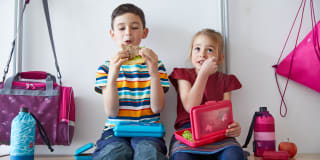
When sweets are shared fairly among siblings or something needs to be given away, children develop an initial understanding of arithmetic operations. Setting the table also requires thinking: 'Dad isn't here today, how many plates do we need then?' And because things sometimes fall when children set the table, our colorful Melamine tableware super practical because it is particularly high-quality and shatterproof!
3. Seesaws and Weighing
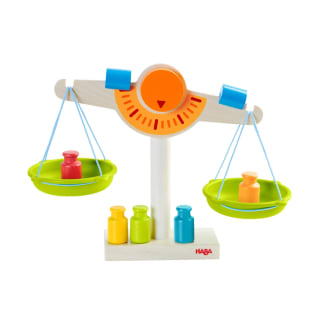
3 children = 1 dad? How can you keep the playground seesaw balanced? Children are amazed that there are many ways to get the seesaw to hover. For experimenting, our HABA beam balance with two pans is fun. Then you can even compare apples with pears. And how can it be that a large ball of cotton weighs less than a small apricot?
4. For tile layers and pattern designers
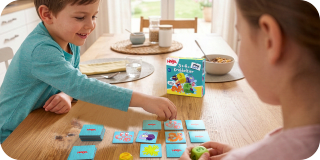
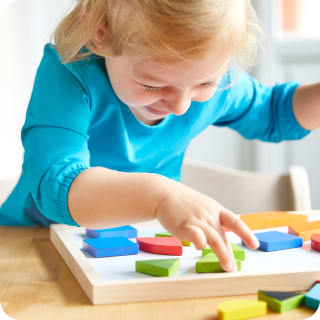
Arrangement games with geometric shapes keep children occupied for a long time; the various designs that can be created with circles, triangles, squares, and rectangles are so fascinating. Even kindergarten children learn that, for example, two triangles can form a rectangle. Symmetry and patterns as mathematical features also appear.
5. Sorting – Not just for neat freaks
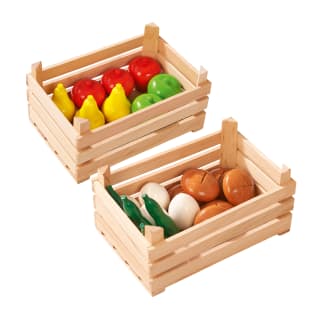
Arrange the toy cars by color or rather by size? Putting away your own clothes: Socks to socks, shirts to shirts. Or in the HABA Orchard Game the apples, plums, pears and cherries to the correct tree – when sorting, children form and recognize higher-level categories – a first form of abstraction.
6. For stackers and little builders
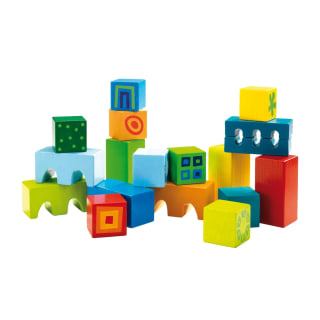
When the art of building goes three-dimensional with building blocks from small to large and other materials, little builders not only develop a first understanding of statics, but also train their spatial imagination as well as their knowledge of geometric solids. Even if they do not yet know the words cuboid, cylinder, pyramid or cone, children "grasp" that, for example, they can create a new, larger solid from two cuboids, or that the base areas of a cone and a cylinder can be the same.